
Production delays caused by unfilled roles, a constant struggle to find candidates with specific technical skills, and high turnover on the factory floor-these are the persistent challenges that define the modern industrial landscape. These issues highlight a critical reality: a reactive approach to hiring is no longer sufficient. Success in this competitive environment demands a strategic and precise approach to manufacturing recruitment, one that builds a resilient workforce and directly supports your operational goals.
This complete guide provides the structure and insight needed to master this complex process. We will equip you with proven strategies to build a robust talent pipeline, significantly reduce your time-to-hire, and improve long-term employee retention. You will gain a clear understanding of today’s challenges, learn how to develop a proactive hiring strategy, and discover when partnering with a specialist can deliver the precision results your business requires for sustained growth.
Understanding the Modern Manufacturing Recruitment Landscape
The manufacturing sector of 2026 is a landscape of profound transformation. Driven by the rapid integration of digital technology, the industry has evolved far beyond traditional production lines. For a foundational Overview of the manufacturing industry, one can see this evolution, but navigating its current state requires a deeper understanding of its talent dynamics. The primary challenge in modern manufacturing recruitment is a widening skills gap, where the competencies required by employers have outpaced the qualifications of the available talent pool. This disparity is accelerated by three critical factors: the technological demands of Industry 4.0, the impending “silver tsunami” of retiring experts, and the persistent challenge of attracting new generations to manufacturing careers.
This convergence of technological advancement and demographic shifts creates a highly competitive and complex hiring environment. Companies now require a workforce that is not only mechanically proficient but also digitally literate, capable of operating in data-rich, automated facilities. Successfully attracting and retaining this new breed of talent is the defining challenge for manufacturers aiming for sustained growth and operational excellence.
The Core Challenges Facing Hiring Managers
Navigating this new terrain presents several distinct obstacles. Today’s hiring managers must address a multi-faceted talent deficit where traditional recruitment methods fall short. The most pressing challenges include:
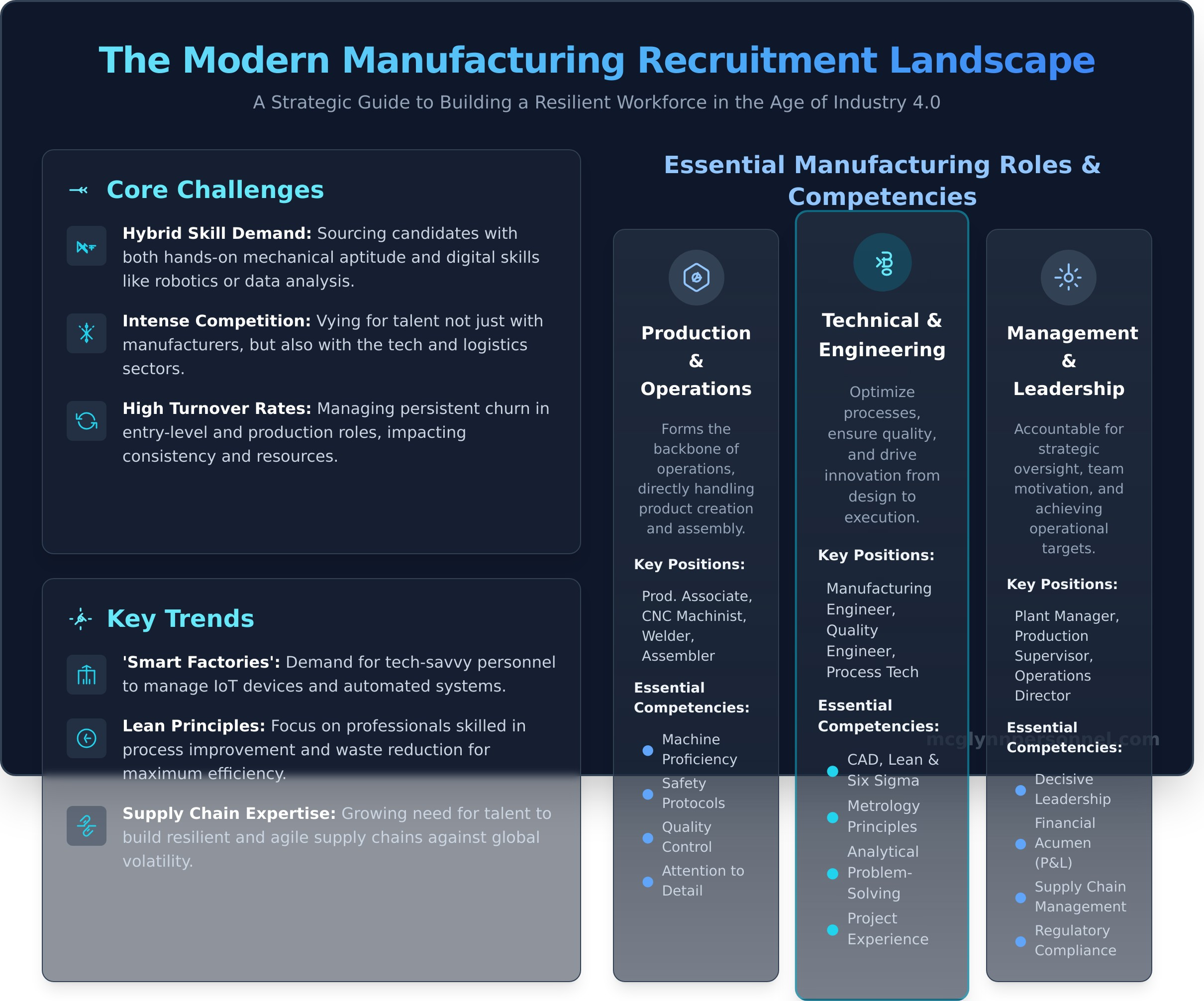
- Hybrid Skill Demand: Sourcing candidates who possess a crucial blend of hands-on mechanical aptitude and sophisticated digital skills, such as robotics programming or data analysis.
- Intense Competition: Competing for skilled labor not just with other manufacturers, but with the technology and logistics sectors that seek similar technical competencies.
- High Turnover Rates: Managing the persistent churn in entry-level and production roles, which drains resources and impacts operational consistency.
- Continuous Upskilling: The imperative to implement robust training programs to keep the current workforce aligned with the pace of technological change.
Key Trends Shaping Manufacturing Hiring
To succeed, recruitment strategies must align with the dominant trends redefining the factory floor. These trends directly influence the types of roles available and the skills required to fill them, shaping the future of manufacturing recruitment.
- The Rise of ‘Smart Factories’: An escalating demand for tech-savvy personnel who can manage, maintain, and optimize interconnected systems, from IoT devices to automated production lines.
- Emphasis on Lean Principles: A continued focus on recruiting professionals with a proven capability in lean manufacturing, process improvement, and waste reduction to maximize efficiency.
- Supply Chain and Logistics Expertise: A growing need for talent skilled in supply chain management to build resilience and agility in response to global market volatility.
- Data-Driven Quality Control: A definitive shift from manual inspection to automated quality control systems, requiring employees who can interpret data and manage sophisticated monitoring technology.
Essential Manufacturing Roles and Required Competencies
A precision-focused approach to manufacturing recruitment begins with a deep understanding of the specific roles that drive a facility’s success. While technical proficiency is foundational, the modern manufacturing environment demands a sophisticated blend of hard and soft skills across all levels. Distinguishing between these competencies is critical for building a resilient and efficient workforce. Our process prioritizes a comprehensive evaluation of both, ensuring every placement is positioned to deliver profound results and bring order to day-to-day operations.
Production and Operations Roles
These roles form the backbone of any manufacturing operation, directly handling the creation and assembly of products. They require a high degree of precision and strict adherence to established protocols. Success depends on tangible, demonstrable skills.
- Key Positions: Production Associate, CNC Machinist, Welder, Assembler.
- Essential Competencies: We look for technical proficiency with specific machinery, deep knowledge of safety protocols, quality control inspection skills, and exceptional attention to detail.
- Recruitment Focus: Our screening emphasizes verifiable experience and often utilizes practical skills tests to confirm capability and ensure quality discipline from day one.
Technical and Engineering Roles
This group is responsible for optimizing processes, ensuring quality, and driving innovation. They bridge the gap between design and execution, enhancing efficiency and product integrity. These professionals must possess both theoretical knowledge and practical application skills.
- Key Positions: Manufacturing Engineer, Quality Engineer, Process Technician.
- Essential Competencies: Core requirements include proficiency in CAD software, lean methodologies, Six Sigma principles, and metrology, complemented by strong analytical and problem-solving abilities.
- Recruitment Focus: Identifying these candidates requires effective recruitment strategies that go beyond resumes. We focus on demonstrated project experience to validate expertise.
Management and Leadership Roles
Leaders in manufacturing are accountable for strategic oversight, team motivation, and ensuring operational and financial targets are met. They provide the structure and vision necessary for sustained growth and performance.
- Key Positions: Plant Manager, Production Supervisor, Operations Director.
- Essential Competencies: Key skills include decisive leadership, strong financial acumen (P&L management), supply chain management, and a thorough understanding of regulatory compliance.
- Recruitment Focus: Our screening for these critical roles is rigorous, centered on a proven track record of success, leadership assessments, and superior stakeholder management skills.
Building a Winning Manufacturing Recruitment Strategy
Success in 2026 requires moving beyond reactive job postings. A proactive, strategic framework is essential for attracting and securing best-in-class talent. This involves architecting a comprehensive hiring plan grounded in a compelling Employer Value Proposition (EVP)-your organization’s core promise of value to employees. An effective strategy brings structure and predictability to the entire talent acquisition lifecycle, ensuring every step is executed with precision.
Sourcing and Attracting Top Talent
Proactive sourcing is the cornerstone of a successful talent pipeline. Instead of waiting for applicants, you must actively engage with skilled professionals where they are. This requires a multi-channel approach that positions your organization as an employer of choice, emphasizing technological advancement and tangible career growth opportunities.
- Utilize niche manufacturing job boards and professional associations to reach specialized talent pools.
- Develop strategic partnerships with technical schools and community colleges to connect with emerging professionals.
- Implement a structured employee referral program to leverage your current team’s trusted networks.
- Craft precise job descriptions that highlight opportunities for skill development and interaction with modern technology.
Effective Screening and Interviewing Techniques
A meticulous screening process ensures that you identify candidates with proven capabilities and the right cultural fit. The objective is to validate technical skills early and assess the soft skills crucial for collaboration and problem-solving in a lean environment. Every interaction should reinforce your company’s vision and commitment to excellence.
- Deploy technical screening questions to validate core competencies at the initial stage.
- Incorporate practical, hands-on tests or simulations to assess real-world application of skills.
- Use behavioral interview questions to evaluate critical thinking, teamwork, and adaptability.
- Train interviewers to articulate the company’s mission, values, and culture with confidence and clarity.
Onboarding and Retention for Long-Term Success
A successful hire is just the beginning; retaining top talent is what drives long-term results. An effective onboarding program and a clear commitment to employee development are critical for fostering loyalty and maximizing productivity. This final stage of the recruitment funnel is foundational for building a stable, high-performing workforce.
- Implement a structured onboarding program that fully integrates new hires over the first 90 days.
- Define clear career paths and internal advancement opportunities to motivate your team.
- Invest in continuous training and upskilling to keep your workforce at the forefront of the industry.
- Foster a culture built on safety, mutual respect, and consistent recognition of contributions.
A well-executed strategy transforms your manufacturing recruitment from a challenge into a competitive advantage. For expert support in designing and implementing these processes, contact McGlynn Personnel to achieve precision placements and profound results.
When to Partner with a Specialized Manufacturing Recruitment Agency
While a proficient internal HR team is a significant asset, the complexities and pace of modern industry often demand specialized expertise. Knowing when to engage an external partner is crucial for maintaining momentum and securing a competitive edge. A strategic partnership is not a sign of internal weakness but a calculated move to leverage dedicated resources for high-stakes talent acquisition.
Signs You Need a Recruitment Partner
Certain operational challenges are clear indicators that it is time to seek external support. A specialist firm can provide the necessary structure and focus when your team is overextended or facing unique hiring hurdles. Consider a partnership if you are experiencing the following:
- Prolonged Vacancies: Critical technical or leadership roles have remained open for more than 60 days, causing production delays and impacting team morale.
- Expertise Gaps: Your internal team lacks the deep, nuanced understanding of specific manufacturing roles, making it difficult to vet technical skills and industry experience effectively.
- Limited Talent Pool: Your search is confined to active job seekers on public boards, and you need to access the vast market of high-performing passive candidates.
- Rapid Scaling: You are launching a new facility or product line and must hire multiple skilled professionals quickly and efficiently without disrupting current operations.
The Value of a Specialist Agency
The return on investment from a specialist firm extends far beyond simply filling a role. Unlike generalist recruiters, a manufacturing-focused agency possesses deep networks of pre-vetted, industry-specific talent. They understand the difference between a process engineer in pharmaceuticals and one in automotive, ensuring precision matching. This expertise is invaluable for confidential leadership searches and provides critical market intelligence on compensation trends and competitor activity.
Common objections, such as cost, are best viewed as an investment. The expense of a prolonged vacancy or a poor hire far exceeds a recruitment fee. Concerns over a perceived loss of control are also unfounded; a true partner provides transparent communication and a structured process, enhancing your control by delivering superior, well-vetted candidates.
Choosing the Right Recruitment Firm
Selecting the right partner is paramount for successful manufacturing recruitment. Due diligence is essential to ensure their capabilities align with your specific needs. When evaluating potential firms, prioritize those who can demonstrate a clear, methodical approach and proven results in your sector.
- Look for proven experience and placements within your specific manufacturing niche.
- Ask detailed questions about their screening, technical validation, and candidate submission process.
- Inquire about their key success metrics, such as placement success and long-term retention rates.
A firm committed to precision and accountability will welcome these questions. See how our precision process delivers results.
Elevate Your Strategy for Precision Placements
Mastering the modern industrial landscape requires a strategic, data-driven approach. As this guide has detailed, success is no longer about simply filling roles but about understanding core competencies, building a resilient employer brand, and implementing a proactive talent pipeline. A well-defined strategy is the foundation for attracting and retaining the high-caliber professionals who will drive your operational excellence. Ultimately, a successful manufacturing recruitment process becomes a significant competitive advantage, fueling innovation and securing long-term growth for your organization.
When you are ready to move from strategy to execution, partnering with a dedicated specialist can accelerate your success. McGlynn Personnel brings a critical advantage with our specialized expertise in advanced manufacturing and engineering. We implement a meticulous, structured process designed to deliver precision placements that yield profound, lasting results. Leveraging our global reach and deep local market insight, we don’t just find candidates-we build the high-performance teams that will define your company’s future. Connect with our manufacturing recruitment specialists today and let us bring structure and efficiency to your talent acquisition.
Frequently Asked Questions
What is the typical process for a manufacturing recruitment agency?
Our process is built on structure and accountability. It begins with a comprehensive client consultation to define the role’s technical requirements and cultural imperatives. We then proceed to candidate sourcing, rigorous multi-stage screening, and the presentation of a qualified shortlist. We manage the interview logistics, facilitate communication between stakeholders, and support the offer and onboarding stages to ensure a seamless and efficient placement from start to finish. Our focus on quality never wavers throughout this process.
How do you screen and assess candidates for highly technical manufacturing roles?
We employ a comprehensive screening protocol to validate technical proficiency. This includes verifying certifications, such as Six Sigma or PMP, and assessing experience with specific systems like ERP or CAD/CAM software. Our specialist consultants conduct competency-based technical interviews designed to evaluate problem-solving skills, quality discipline, and the ability to perform within controlled, compliant environments. This precision matching ensures candidates possess the proven capability to excel from day one.
What is the average time-to-hire when using a specialized recruiter?
Engaging a specialist significantly accelerates the hiring timeline. While the exact duration depends on the role’s complexity, clients typically see a 30-50% reduction in time-to-hire compared to internal processes. For most specialized engineering or management positions, our efficient methodology delivers qualified candidates within weeks, not months. We prioritize a rapid response time without compromising the quality and diligence of our search, delivering superior results efficiently.
How do you ensure a candidate is a good cultural fit for our company?
Cultural alignment is critical for long-term retention and success. During our initial discovery phase, we work to understand your company’s core values, communication style, and operational environment, whether it’s a fast-paced lean setting or a safety-critical operation. We then use targeted behavioral questions during our screening process to assess a candidate’s alignment with these values. Reference checks are also used to corroborate their ability to thrive within a similar corporate structure.
What differentiates your manufacturing recruitment services from competitors?
Our key differentiator is a steadfast commitment to precision. Unlike generalist agencies, we possess deep, specialized knowledge of the advanced manufacturing sector. This expertise informs our meticulous, data-driven matching process, which consistently connects clients with high-caliber talent. Our proactive approach to the manufacturing recruitment landscape ensures we deliver not just candidates, but strategic assets who drive tangible results and bring order to your day-to-day operations.
How do you source candidates who aren’t actively looking for a new job?
We specialize in identifying and engaging passive candidates-the top-tier professionals who are not active on job boards. We achieve this through strategic headhunting, leveraging our extensive proprietary network of industry contacts, and maintaining a consistent presence at key industry forums and professional associations. This proactive sourcing methodology allows us to access a wider, more qualified talent pool, ensuring we find the best-in-class talent for every role.