
In the world of advanced manufacturing, technical terms can often seem as complex as the machinery itself. While the phrase may sound specialized, understanding precision production occupations is essential for anyone building a career or a team in this dynamic sector. These roles are the backbone of modern industry, where accuracy, skill, and expertise converge to create everything from medical devices to aerospace components. Yet, for both aspiring professionals and hiring managers, navigating this field can be challenging. Questions about required skills, long-term career viability, and specific job functions often create a barrier to entry or effective recruitment.
This comprehensive guide is designed to provide clarity and structure. We will define the key roles within precision production, outline the essential skills and training required for success, and explore the promising career outlook for these vital positions. Whether you are seeking your next career milestone or looking to hire a best-in-class expert for your team, this article delivers the actionable insights needed to move forward with confidence and achieve profound results in this critical field.
Defining Precision Production: The Backbone of Modern Manufacturing
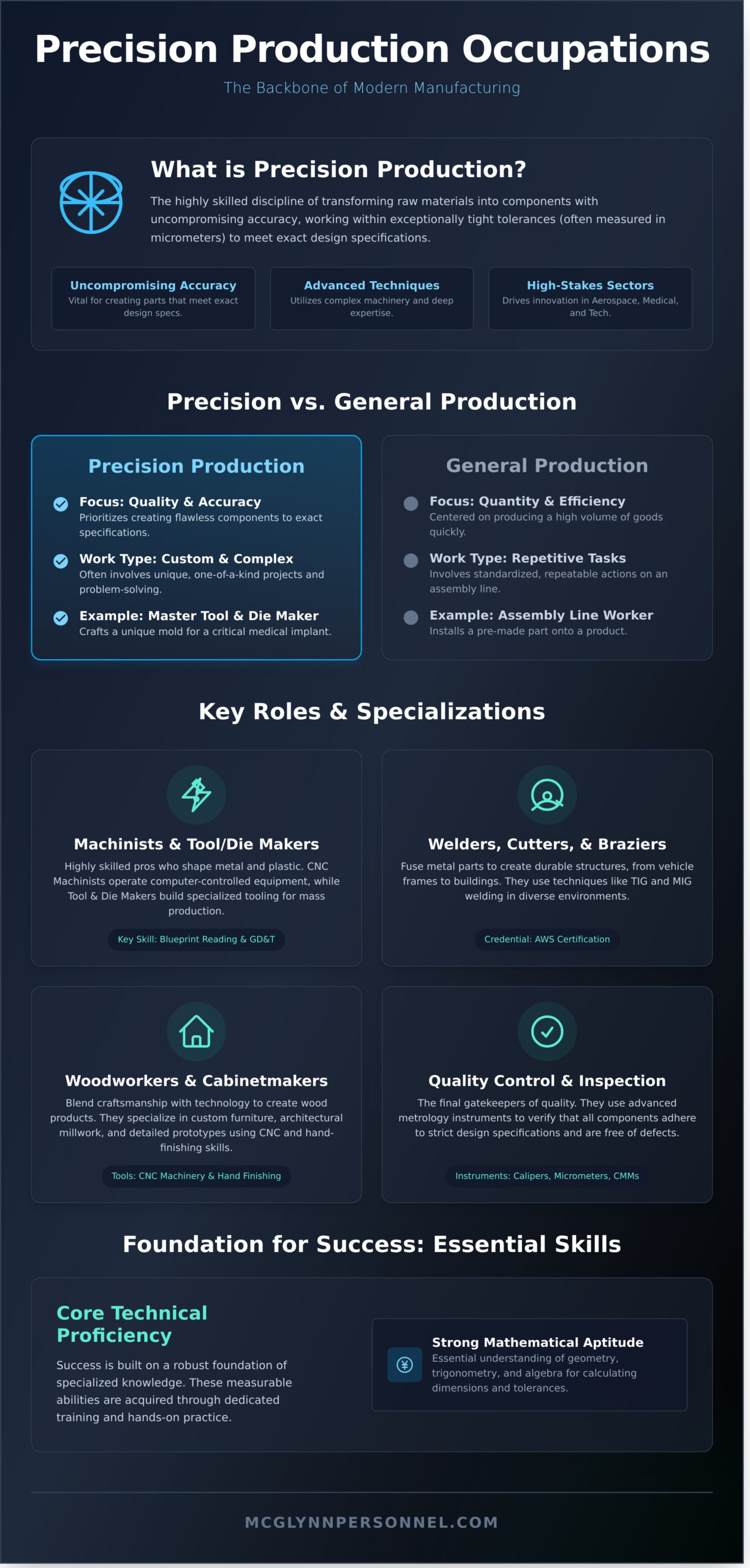
Precision production is far more than a standard manufacturing process; it is the highly skilled discipline of transforming raw materials into components and products with uncompromising accuracy. The core function of these roles is to work within exceptionally tight tolerances-often measured in micrometers-to create parts that meet exact design specifications. Professionals in these fields utilize advanced techniques to achieve these results. A foundational understanding of what is machining, for example, reveals the complexity behind meticulously removing material to create a final shape. This level of control requires a unique combination of technical expertise, sound judgment, and a deep commitment to quality.
These specialized skills are the driving force behind innovation in the world’s most demanding sectors, including aerospace, medical devices, automotive, and technology, where even the slightest imperfection can have profound consequences.
Precision vs. General Production: What’s the Difference?
While both are essential to industry, precision and general production operate on fundamentally different principles. General production often involves repetitive tasks on an assembly line, where the primary focus is on quantity and efficiency. In contrast, precision production prioritizes quality and accuracy, frequently involving custom work and complex problem-solving. Think of the difference between an assembly line worker who installs a pre-made part and a master tool and die maker who crafts a unique mold for a critical medical implant. The former masters a repetitive action, while the latter applies deep knowledge to create a one-of-a-kind, high-stakes component.
The Economic Importance of Precision Occupations
The value of precision production occupations to a modern economy cannot be overstated. These roles are the critical link for innovation and quality control, enabling the creation of complex, high-technology products that define our world. Without skilled machinists, metrology technicians, and toolmakers, groundbreaking advancements in surgical robotics, next-generation aircraft, and semiconductor manufacturing would remain purely theoretical. Furthermore, these highly skilled positions are vital for strengthening domestic supply chains, ensuring that critical manufacturing capabilities are robust, reliable, and secure. They form an essential foundation for national competitiveness and technological leadership.
Key Roles and Specializations in Precision Production
The field of precision production occupations is diverse, encompassing a wide array of specialized roles that form the backbone of modern manufacturing. Professionals in these careers are defined by their meticulous attention to detail, technical expertise, and ability to transform raw materials into finished goods that meet exacting standards. The U.S. Bureau of Labor Statistics offers a comprehensive Production Occupations Outlook that details the scope of these critical careers, from entry-level requirements to long-term prospects. Below, we explore the key job families within this essential sector.
Machinists and Tool & Die Makers
These highly skilled professionals shape metal, plastic, and other materials with exceptional accuracy. CNC Machinists operate computer-controlled equipment to produce components for industries like aerospace and medical devices, while Tool and Die Makers build the specialized tooling and fixtures that make mass production possible. Success in these roles depends on a deep understanding of blueprint reading and geometric dimensioning and tolerancing (GD&T) to ensure every part meets precise specifications.
Welding, Cutting, Soldering, and Brazing Workers
Welders and related professionals are responsible for fusing metal parts to create durable, seamless structures. Working in environments from fabrication shops to large-scale construction sites, they use techniques like TIG and MIG welding to build everything from vehicle frames to structural steel for buildings. Due to the critical nature of their work, many employers require professional credentials, such as an American Welding Society (AWS) certification, to verify skill and ensure safety compliance.
Woodworkers and Cabinetmakers
Blending traditional craftsmanship with modern technology, woodworkers create functional and aesthetic products from wood. Cabinetmakers specialize in high-end custom furniture and architectural millwork, while Model Makers construct detailed wood prototypes for industrial design and architectural visualization. These roles increasingly utilize CNC machinery for precision cutting and shaping but still rely on expert hand-finishing skills to achieve a superior quality product.
Quality Control and Inspection
As the final gatekeepers of quality, inspectors and testers ensure that all manufactured components adhere to strict design specifications. They use advanced metrology instruments-including calipers, micrometers, and Coordinate Measuring Machines (CMMs)-to verify dimensions and tolerances. This role is fundamental to maintaining product integrity and client trust, making it one of the most vital precision production occupations. Their work guarantees that every product leaving the facility is fit for purpose and free of defects.
Essential Skills and Qualifications for a Career in Precision Production
Success in precision production occupations is built on a robust foundation of specialized knowledge and professional discipline. These roles demand a unique combination of technical capability and personal attributes to meet the exacting standards of modern manufacturing. Aspiring professionals must cultivate a specific skill set to not only enter the field but also to achieve long-term career growth in an industry driven by innovation.
Core Technical Skills (Hard Skills)
Technical proficiency is the bedrock of any precision production role. These measurable abilities are acquired through dedicated training and hands-on practice. Key competencies include:
- Strong Mathematical Aptitude: A comprehensive understanding of geometry, trigonometry, and algebra is essential for calculating dimensions, tolerances, and tool paths.
- Blueprint and Schematic Interpretation: The ability to accurately read and interpret complex technical drawings, CAD models, and schematics is non-negotiable.
- Hands-on Operational Skill: Proficiency in operating, maintaining, and troubleshooting specific machinery, from CNC mills to lathes, alongside expertise with precision measuring tools like micrometers and calipers.
- Knowledge of Materials Science: A practical understanding of the properties of various materials, including metals, alloys, plastics, and composites, is crucial for effective machining and fabrication.
Crucial Professional Attributes (Soft Skills)
Alongside technical expertise, certain professional qualities distinguish exceptional candidates. These attributes ensure quality, efficiency, and effective teamwork in a high-stakes environment.
- Exceptional Attention to Detail: A meticulous approach is required to work within microscopic tolerances and ensure every component meets quality control standards.
- Advanced Problem-Solving: The ability to diagnose issues, think critically, and implement effective solutions when machinery or processes deviate from the plan.
- Patience and Focus: Many tasks require sustained concentration over long periods to execute complex operations without error.
- Effective Communication: Clear, concise communication is vital for collaborating with engineers, supervisors, and quality assurance teams to maintain operational excellence.
Education and Training Pathways
There are several structured pathways to acquire the necessary qualifications for a career in this field. The educational framework is well-defined, with the National Center for Education Statistics providing a formal Precision Production Trades definition that outlines the instructional programs. The most common routes include:
- Vocational Schools and Technical Colleges: These institutions offer associate degrees and certificate programs focused on specific trades like machining, welding, or industrial maintenance.
- Apprenticeships: A highly effective model combining paid, on-the-job training under the guidance of experienced mentors with supplemental classroom instruction.
- Industry Certifications: Earning credentials from recognized bodies like the National Institute for Metalworking Skills (NIMS) or the American Welding Society (AWS) validates expertise and enhances employability.
Ultimately, a commitment to continuous learning is paramount. As technology evolves, professionals in precision production must adapt by mastering new software, automation, and advanced manufacturing techniques to remain at the forefront of the industry.
The Future of Precision Production: Trends, Technology, and Career Outlook
A common misconception suggests that automation is rendering precision production roles obsolete. The reality is precisely the opposite. Technology is not eliminating these careers; it is elevating them, creating a strong demand for a new class of highly skilled professionals. The future of precision production occupations is defined by the integration of advanced digital tools, transforming the nature of the work from manual execution to strategic process oversight and optimization.
The Impact of Industry 4.0: Automation and AI
The Fourth Industrial Revolution, or Industry 4.0, has reshaped the modern factory floor. For professionals in this sector, this means adapting to and mastering new technologies. The focus has shifted from operating a single machine to managing complex, interconnected systems. Key technological drivers include:
- CNC Programming and Robotics: Once specialized fields, these are now core competencies. Professionals are expected to program, troubleshoot, and oversee automated equipment to ensure peak performance and quality.
- Additive Manufacturing: 3D printing complements traditional subtractive methods, enabling rapid prototyping and the creation of intricate components that were previously impossible to manufacture.
- Smart Factories and Data Analytics: Modern production environments generate vast amounts of data. The ability to analyze this information is crucial for improving efficiency, implementing predictive maintenance, and ensuring stringent quality control.
Career Growth and Salary Potential
This technological evolution directly translates to significant opportunities for career advancement and increased earning potential. An entry-level operator can build a clear path toward becoming a CNC programmer, a quality control specialist, a production supervisor, or even a manufacturing engineer. Specialization is rewarded, and continuous learning is the key to progress.
The U.S. Bureau of Labor Statistics projects that employment for machinists will grow 7% from 2022 to 2032, a rate faster than the average for all occupations. While the median annual wage for machinists was $48,970 in May 2023, professionals with advanced skills in multi-axis CNC programming, robotics, and metrology command significantly higher compensation. As industries demand greater precision and efficiency, the value of individuals who master these complex systems continues to rise. To explore current opportunities that align with these industry trends, visit mcglynnpersonnel.com.
How to Find and Fill Precision Production Roles
The success of modern manufacturing hinges on connecting highly skilled professionals with the companies that need their expertise. However, a persistent skills gap often makes this a significant challenge. For both job seekers and employers in the world of precision production occupations, navigating this landscape requires a strategic, targeted approach that goes beyond conventional methods.
For Job Seekers: Building Your Career Path
To secure a premier role, your resume must clearly articulate your technical value. Generic descriptions are insufficient; focus instead on quantifiable achievements and specific competencies. Highlight your proficiency with:
- Specific machinery and control systems (e.g., Haas, Fanuc, Siemens)
- Metrology tools and quality assurance processes (e.g., CMM, GD&T)
- Relevant software (CAD/CAM, ERP systems) and industry certifications
While industry-specific job boards are valuable, partnering with a specialist recruiter provides a distinct advantage. An expert consultant understands the nuances of your skills and has access to exclusive opportunities not advertised elsewhere, ensuring your profile reaches the right decision-makers.
For Employers: Overcoming the Talent Shortage
Attracting elite talent requires a job description that speaks their language. Go beyond listing duties and instead detail the technical challenges, equipment, and performance expectations of the role. This level of detail pre-qualifies candidates and demonstrates your commitment to excellence.
Generalist HR departments often lack the deep network and technical insight to effectively source and vet candidates for highly specialized precision production occupations. A dedicated recruitment partner with proven manufacturing expertise bridges this critical gap. We deliver superior results by leveraging an established pool of vetted professionals, ensuring precision matching and reducing your time-to-hire. Our rigorous screening focuses on proven capability and quality discipline, delivering candidates who drive efficiency and accountability from day one.
Partner with us to achieve precision placements for your most critical roles.
Partnering for Success in Precision Production
As we’ve explored, precision production occupations are the cornerstone of modern industry, demanding a sophisticated blend of technical expertise, meticulous attention to detail, and a commitment to quality. The future of this sector is bright, with advancing technology creating significant opportunities for skilled professionals who are prepared to evolve. Success in this dynamic field hinges on aligning your unique capabilities with an organization that values them.
Navigating this landscape requires a partner with proven expertise. McGlynn Personnel offers specialized recruitment for the manufacturing and engineering sectors, leveraging deep industry insight and a global reach to deliver on our commitment: Precision Placements, Profound Results. Whether you are a candidate seeking a new challenge or an employer searching for best-in-class talent, we provide the structure and accountability needed to achieve your goals.
Ready to take the next step? Connect with our specialists to find your next opportunity or top-tier talent. Your future, defined by precision and success, starts now.
Frequently Asked Questions
What is the typical salary for a precision production occupation?
Salaries for precision production occupations vary based on specialization, geographic location, and expertise. An entry-level CNC operator might start around $45,000, while experienced tool and die makers can earn upwards of $80,000 or more. Certifications from organizations like the National Institute for Metalworking Skills (NIMS) significantly increase earning potential. This field rewards proven capability and precision, leading to dependable income growth for dedicated professionals.
Do I need a college degree to become a CNC machinist or toolmaker?
A four-year college degree is generally not a prerequisite for becoming a CNC machinist or toolmaker. Most professionals enter the field through apprenticeships, vocational school programs, or an associate’s degree in machine tool technology. These pathways prioritize hands-on skills, blueprint reading, and proficiency with specific machinery. Employers value demonstrated competence and a commitment to quality discipline over a traditional bachelor’s degree, making this a highly accessible career path.
How is technology like AI and robotics changing jobs in precision production?
Technology is elevating roles within precision production, not eliminating them. AI and robotics are automating repetitive tasks, which enhances efficiency and workplace safety. This allows skilled technicians to focus on higher-value responsibilities such as programming complex CNC machinery, performing advanced quality control with metrology tools, and troubleshooting automated systems. The future of the industry lies in professionals who can effectively collaborate with and manage these advanced technological systems.
Is precision production a good long-term career choice?
Yes, a career in precision production offers excellent long-term stability and growth potential. As advanced manufacturing expands and the current workforce ages, there is a significant and growing demand for skilled professionals. These roles are critical to essential industries like aerospace, medical devices, and defense, ensuring consistent demand. With opportunities for specialization and advancement into roles like programming or management, it provides a structured and rewarding career path for dedicated individuals.
What’s the difference between a machinist and a tool and die maker?
While both roles require exceptional precision, their functions differ. A machinist typically operates machine tools like lathes and mills to create finished parts based on technical drawings. A tool and die maker is a highly specialized machinist who designs, builds, and repairs the tools, dies, and fixtures used in mass production processes. Essentially, the tool and die maker creates the instruments that enable other production workers to manufacture parts consistently and efficiently.
How can I get started in a precision production career with no experience?
Securing a role in this field with no experience is achievable through structured pathways. We recommend exploring local community college or vocational school programs in machine tool technology to build foundational skills. Seeking out apprenticeships offered by companies or trade unions provides invaluable on-the-job training. Another effective strategy is to start in an entry-level position, such as a machine operator or shop assistant, demonstrating a strong work ethic and a commitment to learning the trade.