
Are your job postings for critical engineering roles attracting more noise than signal? The most impactful engineers-the ones capable of transforming your operations-are rarely scrolling through job boards. They are busy driving results in their current positions, making them invisible to conventional recruitment tactics. When standard methods fail to deliver the precision and caliber of talent your business demands, partnering with specialist engineering headhunters provides a direct line to this exclusive, passive talent pool.
Knowing when to make that strategic investment is key to optimizing your hiring process and securing a profound return. This article provides a clear framework for identifying the specific scenarios where a dedicated recruitment partner is the most effective strategy. We will explore the definitive moments-from confidential leadership searches to sourcing highly specialized technical skills-when engaging a headhunter is the most efficient path to connecting with the best-in-class talent your organization requires to achieve its objectives.
Key Takeaways
- Recognize the critical difference between recruiters who engage active job seekers and headhunters who proactively source high-impact, passive talent.
- Identify the specific, high-stakes hiring scenarios where traditional recruitment falls short and a specialized approach becomes essential for success.
- Learn how the methodical process used by top engineering headhunters ensures precision and quality, delivering candidates who are otherwise inaccessible.
- Develop a clear framework for evaluating and selecting the right headhunting partner to guarantee an efficient and successful talent acquisition outcome.
Recruiter vs. Headhunter: Understanding the Critical Difference in Engineering
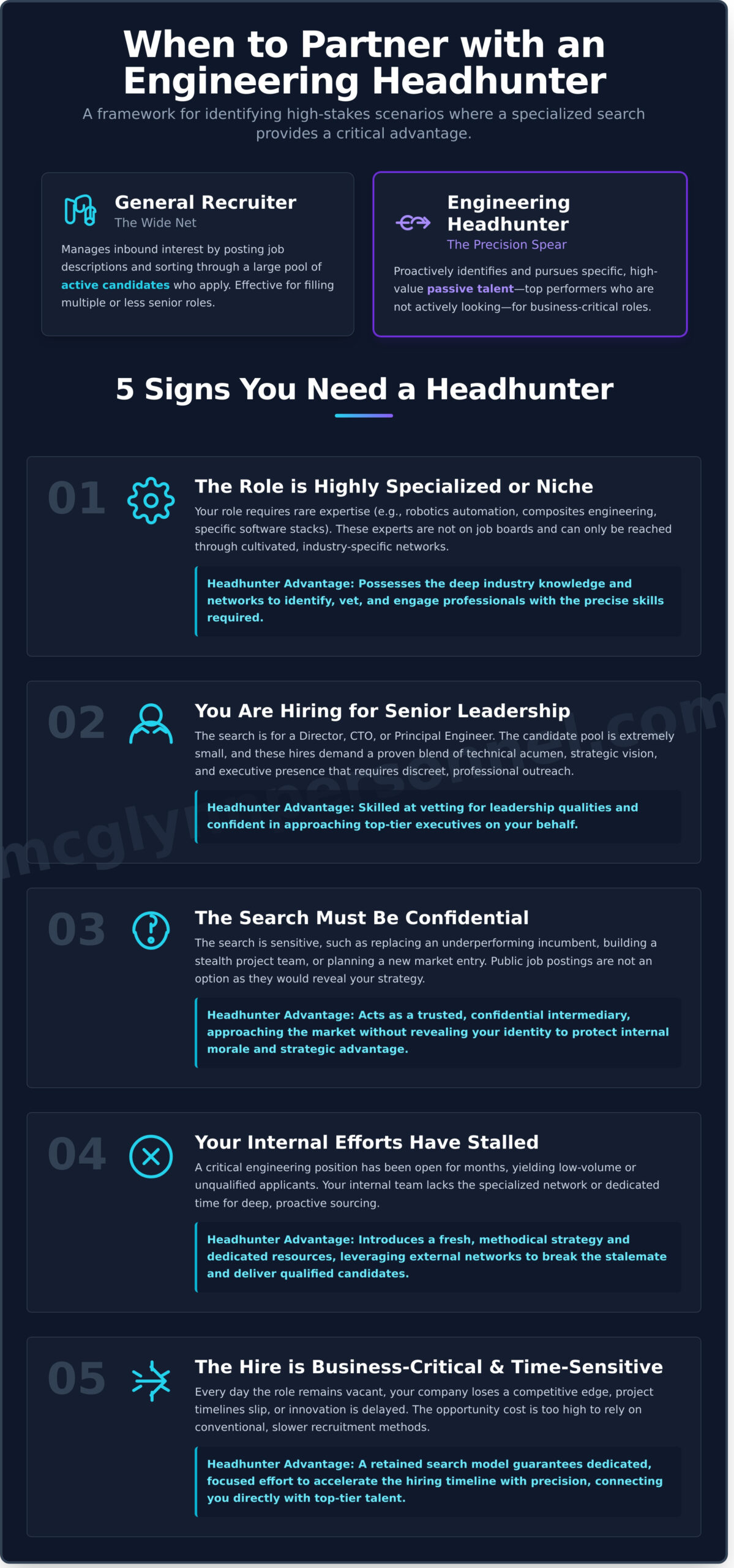
In the world of talent acquisition, the terms “recruiter” and “headhunter” are often used interchangeably. However, for businesses seeking specialized engineering talent, understanding the distinction is crucial for achieving profound results. The core difference lies in their methodology. A general recruiter often acts like a fisherman with a net, posting job descriptions and sorting through the active candidates who apply. In contrast, an engineering headhunter operates like a spear fisherman, proactively identifying and pursuing specific, high-value targets who are not even in the market.
This strategic approach is what separates a standard search from a precision placement. While a recruiter manages inbound interest, a headhunter generates outbound engagement, bringing structure and focused effort to the most challenging talent searches.
The Focus on Active vs. Passive Candidates
Active candidates are individuals actively seeking new employment; they browse job boards, update their resumes, and apply for open positions. While valuable, this talent pool is limited. The most impactful engineers-the innovators and leaders driving their current companies forward-are typically passive candidates. They are excelling in their roles, well-compensated, and not looking for a change. Specialized engineering headhunters build relationships with these top-tier professionals, understanding their career motivations and presenting them with opportunities so compelling they are inspired to make a move.
Contingency vs. Retained Search Models
The operational model further defines the difference. Most traditional recruitment operates on a contingency basis, where payment is only made upon a successful hire. This works well for filling multiple or less senior roles. Headhunting for critical engineering positions, however, often utilizes a retained search model. This approach, central to the practice of Executive search (headhunting), involves an exclusive partnership where our firm dedicates comprehensive resources to your search. A retained model guarantees a methodical, in-depth process focused on finding the single best candidate, not just a suitable one, ensuring accountability and a commitment to quality from start to finish.
Five Signs Your Company Needs an Engineering Headhunter
How do you determine when to move beyond standard recruitment and engage a specialist? This section serves as a practical checklist for hiring managers. The following scenarios represent complex hiring challenges where partnering with engineering headhunters provides a distinct advantage. Engaging a specialist is a strategic investment in securing business-critical talent, aligning with the formal definition of a headhunter as a professional who sources highly qualified candidates for senior-level roles. Evaluate your current hiring challenge against these points to identify if expert intervention is required.
1. The Role is Highly Specialized or Niche
Your company needs to fill a role in a field like robotics automation, composites engineering, or for a specific, high-demand software stack. These top-tier experts are rarely active on general job boards. A headhunter maintains deep, cultivated networks within these niche technical communities. They possess the industry-specific knowledge to understand the unique requirements of the role and can identify and engage professionals with the precise skills you need.
2. You Are Hiring for a Senior Leadership Position
When searching for a Director of Engineering, CTO, or Principal Engineer, you need more than just technical acumen. These critical hires demand a proven blend of technical expertise, strategic vision, and leadership skills. The candidate pool is inherently small and consists of passive candidates who require discreet, professional outreach. Headhunters are skilled at vetting for this executive presence and can confidently approach top-tier leaders on your behalf.
3. The Search Must Be Confidential
Confidentiality is paramount in sensitive situations, such as replacing an underperforming incumbent or building a team for a new market entry before a public announcement. A headhunter acts as a trusted, confidential intermediary. They can approach the market and vet potential candidates without revealing your company’s identity, thereby protecting internal morale, preventing market speculation, and maintaining your strategic advantage.
4. Your Internal Efforts Have Failed
A critical engineering position has been open for months, yielding a low volume of unqualified applicants. Your internal HR or talent acquisition team may lack the specialized network or dedicated time required for deep, proactive sourcing. This is a clear indicator that a more targeted approach is necessary. A headhunter introduces a fresh strategy, immediate access to a new candidate pool, and the focused expertise needed to close the role efficiently.
The Engineering Headhunting Process: A Methodical Approach to Talent
The work of specialised engineering headhunters is not an opaque art; it is a structured, methodical discipline designed to deliver precision and accountability. Far from simply matching resumes to job descriptions, our process is a collaborative partnership. Each phase is engineered to progressively refine the search, ensuring the final candidates presented are not only technically proficient but are also a seamless fit for your company’s culture and strategic objectives.
This structured approach transforms recruitment from a game of chance into a predictable, results-oriented business function.
Phase 1: Discovery and Position Specification
The foundation of a successful placement is a profound understanding of the need. We move beyond the standard job description in a deep-dive discovery session to align with key stakeholders. This initial phase is critical for defining the precise parameters for success.
- Defining core technical competencies and required proficiencies.
- Mapping the role’s impact on business goals and team dynamics.
- Establishing key performance indicators and success metrics.
- Creating a detailed, multi-faceted profile of the ideal candidate.
Phase 2: Market Mapping and Candidate Identification
With a clear mandate, we initiate a research-intensive sourcing phase. This proactive and systematic approach ensures we access the entire talent market, not just active job seekers. We meticulously build a long-list of high-potential professionals who meet the established criteria.
- Systematically identifying target companies and competitor talent pools.
- Leveraging proprietary databases and extensive industry networks.
- Conducting original research to uncover passive, high-caliber talent.
Phase 3: Discreet Outreach and Candidate Engagement
Top engineering talent is rarely looking for a new role; the opportunity must be compellingly presented to them. Our outreach is confidential and professional, designed to build trust and intrigue. We engage potential candidates in conversations that highlight the strategic value and career potential of the role, creating a powerful narrative that resonates with their ambitions.
Phase 4: Rigorous Screening, Vetting, and Presentation
The final phase focuses on meticulous qualification to ensure quality and fit. Candidates undergo in-depth interviews that assess both technical expertise and essential soft skills. We verify career histories and conduct thorough reference checks to validate accomplishments. From this, we present you with a short-list of the most qualified and genuinely interested candidates, complete with comprehensive reports to facilitate an efficient and informed hiring decision.
How to Select the Right Engineering Headhunting Partner
Engaging a recruitment firm is a significant investment in your company’s future. However, not all engineering headhunters are created equal, and your choice of partner will directly impact the quality of talent you see and the ultimate success of your search. A transactional recruiter may fill a seat, but a true partner delivers a strategic asset who drives long-term value. To ensure a profound return on your investment, look for clear evidence of specialization, a structured process, and a commitment to partnership.
Evaluate Their Industry Specialization
Generic recruitment experience is insufficient for highly technical roles. A specialist understands the specific competencies, regulatory environments, and market dynamics of your sector. They speak the same language as your ideal candidates and can accurately assess technical capabilities beyond a keyword match. When vetting a potential partner, demand proof of their expertise.
- Do they have deep, demonstrable experience in your specific engineering domain, such as advanced manufacturing, aerospace, or civil infrastructure?
- Can they provide case studies or testimonials from companies with similar challenges and technical requirements?
- Ask about the depth of their network and their relationships with key talent in your niche.
Assess Their Search Methodology and Process
A premier firm operates with precision and transparency. Their methodology should be a structured, repeatable system designed to deliver consistent, high-quality results. A vague or disorganized approach is a clear red flag, indicating a lack of discipline and accountability. A transparent process builds confidence and ensures all stakeholders remain aligned from kickoff to final placement.
- Inquire about their specific steps for identifying, engaging, and vetting candidates, particularly passive talent not active on job boards.
- What is their communication and reporting cadence? You should expect regular, substantive updates on the search progress.
- How do they screen for both technical proficiency and cultural alignment with your organization?
Consider Their Cultural Fit and Communication Style
Remember, the headhunting firm you choose becomes an extension of your brand in the marketplace. Their professionalism, communication, and conduct directly reflect on your company’s reputation. It is critical to select a partner whose standards of excellence mirror your own. This relationship should be built on trust, mutual respect, and a shared commitment to achieving the best possible outcome.
Ultimately, you are seeking a long-term, trusted advisor who can support your talent acquisition strategy as your business evolves. Discover McGlynn Personnel’s structured approach to see how a dedicated partnership can deliver precision placements and profound results for your team.
Secure Your Next Engineering Leader with Strategic Precision
Ultimately, understanding the distinction between general recruiters and specialist engineering headhunters is the first step toward securing elite talent. When your search for a critical leadership role stalls, requires deep market insight, or demands absolute confidentiality, it is a clear signal to engage an expert partner. Choosing the right firm isn’t just about filling a vacancy; it’s a strategic decision to implement a methodical process that delivers a candidate who not only meets technical requirements but also drives profound, long-term results for your organization.
At McGlynn Personnel, we embody this strategic approach. As specialists in Manufacturing & Engineering Executive Search, our methodical process is engineered for precision placements. We leverage our global reach and deep local market insight to identify and engage transformative leaders who are often inaccessible through traditional channels. We provide the structure and accountability needed to make your most critical hires with unwavering confidence.
Partner with us to find your next engineering leader.
Frequently Asked Questions About Engineering Headhunters
What is the difference between retained and contingency search for engineering roles?
A retained search establishes an exclusive partnership, typically for senior or highly specialized roles. A portion of the fee is paid upfront, guaranteeing dedicated resources and a meticulous, in-depth search process. This model ensures a higher level of commitment and a structured approach. A contingency search is non-exclusive and success-based, with the fee paid only upon a successful hire. This is often suitable for less urgent or more generalized engineering positions where multiple recruitment channels are being utilized.
How much do engineering headhunters typically charge for their services?
Professional recruitment service fees are structured as a percentage of the placed candidate’s first-year guaranteed compensation. This industry-standard fee typically ranges from 20% to 30%, depending on the complexity and seniority of the role. This investment reflects the comprehensive screening, market analysis, and precision matching required to secure best-in-class talent for your organization. The final fee structure is always agreed upon before a search commences, ensuring complete transparency and accountability.
How long does it take to fill a senior engineering role using a headhunter?
The timeline for filling a senior engineering role typically ranges from 8 to 12 weeks. This structured process includes initial market mapping, rigorous candidate vetting, stakeholder interviews, and offer management. Our methodical approach ensures that while we move with urgency, our focus on quality and precision is never compromised. This timeframe allows for the diligence required to deliver candidates who meet the most stringent technical and cultural requirements for leadership and high-impact positions.
Why can’t I just use LinkedIn to find the same candidates myself?
While LinkedIn is a valuable tool, it primarily targets active job seekers. Professional engineering headhunters excel at engaging the passive talent market-the top-tier professionals who are not actively applying but are receptive to superior opportunities. We provide the structure, market insight, and rigorous screening process necessary to identify and secure these high-caliber individuals. This saves your internal team significant time and resources while expanding your access to a much broader talent pool.
What information should I provide to a headhunter to ensure the best results?
To ensure precision matching, you should provide a comprehensive job specification detailing technical competencies, project experience, and required qualifications. Equally important are insights into your company culture, reporting structures, and the strategic objectives of the role. A clear understanding of the compensation package and the unique value proposition of the opportunity allows us to act as a true extension of your team, representing your brand with accuracy and professionalism in the marketplace.
Can headhunters help with international or expatriate engineering placements?
Yes, many reputable engineering headhunters possess global networks and deep expertise in managing international and expatriate placements. We navigate the complexities of cross-border recruitment, including compliance with local employment laws, visa sponsorship, and relocation logistics. Our global reach and local insight ensure we can source best-in-class engineering talent from anywhere in the world to meet your organization’s strategic, operational, and project-based needs, providing a seamless process for both employer and candidate.