
The cycle is frustratingly familiar: you post a role for a high-level mechanical engineer and are met with a flood of unqualified applicants. The risk of a bad hire looms large, and you know the top-tier, passive candidates you truly need are not responding to standard job ads. This inefficient process costs valuable time and resources, leaving critical projects understaffed. For companies committed to excellence, a new approach to finding specialized mechanical engineers is not just an option-it is a strategic necessity.
This guide delivers that strategy. We move beyond the limitations of generic recruitment to provide a comprehensive framework for sourcing, attracting, and hiring elite engineering talent. You will learn proven techniques to access a higher-quality candidate pool, confidently vet complex technical skills, and ultimately reduce your time-to-hire. Our focus is on ensuring your next hire drives long-term value and becomes a pivotal part of your organization’s success, increasing retention and delivering profound results.
Key Takeaways
- Define the role with precision by focusing on core competencies, not just software lists, to attract genuinely qualified specialists.
- Success in finding specialized mechanical engineers depends on shifting from a reactive hiring process to a proactive, strategic framework.
- Discover the specific professional communities and niche channels where elite engineering talent congregates, both online and offline.
- Implement a multi-stage vetting process designed to accurately assess complex technical capabilities, moving beyond a standard HR screening.
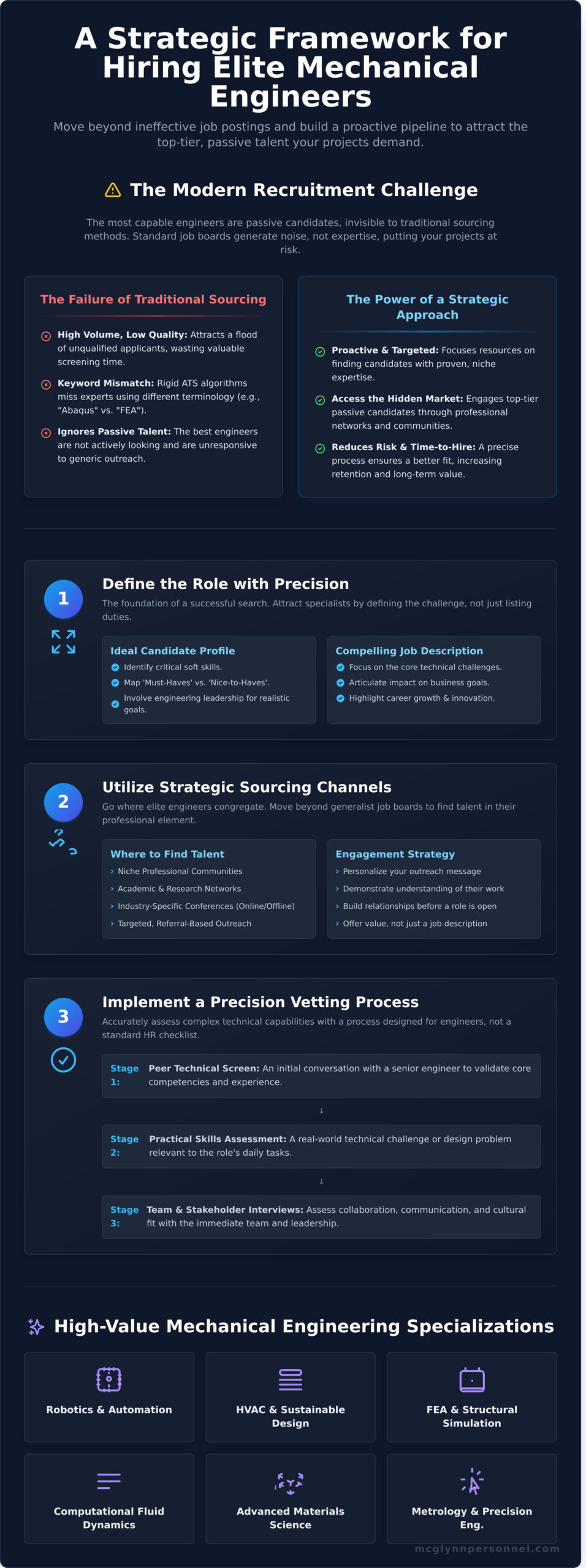
The Modern Challenge: Why Specialized Mechanical Engineers Are Hard to Find
The field of mechanical engineering is vast, but modern industry demands far more than general proficiency. The true recruitment challenge lies in securing professionals with deep, niche expertise. A ‘specialized’ engineer is not just a title; it represents proven mastery in a specific, high-value domain. These disciplines require a distinct combination of theoretical knowledge and hands-on experience in areas such as:
- Robotics and Automation Systems
- HVAC and Sustainable Building Design
- Finite Element Analysis (FEA) and Structural Simulation
- Computational Fluid Dynamics (CFD)
- Advanced Materials Science and Metrology
These specializations are vital for critical industrial operations. For instance, metrology experts are essential for maintaining and calibrating industrial weighing equipment—a specialized field where companies like Independent Scale Service provide key services.
The market for these experts is defined by intense, cross-industry demand and a critically low supply of proven talent. This imbalance makes the process of finding specialized mechanical engineers a high-stakes, strategic imperative. The financial and operational risk of a bad hire is immense. In a technical role, a single miscalculation can trigger costly project delays, catastrophic product failures, and significant reputational damage, impacting stakeholder confidence and the bottom line.
The Talent Pool Paradox
The most capable and experienced engineers are typically passive candidates. They are fully engaged, valued, and delivering results in their current roles-not actively browsing job boards. These top-tier professionals are unresponsive to generic, mass-sent recruitment messages. Furthermore, their unique skill sets often defy standard search keywords, making them virtually invisible to conventional sourcing methods that rely on surface-level data.
The Failure of Traditional Sourcing Methods
Generalist job boards and automated applicant tracking systems (ATS) are fundamentally ill-equipped for the precision required for this level of recruitment. A keyword search for “FEA” on a platform like Indeed might miss an exceptional candidate whose resume details their experience in “non-linear stress analysis” or specific software like “Abaqus.” This reliance on rigid algorithms results in a high volume of low-quality applications while simultaneously filtering out the very experts your organization needs.
Step 1: Defining the Role with Precision Before You Search
The foundation of any successful recruitment effort is a precise definition of the role. A generic request for a “mechanical engineer” attracts a flood of unfocused applications, wasting valuable time and resources. The process of finding specialized mechanical engineers begins not with the search, but with a meticulously crafted role definition that aligns with tangible business objectives. Top-tier engineers are driven by complex challenges; your job description must present a compelling one.
Creating the Ideal Candidate Profile
Before writing the job description, your key stakeholders must align on a detailed candidate profile. This blueprint provides the necessary structure for an efficient and targeted search. We recommend a methodical approach that defines both technical and interpersonal requirements to ensure a lasting, successful placement.
- Go Beyond Technical Skills: Identify essential soft skills. Does the role demand extensive cross-functional collaboration, client-facing communication, or mentoring junior team members? Define the work style that thrives in your environment.
- Map ‘Must-Have’ vs. ‘Nice-to-Have’: Clearly separate non-negotiable competencies (e.g., mastery of FEA for a structural analysis role) from preferred qualifications (e.g., experience with a specific PDM software). This brings clarity to the screening process.
- Involve Engineering Leadership: Your current engineering leaders understand the technical and cultural nuances of their teams. Their input is critical for defining a realistic and effective profile that supports team dynamics.
Crafting a Compelling Job Description
With a clear profile established, you can craft a description that resonates with high-caliber professionals. This document is more than a list of duties-it is a marketing tool designed to attract elite problem-solvers. The goal is to articulate not just what the engineer will do, but what they will achieve.
- Focus on the Challenge: Instead of leading with a list of responsibilities, describe the core projects and technical hurdles the new hire will tackle. Frame the role around its contribution to innovation and key business goals.
- Articulate Career Growth: With a consistently strong job outlook for mechanical engineers, top candidates are evaluating their long-term career trajectory. Clearly outline opportunities for advancement, skill development, and mentorship.
- Showcase Your Environment: Highlight what makes your engineering department unique. Discuss your technology stack, commitment to R&D, collaborative culture, or state-of-the-art lab facilities to attract candidates who align with your values.
This initial investment in precision is the most critical factor in finding specialized mechanical engineers who deliver profound results. A well-defined profile and a compelling job description act as a powerful filter, ensuring that only the most qualified and motivated candidates enter your pipeline.
Step 2: Strategic Sourcing Channels for Elite Engineers
Successfully finding specialized mechanical engineers requires a disciplined, multi-channel strategy that extends far beyond standard job boards. While online freelance platforms serve a purpose for short-term projects, securing elite, permanent talent demands a more proactive and structured approach. The most proficient engineers are often passive candidates-top performers who are not actively seeking new roles but are receptive to compelling opportunities. With the profession evolving rapidly, as detailed in the Bureau of Labor Statistics report on Mechanical Engineers, employers must build a robust talent pipeline before a critical need arises. This ensures you are consistently connecting with best-in-class professionals.
Leveraging Niche Professional Networks
Specialized engineers congregate in communities built around shared technical challenges and expertise. To access this talent, you must engage authentically in these spaces. This includes:
- Targeting specific subreddits (e.g., r/Engineering, r/AskEngineers) and industry forums dedicated to CAD software, FEA, or CFD analysis.
- Utilizing alumni networks from top-tier engineering universities to connect with proven talent.
- Monitoring discussions on platforms like GitHub for engineers with strong mechatronics or robotics programming skills.
Direct Sourcing and Headhunting
Direct sourcing is the methodical process of identifying, qualifying, and engaging passive candidates. This precision-driven tactic is fundamental to finding specialized mechanical engineers who are not available on the open market. Effective techniques involve mapping the organizational structures of competitor firms to identify high-achievers, reviewing speaker lists from technical conferences, and sourcing leads from professional publications and patent filings. This proactive outreach demonstrates a commitment to securing top-tier talent.
Industry Events and Referrals
Attending industry trade shows, technical seminars, and conferences provides invaluable opportunities to network directly with leading engineers. However, the most powerful sourcing channel is often internal. A well-managed employee referral program consistently yields the highest quality candidates who are already vetted for cultural fit. Referrals bring a level of trust and accountability that is difficult to replicate, making them a cornerstone of any efficient and successful recruitment strategy.
Step 3: The Art of Attraction and Engagement
The paradigm for finding specialized mechanical engineers has shifted. The most accomplished candidates are not simply looking for a job; they are searching for a career-defining challenge. They are evaluating your organization, your technical leadership, and your company culture as rigorously as you are assessing their skills. To attract this elite talent, your process must move beyond simple recruitment and become a strategic engagement built on mutual respect and compelling opportunity.
Your employer brand is your primary asset in this exchange. It is communicated through every interaction, from the initial outreach to the final offer. A strong brand showcases a commitment to innovation, a culture that empowers its engineers, and a clear vision for the future-factors that are often more persuasive than compensation alone. This is about offering a bespoke opportunity, and for an interesting look at what that level of customization means in another field, you can find out more about tailored travel experiences.
Making the First Contact
Your initial outreach is the most critical step. Generic, templated messages are immediately dismissed by top-tier professionals. A successful approach is personalized, respectful, and focused on the individual. We recommend you:
- Reference Specific Accomplishments: Mention a specific project, a published paper, or a patent they hold. This demonstrates genuine interest and that you have done your research.
- Focus on the Challenge: Frame the position as an opportunity to solve a complex problem or lead a groundbreaking initiative, not just a list of responsibilities.
- Be Transparent: Clearly outline the role, its position within the team, and the key stages of the recruitment process. Honesty builds immediate trust.
Selling the Opportunity, Not Just the Job
Once you have their attention, the focus must be on the holistic opportunity. A job description lists tasks; a true opportunity outlines impact and growth. Clearly articulate how this role contributes directly to the company’s strategic goals. Detail the resources and autonomy the engineer will command, such as access to advanced R&D labs, a dedicated budget, or the authority to build a team. Introducing them to potential peers or the hiring manager early in the process provides an authentic glimpse into your collaborative environment and technical culture.
Connecting a candidate’s skills to a role is standard; connecting their ambition to a profound challenge is what secures elite talent. Learn how we connect top talent with profound opportunities.
Step 4: A Vetting Process Built for Precision
The challenge of finding specialized mechanical engineers demands a recruitment process that goes far beyond a standard resume review. A generic HR screening can identify keywords, but it cannot accurately assess the nuanced problem-solving abilities and deep technical knowledge required for high-stakes engineering roles. To secure best-in-class talent, you must implement a multi-stage vetting process designed for technical and cultural validation.
A robust evaluation framework provides structure and minimizes bias, ensuring every candidate is assessed against the same high standards. We recommend a process that includes:
- An initial screen to confirm foundational qualifications.
- A technical deep-dive interview led by your senior engineers.
- A panel interview focused on behavioral competencies and team collaboration.
- A final interview with key leadership stakeholders.
This methodical approach ensures that your best technical staff are directly involved in the evaluation, validating a candidate’s expertise with firsthand knowledge of your operational challenges.
Technical Skills Assessment
Move beyond abstract brain teasers and assess candidates with practical, relevant challenges. A portfolio review or a case study based on a real-world problem your team has faced is far more insightful. The goal is not merely to see if they arrive at the correct answer, but to evaluate their problem-solving methodology, their thought process under pressure, and their ability to articulate complex technical concepts clearly and logically.
Evaluating Soft Skills and Cultural Fit
Technical proficiency alone does not guarantee success. Use structured behavioral questions (e.g., “Describe a time you had to pivot on a project due to new data”) to gauge critical soft skills like communication, adaptability, and collaboration. Assess how a candidate navigates ambiguity and responds to constructive feedback. This ensures their work style and professional values align with your team dynamics and company culture, fostering long-term retention and performance.
Executing this level of detailed vetting requires significant resources and expertise. This structured approach is what separates an adequate hire from a transformative one, making it a non-negotiable step in finding specialized mechanical engineers who can deliver profound results for your organization.
When to Partner with a Specialized Engineering Recruiter
The process of finding specialized mechanical engineers is a complex undertaking. As this guide has illustrated, it demands not only significant time and resources but also a deep understanding of niche technical disciplines. When your internal team is stretched thin or lacks the specific industry knowledge to vet candidates effectively, a strategic partnership with a recruitment firm can be the most efficient path to securing top talent.
A specialist recruiter’s primary advantage is their established network. The most sought-after engineers are often passive candidates-highly skilled professionals who are not actively applying for jobs. A dedicated firm cultivates these relationships, providing you with exclusive access to a vetted pool of talent that you cannot reach through traditional job postings.
Furthermore, a specialist firm possesses the technical literacy required to properly assess candidates. We understand the nuances between proficiency in FEA and CFD, and we can rigorously evaluate a candidate’s experience in mechatronics or lean manufacturing. This ensures that only the most qualified and relevant individuals are presented to your team, saving you invaluable time.
Ultimately, the decision comes down to return on investment. Consider the significant cost of a prolonged vacancy: delayed projects, lost revenue, and overburdened teams. A successful placement drives innovation and growth. The strategic investment in a recruitment partner often pales in comparison to the cost of a critical role remaining unfilled.
The McGlynn Personnel Advantage
At McGlynn Personnel, we deliver Precision Placements for Profound Results. Our structured process is designed for long-term success, ensuring a precise match for your technical and cultural requirements. We bring structure and accountability to your search, leveraging deep industry networks to connect you with best-in-class talent. Explore our specialized engineering recruitment services at mcglynnpersonnel.com.
Is a Recruitment Partner Right for You?
A partnership is the optimal solution when certain conditions are met. Consider engaging a specialist firm if your search aligns with any of the following scenarios:
- The position is business-critical and the hiring process is time-sensitive.
- Your internal HR or talent acquisition team lacks the required technical expertise.
- The search must be conducted confidentially or is for an executive-level role.
- You have struggled to attract qualified candidates through your own channels.
Achieve Precision in Your Talent Acquisition Strategy
The search for elite engineering talent demands more than a simple job posting; it requires a deliberate and structured approach. Success hinges on defining the role with absolute clarity and deploying a multi-channel sourcing strategy built for a competitive market. Ultimately, the challenge of finding specialized mechanical engineers is overcome not by chance, but by a methodical process that attracts, engages, and meticulously vets top-tier candidates.
When your objectives demand efficiency and unparalleled expertise, partnering with a specialist is the most effective path forward. As a dedicated partner in the Manufacturing & Engineering sectors, McGlynn Personnel provides the deep industry insight required for these critical hires. Our global reach and unwavering focus on creating long-term, high-impact placements ensure you connect with professionals who will drive your organization’s success.
Let us bring structure and accountability to your recruitment process. Partner with us to find the precision engineering talent you need. Your next profound result begins with the right placement.
Frequently Asked Questions
What is the difference between a general recruiter and a specialized engineering recruiter?
A general recruiter casts a wide net across various industries, while a specialized engineering recruiter possesses deep domain expertise. This specialization allows them to understand the nuanced technical requirements of roles in areas like FEA or CFD. They maintain a curated network of high-caliber, often passive, engineering talent and can conduct more rigorous, technically-informed screenings. This precision results in a higher quality of candidates and a more efficient hiring process.
How long does it typically take to find and hire a specialized mechanical engineer?
The timeline for finding specialized mechanical engineers typically ranges from 6 to 12 weeks. This comprehensive process includes initial sourcing and screening (2-3 weeks), multiple rounds of technical and cultural-fit interviews (3-5 weeks), and the final offer and negotiation stage (1-4 weeks). A structured, methodical approach is essential to maintain momentum and secure top-tier professionals in a competitive market, ensuring no stage is rushed at the expense of quality.
What are the most in-demand specializations within mechanical engineering right now?
Currently, we observe significant demand for mechanical engineers with expertise in robotics and automation, sustainable energy systems, and advanced materials science. Professionals skilled in mechatronics, computational fluid dynamics (CFD), and additive manufacturing (3D printing) are also highly sought after. These specializations are critical as industries from aerospace to consumer electronics push the boundaries of innovation, efficiency, and sustainability in their product development cycles.
How can we compete with larger companies for top engineering talent?
Smaller companies can compete by highlighting their unique value proposition. Emphasize opportunities for greater project ownership, direct impact on business outcomes, and a more agile company culture. Offer compelling professional development paths, flexible work arrangements, and meaningful equity options. Communicating a clear, inspiring mission and showing how an engineer’s work directly contributes to it is often more persuasive than a salary-focused offer from a larger competitor.
What are the key red flags to watch for when interviewing mechanical engineers?
Key red flags include an inability to articulate their specific contributions to past team projects or a lack of depth when explaining technical challenges they have overcome. Be cautious of candidates who show little curiosity about your company’s specific engineering problems or growth plans. Vague answers regarding software proficiency or a resume that lists skills without corresponding, verifiable project experience warrant a more detailed and structured inquiry.
How do you verify the technical skills of a candidate from their resume alone?
A resume serves only as an initial indicator; it cannot be used for definitive skill verification. True validation requires a multi-faceted assessment process. We utilize structured technical interviews where candidates solve real-world problems relevant to the role. This is often supplemented with practical skills assessments and detailed reference checks with former supervisors who can speak directly to the candidate’s specific technical capabilities and on-the-job performance.