
An inbox filled with unqualified CVs. Hours lost explaining complex technical requirements to a generalist recruiter. The high cost of a bad hire that sets your projects back months. If these challenges sound familiar, you understand that the wrong recruitment process does more than waste time-it can damage your employer brand and hinder growth. The challenge isn’t merely filling a vacancy; it’s about strategically building a high-performing engineering team. This makes knowing how to choose an engineering recruitment partner one of the most critical decisions you can make.
A true recruitment partner acts as an extension of your team, bringing order and precision to the hiring process. They understand your technical requirements, respect your time, and are committed to delivering profound results. This strategic guide moves beyond generic advice to provide a clear framework for evaluation. You will learn the essential criteria for selecting a specialist who can provide a small, curated list of exceptional candidates, helping you fill critical roles faster and build the foundation for a trusted, long-term partnership.
Key Takeaways
- Establish clear internal requirements and success metrics before you begin your search to ensure you can measure a partner’s performance effectively.
- Verify a potential partner’s deep industry expertise; a generalist recruiter cannot provide the precision needed for specialized engineering roles.
- Assess a recruiter’s process and communication protocols, as their methods become an extension of your own employer brand during the candidate search.
- Learn how to choose an engineering recruitment partner by conducting final due diligence, from verifying references to scrutinizing contractual terms, to mitigate risk.
Step 1: Foundational Work – Defining Your Needs and Success Metrics
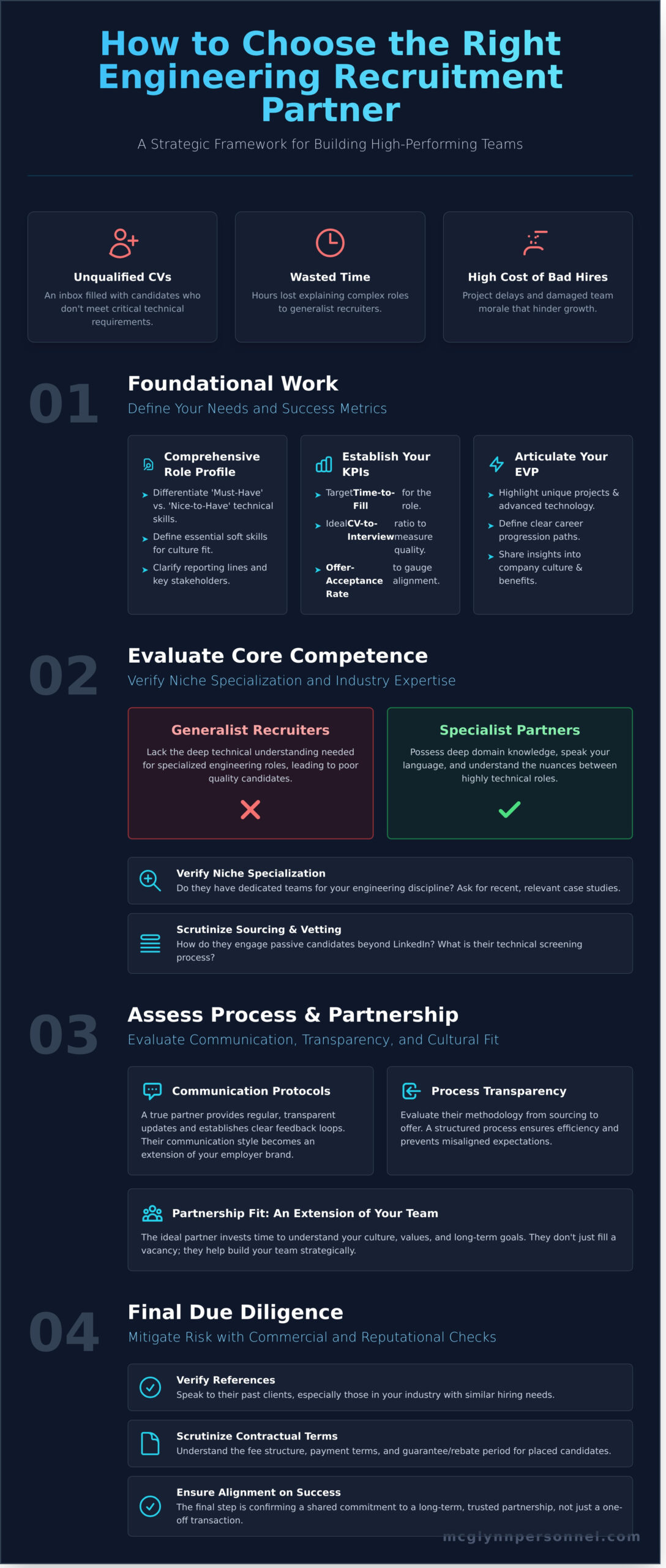
Before you can evaluate potential agencies, you must first achieve internal clarity. The process of learning how to choose an engineering recruitment partner that delivers sustained value begins with a meticulous definition of your own requirements and success metrics. This foundational work ensures you can measure a partner’s performance against clear, objective standards. A detailed brief empowers a high-caliber partner to operate as a true extension of your team, preventing misaligned expectations and ensuring efficiency from the start.
Develop a Comprehensive Role Profile
Move beyond a standard job description to create a detailed profile that provides critical context. This document should articulate the project’s strategic impact, the challenges the new hire will solve, and their potential for growth within the organisation. We recommend outlining:
- Technical Skills: Differentiate between ‘must-have’ competencies and ‘nice-to-have’ qualifications and certifications.
- Soft Skills: Define the essential behavioural traits required for a strong team and company culture fit.
- Organisational Structure: Clarify the reporting lines and identify the key internal stakeholders the role will interact with.
Establish Your Key Performance Indicators (KPIs)
To bring structure and accountability to the partnership, you must establish measurable goals. These metrics provide objective data points throughout the entire recruitment process, allowing you to create a performance scorecard. Key KPIs to track include your ideal ‘time to fill,’ a target CV-to-interview ratio to measure candidate quality, and the interview-to-offer and offer-acceptance rates to gauge alignment and effectiveness.
Articulate Your Employer Value Proposition (EVP)
Top engineering talent, especially passive candidates, must be compelled to consider a new opportunity. Your recruitment partner is your brand ambassador, and they need a powerful narrative to succeed. Clearly articulate why a premier engineer should join your company. Highlight unique projects, advanced technology stacks, or defined career progression paths. Arm your partner with compelling insights into your company culture, benefits, and commitment to work-life balance.
Defining and communicating your EVP effectively is a marketing challenge. If this isn’t a core strength for your team, a professional agency can help sharpen your message. For over 30 years, CGT Marketing has helped businesses build powerful brand narratives that resonate with key audiences, including potential hires.
Showcasing your company’s innovation at industry conferences or exhibitions is another powerful way to build this employer brand. For companies looking for creative and technical solutions to make these events successful, you can visit TPG Events (The Technical Production Group).
Step 2: Evaluating Core Competence and Industry Expertise
Once you have defined your needs, the most critical factor in your decision-making process is the recruiter’s genuine understanding of the engineering landscape. A generalist recruiter who places sales managers one day and software developers the next cannot grasp the specific technical competencies, compliance standards, and cultural nuances of your industry. The success of your search hinges on finding a partner who speaks the same technical language as your hiring managers and candidates.
This is the fundamental step in learning how to choose an engineering recruitment partner that delivers precision, not just volume. You need a specialist who can differentiate between a Senior Mechanical Design Engineer with experience in injection molding and one who specializes in high-speed automation. This level of detail is non-negotiable for filling mission-critical roles.
Verify Their Niche Specialization
A truly specialized firm will demonstrate its expertise through its structure, content, and track record. To assess this, ask direct questions and conduct your own research:
- Dedicated Teams: Do they have recruiters or entire teams dedicated exclusively to your engineering discipline, such as advanced manufacturing, civil engineering, or embedded systems?
- Technical Acumen: Challenge them by asking for the key differentiators between two closely related roles in your sector. Their response will quickly reveal their depth of knowledge.
- Proven Placements: Request examples or case studies of recent placements for senior or highly technical roles that mirror your current needs.
Scrutinize Their Sourcing and Vetting Strategy
The best engineering talent is often not actively looking for a new role. A top-tier partner must have a robust strategy for engaging this passive candidate market. A key part of learning how to find a recruiter is to look beyond their promises and analyze their process. Ask them where they find candidates beyond LinkedIn and public job boards. Inquire about their technical screening process-is it conducted by a former engineer or someone with validated domain expertise? An effective partner will have a structured methodology for assessing not just technical skills but also a candidate’s problem-solving capabilities and ability to collaborate within a team.
Gauge Their Market Intelligence
A recruitment agency fills a vacancy; a true partner provides strategic counsel. An expert firm should operate as an extension of your team, offering valuable market intelligence that informs your hiring strategy. Can they provide accurate, up-to-the-minute salary benchmarks for the role in your specific geographic area? Do they offer insights into market trends, talent availability, and competitor hiring activity? This advisory role is crucial for crafting a compelling offer that attracts and secures best-in-class talent. Partner with experts in precision engineering recruitment.
Step 3: Assessing Process, Communication, and Partnership Fit
An effective recruitment partnership extends far beyond sourcing candidates. The agency you select becomes an extension of your own team and a direct reflection of your employer brand. Therefore, a critical step in understanding how to choose an engineering recruitment partner is to rigorously assess their operational methodology. Look for a firm that prioritises a structured, transparent, and accountable working relationship, ensuring their processes align with your standards for quality and professionalism.
Demand a Structured and Transparent Process
A premier recruitment partner operates with precision and clarity. They should be able to provide a comprehensive overview of their methodology without hesitation. Before committing, insist on understanding their exact process for identifying, vetting, and presenting engineering talent. This diligence ensures there are no ambiguities once the search begins.
- Request a step-by-step overview of their recruitment and screening process.
- Clarify who your dedicated point of contact will be and their level of experience.
- Understand how they manage candidate communication and feedback loops to ensure a positive experience.
- Confirm they have a system for tracking progress and providing regular, insightful reports.
Evaluate Communication and Reporting Standards
Clear, consistent communication is the bedrock of a successful partnership. Your initial conversations with a potential agency are a strong indicator of their future performance. A strong partner communicates proactively, providing not just updates but also strategic insights, especially when facing challenges. This level of due diligence is critical; as highlighted by Forbes in its guide to choosing a recruiting agency, a lack of alignment on process and communication is a common pitfall. Agree on a regular cadence for updates and clarify which key performance indicators-such as time-to-submit, interview-to-offer ratio, and candidate pipeline health-will be included in their reports.
Ensure They Can Represent Your Employer Brand
Remember, the recruiter is often the very first point of contact a potential employee has with your organisation. Their professionalism, communication style, and understanding of your company’s mission are paramount. They must be able to articulate your values and culture authentically to attract candidates who are not just technically qualified but also a strong cultural fit. Choose a partner you would be proud to have represent your business in the competitive engineering talent market.
Step 4: Final Due Diligence and Commercial Terms
Before signing any agreement, the final step is to conduct thorough due diligence on your prospective partner’s performance and commercial terms. This critical phase protects your investment, minimises risk, and ensures complete alignment on expectations and deliverables. A confident and reputable firm will welcome this scrutiny, providing transparent access to the information you need. The details of the contract, from fee structures to performance guarantees, are foundational to a successful partnership and are a key consideration in how to choose an engineering recruitment partner.
Review Case Studies and Check References
Verifiable results are the most reliable indicator of a firm’s capability. Request case studies for successfully filled engineering roles that are similar to yours in scope and complexity. Beyond this, ask for contact information for 2-3 recent clients to serve as references. When speaking with them, inquire about:
- The agency’s communication style and responsiveness.
- The quality and relevance of the candidate shortlist provided.
- How the agency managed any challenges or unexpected hurdles during the search.
- Their overall satisfaction and willingness to partner with the agency again.
Clarify the Fee Structure and Contract
A transparent fee structure is non-negotiable. It is vital to understand the difference between a contingent search (fee paid only upon successful placement) and a retained search (an upfront commitment for a dedicated, in-depth search). Request a detailed breakdown of the fee percentage, payment schedule, and invoicing terms. Ensure the agreement explicitly states there are no hidden costs, such as administrative fees or unexpected travel charges. Review every clause carefully before signing.
Understand the Guarantee and Replacement Policy
A strong guarantee policy demonstrates an agency’s accountability and confidence in their placement quality. Ask directly: what happens if a candidate resigns or is terminated within the first few months? A standard guarantee period is typically 90 to 180 days. Clarify whether the policy offers a free replacement search or a partial/full refund. This policy is a crucial safety net and a powerful indicator of the firm’s commitment to delivering long-term value, not just filling a vacancy.
A meticulously defined agreement is the bedrock of a successful, long-term partnership. At McGlynn Personnel, we build this foundation on clarity, precision, and accountability. Contact us to learn more about our best-in-class talent acquisition services.
Forge a Strategic Partnership for Engineering Excellence
Selecting the right engineering recruitment partner is a strategic decision, not merely a transactional one. The process requires meticulous internal preparation to define your needs and a thorough evaluation of a potential partner’s industry expertise, process alignment, and communication style. Ultimately, the answer to how to choose an engineering recruitment partner lies in finding a firm that operates as a true extension of your team, one committed to delivering profound results.
As specialists in the Manufacturing, Engineering, and Real Estate sectors, McGlynn Personnel delivers on this promise. Our proven process is designed for precision placements, combining global reach with the deep local market insight needed to find candidates who will drive your projects forward. We bring structure and accountability to every search, ensuring you connect with best-in-class talent that aligns perfectly with your objectives.
Ready to build a world-class team? Connect with a recruitment partner that understands precision. Contact McGlynn Personnel today. Your company’s next milestone is within reach.
Frequently Asked Questions About Engineering Recruitment
What is the difference between contingent and retained recruitment?
Contingent recruitment operates on a success-fee basis, where the fee is paid only after a candidate is successfully hired. This model is often used for mid-level roles where multiple agencies may compete. In contrast, a retained search establishes an exclusive partnership where an upfront fee secures dedicated resources for a comprehensive search. This approach is optimal for senior, highly specialized, or business-critical roles, ensuring a focused and meticulous process with greater accountability.
How much do engineering recruitment agencies typically charge?
Agency fees are typically calculated as a percentage of the candidate’s guaranteed first-year annual salary. For contingent searches, this figure generally ranges from 20% to 30%. Retained search fees, which reflect a deeper level of committed service and resources, may be structured in installments-for example, one-third to commence the search, one-third upon presentation of a shortlist, and the final payment upon successful placement. This structure ensures a dedicated, high-priority search process.
How long does it take to fill a specialized engineering role with an agency?
The timeline for filling a specialized engineering role depends on the complexity of the position and current market dynamics. A proficient recruitment partner can typically present a qualified shortlist of vetted candidates within two to three weeks. The subsequent interview, offer, and acceptance stages often take an additional two to five weeks. For executive-level or extremely niche roles, a more exhaustive search may extend to 12 weeks to ensure absolute precision in the final placement.
What information is most important to provide to a recruitment partner?
To ensure a precise match, providing a comprehensive job specification is foundational. Beyond the technical skills, it is critical to share insights into your company culture, team structure, and the specific business objectives the new hire will be expected to achieve. Clearly defining the salary range, performance metrics, and the interview process enables your recruitment partner to act as a true extension of your team, attracting candidates who are aligned with your long-term strategic goals.
Should I work with one exclusive recruitment partner or multiple agencies?
When learning how to choose an engineering recruitment partner, the question of exclusivity is critical. Engaging multiple agencies can dilute accountability and create inconsistent brand messaging in the market. Committing to an exclusive partnership fosters a stronger relationship, allowing your recruitment partner to invest the necessary time and resources to deeply understand your needs. This focused approach typically results in a more efficient process and a higher caliber of candidates for your most important roles.
What are the most common red flags to watch for in a recruitment agency?
A crucial step in how to choose an engineering recruitment partner is recognizing red flags. Be wary of agencies that lack deep specialization in the engineering sector or submit a high volume of untargeted CVs. Other warning signs include poor communication, an unclear or unstructured recruitment process, and an inability to provide meaningful market insights. A dependable partner operates with transparency, precision, and a clear focus on quality over quantity to build a trusted, long-term partnership.