
The success of a critical leadership appointment can define your company’s future, while a misstep can result in significant financial and operational disruption. This high-stakes environment demands a strategic decision, yet the choice is often clouded by confusing industry jargon. Understanding the fundamental differences in the retained search vs contingency for executive roles debate is the first step toward securing a candidate who will drive profound results and bring structure to your leadership team.
This article provides a clear, structured comparison to demystify these two primary approaches. We will move beyond the surface-level debate about upfront fees to explore the critical differences in process, commitment, and outcomes. You will gain the insight needed to confidently select the right search model, understand the true ROI of your investment, and forge a recruitment partnership that delivers dependable, best-in-class talent for your most vital positions.
Key Takeaways
- Understand how the financial structure of a search agreement directly dictates the level of commitment, resources, and accountability you receive from your recruitment partner.
- Discover how the exclusivity of a retained search drives a more comprehensive and meticulous vetting process, ensuring a higher caliber of candidates for critical leadership roles.
- Learn a clear framework for deciding between retained search vs contingency for executive roles based on the urgency, confidentiality, and strategic importance of the position.
- Recognize why a retained partnership is the superior choice for high-stakes placements where precision, market intelligence, and guaranteed results are non-negotiable.
Understanding the Fundamentals: Retained vs. Contingency Search
Securing the right leadership is one of the most critical investments an organization can make. An executive hire dictates strategy, shapes culture, and drives performance, making the stakes exceptionally high. The process of identifying and attracting this caliber of talent requires a structured, precise approach. The field of executive search offers two primary engagement models to achieve this: retained and contingency. These are not simply different payment structures; they represent fundamentally distinct strategic partnerships.
Making an informed decision when evaluating retained search vs contingency for executive roles depends entirely on the position’s strategic importance, urgency, and complexity. Understanding the core mechanics of each model is the first step toward aligning your recruitment strategy with your business objectives and ensuring a successful, long-term placement.
What is Contingency Search?
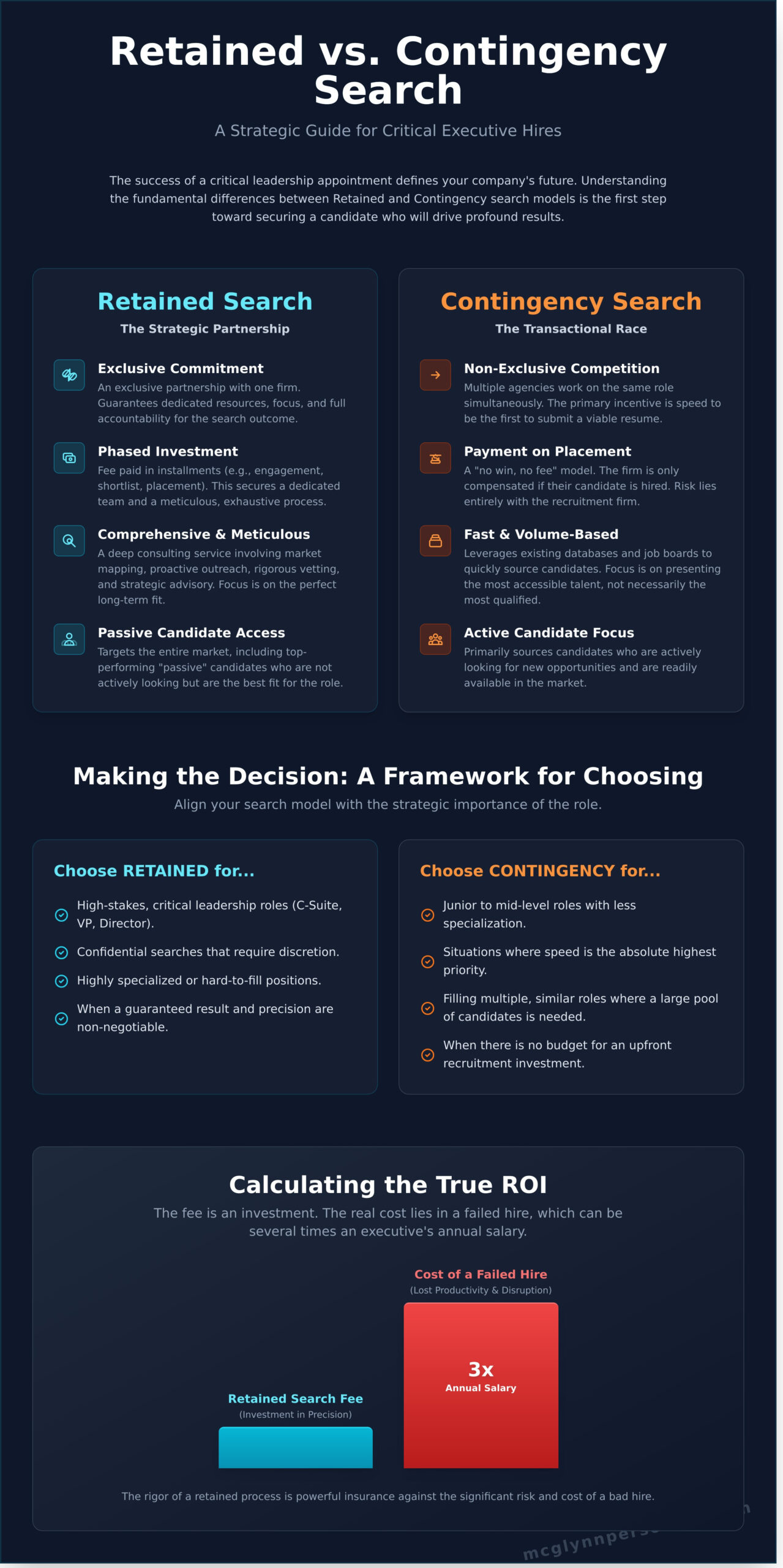
The contingency model operates on a “no win, no fee” basis. A recruitment firm is compensated only if their candidate is successfully hired. This success-based framework often creates a competitive environment where multiple agencies work on the same role simultaneously. The primary focus is speed, leveraging existing databases and job boards to source active candidates who are readily available in the market. This approach is typically suited for filling junior to mid-level roles where the required skill set is less specialized.
What is Retained Executive Search?
A retained search is an exclusive, partnership-based engagement. Your organization partners with a single firm, paying a fee in installments throughout a dedicated search process. This model is not a race to find a resume; it is a comprehensive consulting service designed for critical, senior-level, or highly specialized appointments. The process involves in-depth market mapping, proactive outreach to passive candidates (top performers not actively looking), and rigorous vetting to ensure a precise match for both skill and cultural fit. This method provides accountability and a profound level of commitment.
The Financial Commitment: Analyzing Fee Structures and ROI
When evaluating retained search vs contingency for executive roles, the most immediate difference lies in the financial model. However, this distinction goes far beyond simple cost; it fundamentally dictates the search firm’s level of commitment, the allocation of risk, and the ultimate return on your investment. Understanding this dynamic is crucial for selecting a partner who can deliver not just a candidate, but the right long-term leader for your organization.
The Contingency Fee Model: Payment on Placement
The contingency model operates on a “no placement, no fee” basis, with payment collected only after a candidate is successfully hired. The fee is typically a percentage of the executive’s first-year salary. While the absence of an upfront cost can seem attractive, it incentivizes a focus on speed and volume. A contingency firm’s business model requires them to work on multiple searches simultaneously, often presenting the most accessible candidates rather than the most qualified. The risk lies entirely with the search firm, compelling them to prioritize transactional efficiency over deep, dedicated partnership.
The Retained Fee Model: A Phased Investment
A retained search is a true partnership, secured by a fee paid in installments-typically in three tranches: upon engagement, upon presentation of a candidate shortlist, and upon successful placement. This structure secures a dedicated team, guaranteeing their focused time and resources for an exhaustive search. The fee is an investment in a meticulously structured process that includes in-depth market mapping, comprehensive candidate vetting, and strategic consultation. It establishes mutual accountability and ensures a commitment to precision from start to finish.
Calculating the True ROI of Your Search
The true cost of recruitment extends far beyond the search firm’s fee. Research consistently shows that the cost of a failed executive hire-factoring in lost productivity, team disruption, and replacement expenses-can be several times their annual salary. A comprehensive approach to analyzing fee structures and ROI reveals that the retained fee acts as powerful insurance against this significant risk. The rigor of a retained process is engineered to produce a superior long-term match, delivering a leader who drives growth and stability. This is where profound results are truly generated.
Need to fill a critical role? Learn about our executive search process.
Process & Partnership: A Tale of Two Methodologies
Understanding the operational differences between search models is critical when evaluating retained search vs contingency for executive roles. The choice is not merely about payment structure; it reflects a fundamental divergence in methodology, commitment, and partnership. One is a high-volume, transactional race, while the other is a dedicated, consultative engagement. As detailed in industry analyses like Merraine Group’s guide on Retained Search vs. Contingent: What’s the Difference?, the processes are designed to achieve entirely different outcomes.
The Contingency Process: A Race for Resumes
The contingency model operates on speed and volume. Since recruiters are in direct competition with other firms-and often your internal team-the primary objective is to be the first to submit a viable resume. This incentivizes a rapid, keyword-driven approach to matching CVs with job descriptions rather than a deep assessment of cultural alignment or long-term strategic fit. Consequently, the candidates presented are typically those who are actively on the market and widely available.
The Retained Process: A Strategic Partnership
A retained search is a comprehensive, exclusive partnership. It begins with a deep discovery phase to understand your organization’s strategic objectives, leadership dynamics, and culture. This allows the search partner to act as a true extension of your brand in the marketplace. The process is methodical and exhaustive, built on:
- In-depth Market Mapping: We identify and analyze the entire talent landscape for your role, not just the active job seekers.
- Proactive Headhunting: We target and engage high-performing, passive candidates who are not looking for a new role but are the right fit for the opportunity.
- Rigorous Vetting: Our process includes competency-based interviews, thorough referencing, and detailed candidate assessments to ensure a precision match.
Impact on Candidate Experience and Employer Brand
Your choice of search model directly impacts how your company is perceived by top-tier talent. In a contingency search, it is common for a desirable executive to be contacted by multiple recruiters for the same position, which can devalue the role and create a chaotic impression. Conversely, a retained search ensures a consistent, professional message delivered by a single, trusted partner. This exclusivity signals the strategic importance of the hire, enhances your employer brand, and commands the attention of the industry’s best leaders.
Making the Decision: A Framework for Choosing Your Search Model
Selecting the right search model is not a matter of preference; it is a strategic business decision. The optimal choice directly aligns with the role’s importance, complexity, and potential impact on your organization. While both contingency and retained agreements have their place, understanding the fundamental differences is crucial for efficient and successful talent acquisition. The debate over retained search vs contingency for executive roles resolves when you precisely define the stakes of the hire.
This framework provides the structure needed to make a confident, results-oriented decision that protects your investment and secures best-in-class leadership.
When to Use Contingency Search
A contingency model is a practical tool for specific hiring scenarios. It is most effective when speed is the primary driver and the talent pool is broad. This approach is best suited for junior to mid-level positions where multiple agencies can compete to fill the role quickly, and your internal HR team has the capacity to manage various points of contact and a high volume of resumes.
When Retained Search is the Only Option
For critical leadership appointments, a retained search provides the necessary precision, accountability, and depth. This model is non-negotiable for C-suite, VP, and other senior executive positions where a failed hire would create significant disruption. It is essential for confidential searches, highly specialized roles in niche markets, or any situation that demands exhaustive market mapping and a dedicated partnership to secure a candidate who will deliver profound results.
Part of securing and retaining such high-caliber talent involves providing them with the professional amenities that facilitate their success. This can include anything from relocation support to executive transportation for business travel and client meetings. To see an example of a service that caters to this need, you can discover MSP Car Service and their corporate transportation solutions.
This level of dedication isn’t limited to corporate roles; specialized agencies like Superstar Nannies apply similar retained principles to the high-stakes world of placing elite childcare and private household staff, where trust and precision are paramount.
Retained vs. Contingency: At-a-Glance Comparison
| Feature | Retained Search | Contingency Search |
|---|---|---|
| Fee Structure |
|
|
| Exclusivity |
|
|
| Candidate Pool |
|
|
| Process Depth |
|
|
| Best For |
|
|
Ultimately, the decision in the retained search vs contingency for executive roles analysis depends on your strategic priorities. For hires that will shape the future of your company, a dedicated, structured, and accountable partnership is the only path to securing transformational talent. To discuss a retained search for your next leadership role, contact our team of specialists.
Why McGlynn Personnel Utilizes a Retained Model for Executive Search
At McGlynn Personnel, our commitment to “Precision Placements, Profound Results” is the foundation of our methodology. When clients evaluate retained search vs contingency for executive roles, they often find that a contingency model prioritizes speed over substance. We have deliberately chosen the retained search model because it aligns with our core values of accountability, diligence, and partnership. It provides the necessary structure to conduct an exhaustive, confidential, and highly targeted search, ensuring we deliver not just a candidate, but the right leader to drive your organization’s success.
A Commitment to Structure, Accountability, and Quality
The retained model establishes an exclusive partnership, making us fully accountable for the search outcome. This commitment allows us to invest significant, dedicated resources into a methodical process that goes far beyond surface-level candidate sourcing. Our focus is not on the volume of résumés submitted but on the caliber and long-term cultural fit of the leaders we present. We ensure every candidate is rigorously vetted for proven capability and alignment with your strategic objectives.
Deep Expertise in Manufacturing, Engineering, and Real Estate
Executive leadership in highly technical sectors like advanced manufacturing, engineering, and real estate demands more than general recruitment experience. These roles require a profound understanding of industry-specific challenges, compliance standards, and operational complexities. Our retained approach enables us to perform a deep dive into these niche talent pools, identifying and engaging passive candidates who possess the precise technical acumen and leadership qualities your organization requires. This level of specialized focus is a key differentiator that ensures a truly qualified placement.
Building Long-Term Strategic Talent Partnerships
We view every executive search as the beginning of a long-term strategic relationship. By operating as an extension of your leadership team, we gain an intimate understanding of your business goals, culture, and future talent needs. This collaborative approach transforms the recruitment process from a transactional service into a strategic partnership dedicated to building your organization’s leadership capital for years to come. Partner with us to find your next industry leader.
Partnering for Precision: Making the Final Decision
The choice between search models ultimately hinges on the strategic value of the role you need to fill. While contingency offers flexibility for less critical positions, a retained search provides the dedicated partnership, rigorous methodology, and market insight necessary for securing transformative leadership. When evaluating retained search vs contingency for executive roles, the decision becomes an investment in accountability, precision, and a guaranteed outcome.
At McGlynn Personnel, we exclusively utilize a retained model because our commitment is to building long-term partnerships. Our proven process is engineered for the unique demands of the Manufacturing, Engineering, and Real Estate sectors, where high-impact executive talent is the cornerstone of success. We provide the structure and accountability required to deliver profound results.
If your organization requires a meticulous, results-oriented approach to securing its next leader, we invite you to connect with our team. Contact McGlynn Personnel to discuss your executive search needs. Let us help you build the leadership team that will drive your company’s future success.
Frequently Asked Questions
What is a typical fee for a retained executive search?
A retained search fee is structured as a percentage of the candidate’s guaranteed first-year total cash compensation, typically ranging from 30% to 33%. This fee is paid in three installments: an initial retainer to commence the search, a second upon presentation of a candidate shortlist, and a final payment upon the successful hire. This structured model ensures a dedicated partnership and mutual commitment, guaranteeing a thorough process focused on precision and quality for your executive hire.
What happens if a retained search does not result in a hire?
In the rare event a retained search does not culminate in a placement, a reputable firm will offer a guarantee. This often involves restarting the search for the same position at no additional fee or providing a credit toward a future search. The initial retainer covers the comprehensive market research, mapping, and candidate engagement already performed. Our commitment is to deliver superior results, and we ensure accountability to foster a long-term partnership with our clients.
How long does a typical retained executive search process take?
A comprehensive retained executive search follows a methodical timeline, typically lasting from 12 to 16 weeks. This process is broken into distinct phases: initial discovery and role definition (2-3 weeks), in-depth market research and candidate sourcing (4-6 weeks), and rigorous interviewing to produce a qualified shortlist (3-4 weeks). The final selection, referencing, and offer negotiation stages usually take an additional 2-3 weeks. This structured approach ensures a diligent and precise matching process.
Can contingency search be effective for senior-level roles?
While contingency search can fill some senior-level positions, it is often less effective for critical executive or highly specialized leadership roles. The contingency model is better suited for roles where a large pool of active candidates already exists. For confidential, C-suite, or business-critical positions that require deep market mapping and attracting passive candidates, the dedicated resources inherent in a retained model consistently deliver more qualified and better-aligned leaders for long-term success.
Why shouldn’t I use multiple contingency firms instead of one retained firm for an executive search?
Engaging multiple contingency firms creates a race for speed, not a search for quality. This approach often results in duplicated efforts and damages your employer brand as top candidates are approached by several recruiters for the same role. When evaluating retained search vs contingency for executive roles, a single retained partner provides accountability and a unified, professional representation. This exclusive partnership ensures a meticulous, confidential process focused on finding the absolute best fit for your organization.
What does the ‘off-limits’ agreement in a retained search mean?
The ‘off-limits’ agreement is a cornerstone of the retained search partnership, demonstrating a commitment to our client’s long-term stability. It is a contractual promise that our firm will not recruit any employee from your organization for a predetermined period, typically one to two years, following a search. This policy protects your investment in talent and ensures our relationship is built on a foundation of trust, integrity, and mutual respect for your team.