
Aerospace Engineering Job Outlook 2025: A Strategic Career Guide
The aerospace industry is at a critical inflection point. While headlines announce a talent shortage, many engineers face hundreds of applicants for every role, creating uncertainty about job security and the relevance of their current skills. Navigating this complex landscape requires more than a degree; it demands strategic insight into the future of the field. This guide is designed to provide that clarity, offering a comprehensive and data-driven analysis of the aerospace engineering job outlook 2025. We are committed to connecting premier talent with profound opportunities, and this guide is the first step in that process.
Here, you will find a detailed breakdown of the sectors poised for significant growth, from sustainable aviation to commercial space exploration. We identify the specific technical proficiencies and soft skills that employers will prioritize, ensuring you can proactively address any skill gaps. By moving beyond speculation to provide actionable strategies, our goal is to empower you with the confidence and structure needed to secure your next career milestone. Your journey toward a successful and future-proof career in aerospace engineering begins with this strategic framework.
The State of the Industry: Growth, Demand, and Key Projections for 2025
As we analyze the aerospace engineering job outlook 2025, the data reveals a landscape of steady growth and highly specific demand. The field of aerospace engineering, which encompasses the design, development, and testing of aircraft and spacecraft, is not just expanding-it’s evolving. While foundational statistics point to a healthy industry, success for professionals hinges on understanding where the most dynamic opportunities lie. This requires moving beyond general projections to see the specific sectors driving innovation and creating new roles.
Analyzing the Numbers: What Projections Mean for You
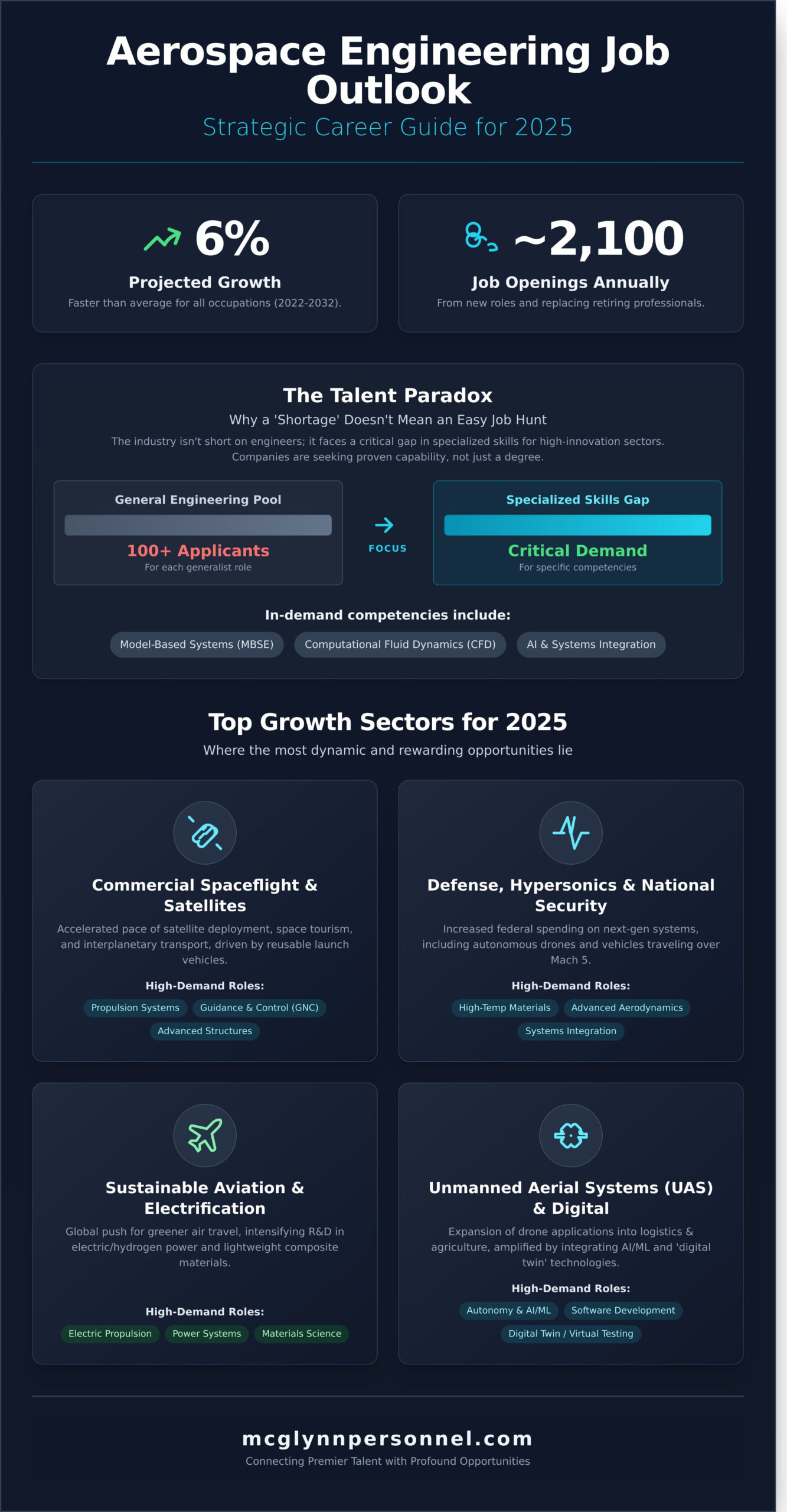
The U.S. Bureau of Labor Statistics (BLS) projects a 6% growth for aerospace engineers from 2022 to 2032, a rate faster than the average for all occupations. This translates to approximately 2,100 job openings each year, stemming from both new position creation and the need to replace retiring professionals. For candidates, this figure represents a consistent and dependable demand for qualified talent, ensuring a stable foundation for career planning and advancement.
Key Drivers of Demand in 2025
The overall growth is not uniform; it is concentrated in several high-momentum sectors that demand specialized expertise. Employers are actively recruiting for roles tied to these key initiatives:
- The Commercial Space Economy: Companies like SpaceX, Blue Origin, and a growing number of startups are accelerating the pace of satellite deployment, space tourism, and interplanetary transport, creating a high demand for systems, propulsion, and materials engineers.
- Defense Modernization: Increased federal spending on next-generation defense systems-including hypersonics, autonomous drones, and advanced fighter jets-fuels a constant need for engineers in R&D, testing, and systems integration.
- Sustainable Aviation: The global push for greener air travel has intensified research into electric and hydrogen-powered aircraft, lightweight composite materials, and more efficient engine designs, opening doors for specialists in these innovative fields.
The Talent Paradox: Why a ‘Shortage’ Doesn’t Mean an Easy Job Hunt
Many job seekers express frustration when seeing a posting with over 100 applicants, which seems to contradict reports of a talent shortage. This is the talent paradox. The industry isn’t facing a general shortage of engineers; it faces a critical gap in specialized skills. Companies are not just looking for a degree-they are searching for proven capability in areas like model-based systems engineering (MBSE), computational fluid dynamics (CFD), and AI integration. The aerospace engineering job outlook 2025 favors professionals who have cultivated these advanced, in-demand competencies.
Top Growth Sectors within Aerospace for 2025
Understanding broader industry trends is essential, but a successful career strategy requires a focused approach. While the general Aerospace Engineering Job Outlook from sources like the U.S. Bureau of Labor Statistics projects steady growth, the most significant opportunities are concentrated in specific, high-innovation sectors. The aerospace engineering job outlook 2025 is defined by rapid advancements in several key areas. For engineers and technical professionals, targeting these niches provides a clear roadmap to the most dynamic and rewarding roles. Below, we identify four sectors poised for significant expansion.
Commercial Spaceflight and Satellite Constellations
The commercialization of space continues to accelerate, driven by innovations in reusable launch vehicles and the deployment of massive satellite constellations like Starlink. This sector demands talent for roles in propulsion systems, guidance, navigation, and control (GNC), and advanced structural design. Both agile startups and established aerospace giants are competing fiercely for skilled engineers to support missions ranging from satellite internet to the first wave of space tourism.
Defense, Hypersonics, and National Security
A renewed focus on national security and technological superiority is fueling a surge in government contracts for advanced defense systems. The field of hypersonics-vehicles traveling at over five times the speed of sound-is a critical area of investment, creating robust demand for engineers specializing in high-temperature materials, advanced aerodynamics, and propulsion. Roles in the defense sector offer exceptional stability and the opportunity to work on mission-critical, cutting-edge projects.
Sustainable Aviation and Electrification
The global push to reduce carbon emissions is fundamentally reshaping aircraft design. The industry is heavily investing in sustainable aviation, creating opportunities for engineers focused on electric and hybrid-electric propulsion, hydrogen fuel technologies, and lightweight composite materials. Professionals with backgrounds in electrical engineering, power systems, and materials science are particularly well-positioned to lead this green transition in aviation.
Unmanned Aerial Systems (UAS) and Digital Systems
The application of Unmanned Aerial Systems (UAS), or drones, is expanding far beyond military use into logistics, agriculture, and infrastructure inspection. This growth is amplified by the integration of digital technologies. Companies are seeking engineers who can merge aerospace principles with software development, autonomy, and AI/machine learning. Expertise in systems integration and the use of “digital twins” for virtual design and testing is a highly valued and in-demand skill set.
The Most In-Demand Aerospace Engineering Skills for 2025
To capitalize on the promising aerospace engineering job outlook 2025, professionals must cultivate a skill set that extends beyond traditional academic knowledge. Employers are actively seeking candidates who possess a strategic blend of advanced technical capabilities and sophisticated professional competencies. Focusing on these high-demand areas ensures you are not just qualified, but positioned for leadership and innovation in a rapidly evolving industry.
Essential Technical Competencies: Beyond the Textbook
Mastery of modern engineering tools and methodologies is non-negotiable. These skills demonstrate an ability to enhance efficiency, precision, and design integrity from concept to completion.
- Model-Based Systems Engineering (MBSE): Proficiency in MBSE frameworks and tools like SysML is critical for managing the immense complexity of modern aerospace systems, from commercial aircraft to interplanetary missions.
- Advanced Simulation: Expertise in Computational Fluid Dynamics (CFD), Finite Element Analysis (FEA), and thermal analysis software (e.g., ANSYS, Abaqus) is essential for virtual prototyping, performance validation, and reducing development costs.
- Software & Programming: Strong command of Python, C++, and MATLAB is no longer optional. These languages are vital for automating complex calculations, analyzing test data, and developing custom control systems.
The Digital Engineering Revolution: AI and Data Analysis
The aerospace sector is undergoing a profound digital transformation. Rather than replacing engineers, technologies like Artificial Intelligence (AI) are becoming powerful co-pilots. AI algorithms are now integral to optimizing aerodynamic designs, performing predictive maintenance on aircraft fleets, and enhancing manufacturing processes. As detailed in Deloitte’s 2025 Aerospace and Defense Industry Outlook, the industry’s future is deeply tied to data-driven decision-making. A foundational understanding of data analysis and machine learning principles allows engineers to leverage these tools effectively, turning vast datasets into actionable intelligence.
Critical Professional Skills: What Sets Candidates Apart
Technical expertise alone is not enough. Top-tier candidates differentiate themselves with professional skills that enable them to lead, collaborate, and drive projects forward effectively.
- Systems Thinking: The ability to understand how individual components and subsystems interact within a complex, integrated system is paramount. This holistic perspective prevents costly errors and ensures project cohesion.
- Project Management: A working knowledge of project management principles, particularly agile methodologies, demonstrates you can deliver results on time and within budget in dynamic development environments.
- Effective Communication: The capacity to translate complex technical data for diverse stakeholders-including management, clients, and non-technical team members-is a high-value skill that facilitates alignment and successful project outcomes.
Positioning for Success: Your Job Search Strategy for 2025
Understanding market trends is the first step; translating that knowledge into a strategic job search is what secures profound results. The positive aerospace engineering job outlook 2025 presents significant opportunities, but competition for premier roles remains intense. A methodical and targeted approach is essential to position yourself as a best-in-class candidate and advance your career trajectory.
Crafting a Future-Proof CV and Project Portfolio
Your CV must be a precision instrument, engineered to meet the specific demands of today’s employers. Generic applications are inefficient. Instead, focus on demonstrating direct value and proven capability in the industry’s most dynamic sectors.
- Tailor for Impact: Customise your CV for each application, highlighting experience in high-growth areas like sustainable aviation, space exploration, or advanced defence systems.
- Integrate Keywords: Analyse job descriptions and strategically embed essential technical keywords, such as Model-Based Systems Engineering (MBSE), Python, additive manufacturing, or composite materials.
- Showcase, Don’t Just Tell: Develop a digital portfolio of projects that provides tangible proof of your skills. Include simulations, design work, or code repositories to demonstrate practical application of your expertise.
Networking and Building Your Professional Brand
Your professional network is a critical asset. Building a strong personal brand within the aerospace community increases your visibility and provides access to valuable industry insights and opportunities. Proactive engagement ensures you are on the radar of key decision-makers and recruiters.
- Join professional organisations like the American Institute of Aeronautics and Astronautics (AIAA) to connect with peers and industry leaders.
- Optimise your LinkedIn profile with a professional headshot, detailed project descriptions, and relevant skills to attract recruiter attention.
- Attend industry conferences, trade shows, and webinars to stay current on technological advancements and expand your professional connections.
Partnering with a Specialized Engineering Recruiter
To gain a decisive competitive advantage, consider partnering with a recruitment firm that specialises in the aerospace and engineering sectors. A specialist partner does more than find job listings; they provide structure and expert guidance throughout your career transition. They possess deep market knowledge and have access to a network of unadvertised positions, giving you entry to opportunities not available on public job boards.
A dedicated recruiter acts as your advocate, offering strategic advice on your CV, preparing you for complex technical interviews, and negotiating on your behalf. They are committed to understanding your long-term goals and connecting you with roles that offer genuine growth. Connect with our engineering recruitment specialists to advance your career.
Chart Your Course for 2025 and Beyond
As we’ve explored, the aerospace industry is poised for significant growth, driven by advancements in commercial spaceflight, defense systems, and sustainable aviation. Your success hinges on mastering in-demand skills in areas like digital engineering and composites, and adopting a strategic job search approach. This proactive stance is essential for capitalizing on the promising aerospace engineering job outlook 2025.
Navigating this dynamic landscape requires a partner with deep industry insight and a proven record. At McGlynn Personnel, we specialize in high-value engineering recruitment, leveraging our global reach to connect exceptional talent with leading opportunities. Our commitment to Precision Placements, Profound Results ensures we align your expertise with a role where you can make a significant impact.
Take the next decisive step in your career. Partner with McGlynn Personnel to find your next opportunity in aerospace engineering. Let us help you connect with the roles that will define the future of the industry. Your next career milestone begins here.
Frequently Asked Questions
Is an advanced degree (Master’s or PhD) necessary to succeed in aerospace engineering?
An advanced degree is not a universal requirement for a successful career, but it is a significant asset for specialized roles. A Bachelor of Science is the standard entry-level qualification for most design, manufacturing, and testing positions. However, for roles in advanced research, complex systems analysis, and academia, a Master’s or PhD is often essential. Pursuing a higher degree demonstrates a commitment to deep technical expertise and can accelerate advancement into leadership or senior specialist tracks.
How will Artificial Intelligence realistically impact the day-to-day job of an aerospace engineer?
Artificial Intelligence will function as a powerful tool to augment, not replace, the aerospace engineer. It will drive efficiency by automating repetitive design iterations, optimizing complex simulations, and analyzing vast datasets from testing and operations. This allows engineers to shift their focus from routine calculations to high-level strategic problem-solving, innovation, and system integration. Expect AI to enhance precision in areas like predictive maintenance and materials science, leading to more robust and reliable aerospace systems.
What is the typical salary range for an aerospace engineer in 2025?
The aerospace engineering job outlook 2025 indicates a competitive compensation landscape. Entry-level engineers can expect salaries ranging from $75,000 to $95,000 annually. Mid-career professionals with 5-10 years of experience typically earn between $110,000 and $150,000. Senior engineers, specialists, and managers in high-demand sectors like defense or space exploration can command salaries exceeding $170,000, with location and specific expertise being significant factors in determining the final compensation package.
Which countries or regions show the highest demand for aerospace engineers?
The demand for aerospace engineers is concentrated in established global hubs. In the United States, key regions include California, Washington, Texas, and Florida, driven by major defense contractors and commercial space companies. Within Europe, France and Germany remain dominant due to industry giants like Airbus and their extensive supply chains. The Asia-Pacific region, particularly China, is also experiencing rapid growth in both commercial aviation and national space programs, creating significant new opportunities for qualified talent.
How can I stand out when a single job posting receives hundreds of applications?
To stand out in a competitive field, candidates must demonstrate proven capability beyond academics. A tailored resume that precisely matches its keywords and requirements to the job description is critical. Emphasize hands-on experience from internships, co-ops, or complex student projects (e.g., SAE Aero Design, rocketry clubs). Specializing in a high-demand niche like hypersonics, autonomous systems, or composite materials provides a distinct advantage and showcases a commitment to a focused career trajectory.
Are security clearances a common requirement for aerospace jobs, and how do I get one?
Security clearances are a frequent requirement, particularly for roles within the defense, intelligence, and government sectors. An individual cannot apply for a clearance independently; the hiring company must sponsor the process after a contingent job offer is made. This involves an extensive background investigation conducted by the government that examines your personal history, finances, and character. To be eligible, you must typically be a U.S. citizen and maintain a record that demonstrates reliability and trustworthiness.