
Delayed project timelines, expanding budgets, and declining team morale are often symptoms of a single, identifiable issue. While these challenges are complex, they can frequently be traced back to a single root cause: a misaligned hire. The true cost of a bad hire in engineering extends far beyond the initial recruitment expenses and salary. It is a compounding liability that silently erodes your team’s productivity, compromises quality standards, and can even introduce significant safety risks.
This article provides a structured framework to quantify these hidden financial, productivity, and safety-related impacts. We will equip you with a clear understanding of the risks, help you build a compelling business case for investing in a more rigorous hiring process, and deliver actionable strategies to secure your team’s long-term success. By prioritising precision in talent acquisition, you can build the high-performing, cohesive engineering team your organisation depends on.
Key Takeaways
- Understand how a single poor engineering hire is a critical business risk that can jeopardize project timelines, compromise product quality, and impact your bottom line.
- Learn a clear, step-by-step formula to calculate the direct financial cost of a bad hire in engineering, accounting for recruitment, onboarding, and replacement expenses.
- Discover the significant, often overlooked, impacts on team productivity and morale when a subpar engineer disrupts workflow and drains the energy of your top performers.
- Identify the common failure points in engineering recruitment and implement a proactive strategy to mitigate risk and secure high-caliber talent for your team.
Why a Bad Hire in Engineering is a Critical Business Risk, Not Just an HR Problem
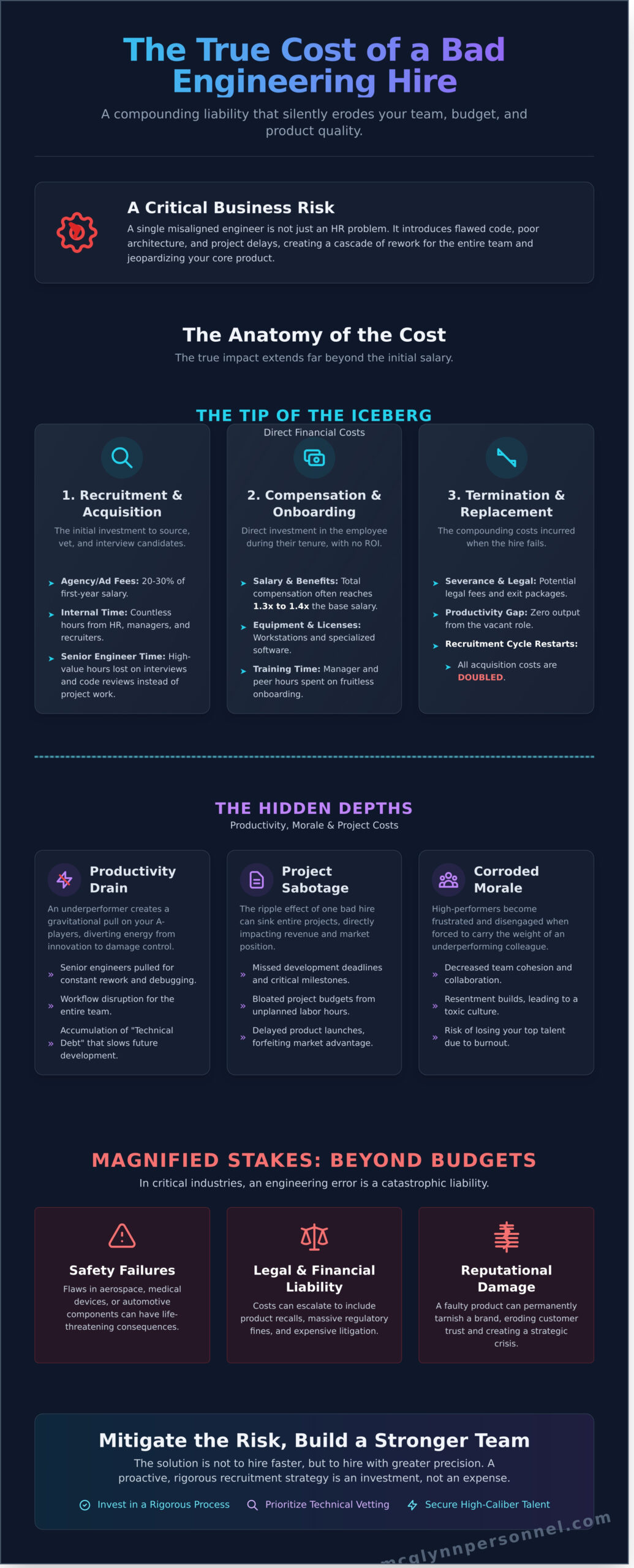
Engineering teams are the architects of innovation, building the very foundation of your products and services. While any poor hiring decision carries a cost, a misstep in this department transcends typical HR challenges and becomes a critical business risk. The consequences of such a decision often lead to high employee turnover and operational disruption, but the impact is far more profound in a technical environment. Unlike a flawed marketing campaign that can be corrected, a fundamental engineering error can compromise your core offering, jeopardizing revenue streams and market position. The true cost of a bad hire in engineering is a compounding liability that affects your entire organization.
This risk manifests in two primary ways: the immediate disruption to operational efficiency and the long-term exposure to significant liability.
The Ripple Effect on Project Lifecycles
A single underperforming engineer can introduce flawed code, poor design architecture, or inadequate documentation into a project. This does not merely affect their individual tasks; it creates a cascade of rework for the entire team. Senior engineers are pulled from high-value innovation to debug and correct foundational mistakes, accumulating “technical debt”-the implied cost of rework caused by choosing an easy but limited solution. This debt inevitably leads to:
- Missed development deadlines and critical milestones.
- Bloated project budgets due to unplanned labor hours.
- Delayed product launches, forfeiting first-mover advantage and revenue.
Magnified Stakes: Safety, Compliance, and Liability
In many sectors, the stakes are significantly higher. For industries like aerospace, medical devices, or automotive manufacturing, an engineering error can lead to catastrophic safety failures. A software flaw in an avionics system or a structural weakness in a load-bearing component carries immense liability. The financial consequences extend far beyond initial development costs to include product recalls, regulatory fines, and litigation. More importantly, the reputational damage from a faulty or unsafe product can erode customer trust and permanently tarnish a brand, creating a strategic crisis that is difficult to overcome.
Calculating the Direct Financial Costs of a Failed Engineering Hire
While the ripple effects of a poor hire are extensive, the direct financial impact provides a clear, quantifiable starting point. Understanding these tangible expenses is critical for any organization committed to precision and efficiency. The total cost of a bad hire in engineering can be calculated by systematically evaluating the investment made across three distinct phases: acquisition, employment, and termination.
This calculation reveals the immediate financial loss, but it is crucial to recognize this as the “tip of the iceberg.” The true cost extends far beyond these direct expenses into project delays and diminished team productivity.
Recruitment and Acquisition Costs
The initial investment to source and vet candidates is substantial. For specialized engineering roles, this includes not just standard expenses but also technical validation. Key costs include:
- Agency and Advertising Fees: Often 20-30% of the first-year salary.
- Internal Time Investment: Hours spent by HR, recruiters, and hiring managers.
- Technical Vetting: The cost of assessment platforms (e.g., Codility, HackerRank) and, most significantly, the billable hours lost when senior engineers and tech leads conduct interviews and code reviews instead of driving project progress.
Compensation and Onboarding Investment
Once a candidate is hired, the investment accelerates. This phase includes all compensation paid during their tenure, plus the resources required to integrate them. The costs cover salary, benefits (typically 1.3 to 1.4 times salary), payroll taxes, and essential equipment like high-performance workstations and specialized software licenses. Furthermore, significant time is invested by managers and peers in training the new hire on proprietary systems and complex codebases-an investment that yields no return if the employee fails.
Termination and Replacement Expenses
When a hire doesn’t work out, the organization incurs a third wave of costs. These include severance pay, potential legal consultation fees, and the administrative burden of offboarding. Critically, the entire recruitment cycle must be restarted, doubling the acquisition costs. The productivity gap during this extended vacancy creates further strain, and the damage deepens when you consider the hidden costs in software engineering, such as the accumulation of technical debt or increased team friction.
Sample Calculation: Mid-Level Engineer ($120,000 Salary, 6-Month Tenure)
- Recruitment Costs: $24,000 (20% agency fee) + $8,000 (internal time) = $32,000
- Compensation & Onboarding: $60,000 (6 mos. salary) + $18,000 (benefits/taxes) + $5,000 (equipment/training) = $83,000
- Termination/Replacement: $10,000 (1 mo. severance) + $32,000 (restarting recruitment) = $42,000
In this conservative scenario, the direct cost of a bad hire in engineering quickly exceeds $157,000-a significant financial blow that underscores the importance of getting recruitment right the first time.
The Hidden Costs: How a Bad Engineer Drains Productivity and Morale
While the direct financial impact of a poor recruitment decision is significant, it is often just the tip of the iceberg. The true cost of a bad hire in engineering multiplies through unseen, yet profoundly damaging, effects on your team’s daily operations, core culture, and forward momentum. These intangible costs erode the very foundation of efficiency and innovation you have worked to build.
Lost Productivity and Opportunity Cost
A substandard engineer does not operate in a vacuum; their lack of capability creates a ripple effect across the entire department. Senior engineers are frequently pulled from high-value, strategic work to correct errors, rewrite code, or provide excessive oversight. This diversion of resources creates a significant opportunity cost, as critical projects are delayed and innovative concepts are shelved in favour of remedial action and micromanagement.
Degraded Team Morale and Culture
Your top performers are driven by a commitment to excellence. When they are consistently forced to compensate for a colleague’s shortcomings, their engagement and motivation inevitably decline. This erosion of accountability can poison a positive team culture, leading to widespread frustration and, in the worst cases, the resignation of your most valuable engineers. The damage manifests in several ways:
- A breakdown of trust and collaborative spirit.
- Increased disengagement from A-players who feel their standards are not valued.
- A gradual decline in the team’s overall quality and output.
Stifled Innovation and Knowledge Drain
Progress in a technical environment depends on proactive problem-solving and shared intellectual curiosity. A disengaged or under-skilled hire often contributes little to new ideas, acting as a drag on the pace of innovation. When they eventually depart, any project-specific knowledge they managed to acquire is lost, forcing your team to reinvest time and resources, further compounding the long-term damage.
Mitigating these profound risks requires a recruitment process built on precision and proven capability. Learn how the structured approach at McGlynn Personnel ensures you connect with talent that strengthens, rather than weakens, your engineering department.
Mitigating Risk: The Proactive Approach to Engineering Recruitment
While understanding the financial and operational damage of a poor hire is crucial, the most effective strategy is not calculating the fallout but preventing it entirely. A proactive, structured approach to recruitment is the only dependable way to mitigate risk and ensure every new team member adds immediate and long-term value. The focus must shift from damage control to precision-led talent acquisition, effectively neutralizing the cost of a bad hire in engineering before it can materialize.
This strategic shift begins with recognizing and addressing the systemic weaknesses inherent in many traditional hiring models.
Common Pitfalls in Technical Hiring
Most hiring errors stem from a breakdown in process. When internal teams are under pressure to fill a role, they often fall into predictable traps that significantly increase the likelihood of a mis-hire. These critical failure points include:
- Rushing the process to fill a vacancy, leading to overlooked red flags and compromised standards.
- Over-relying on resumes and interviews instead of implementing robust, practical capability assessments that prove technical competency.
- Failing to accurately assess cultural and team fit, resulting in friction, poor integration, and decreased morale.
- Lacking a structured interview process with consistent evaluation criteria and disciplined feedback loops.
This need for structured, repeatable systems to mitigate risk is a common theme in high-stakes professional environments. For instance, in the legal sector, firms use platforms like Retainer Engine to systematize their client acquisition and intake, preventing the costly consequences of a poor initial fit.
Beyond these process failures, another common oversight is inadequate due diligence. Verifying credentials, employment history, and screening for potential red flags is a critical step that is often rushed or skipped entirely. For roles with significant responsibility, engaging a professional firm like the International Investigative Group can provide an essential layer of security, ensuring that a candidate’s background aligns with their claims.
The Value of a Specialized Recruitment Partner
A specialist partner introduces the structure, expertise, and accountability needed to navigate these common pitfalls. By engaging recruitment experts, you gain immediate access to a pre-vetted network of high-caliber talent, rigorous technical screening, and objective, third-party assessments of both hard skills and cultural alignment. This methodical approach transforms hiring from a high-stakes gamble into a calculated, strategic investment. Avoid costly hiring mistakes. Partner with our engineering specialists.
Ultimately, preventing the significant cost of a bad hire in engineering requires a commitment to a best-in-class acquisition process. Investing in a specialized partnership is not an added expense; it is a critical function of risk management. It ensures your engineering teams are built with precision, staffed by proven performers, and positioned for profound, sustainable results.
From Costly Risk to Strategic Asset: Secure Your Next Engineer
The consequences of a poor hiring decision extend far beyond the balance sheet. As we have explored, a mismatched engineer can disrupt team morale, stall critical projects, and erode your competitive edge. Understanding the full spectrum of these direct and hidden impacts is the first step in appreciating the true cost of a bad hire in engineering. The most effective strategy is not reactive, but proactive-a structured approach grounded in technical and cultural diligence.
At McGlynn Personnel, we transform this risk into a strategic advantage. As specialists in Engineering & Manufacturing Recruitment, our process is built on a foundation of precision. We deliver profound results through a comprehensive screening process that validates proven capability and ensures a seamless organisational fit. We don’t just fill a vacancy; we provide the accountability and structure necessary for long-term success.
Don’t leave your most critical roles to chance. Partner with an expert who understands the stakes.
Secure Your Next Engineering Hire with Precision. Contact Us.
Frequently Asked Questions
How do you define a ‘bad hire’ in a technical or engineering role?
A bad hire in an engineering context is an individual who fails to meet the core performance, technical, and behavioral expectations of their role. This extends beyond a simple lack of coding ability. It includes consistently delivering substandard work that creates technical debt, failing to integrate with team workflows and communication protocols, and negatively impacting project timelines and team morale. Ultimately, they represent a net drain on organizational resources and productivity.
What is the most common reason a new engineering hire fails within the first year?
The most common reason for failure is not a lack of technical skill, but a fundamental misalignment with the company’s culture and work processes. A new engineer may possess the required expertise but struggle to adapt to specific development methodologies, communication styles, or collaborative standards. This disconnect often stems from an interview process that over-indexed on technical prowess while failing to properly assess behavioral compatibility and adaptability to the established engineering environment.
How can we improve our technical interview process to better vet candidates?
To improve vetting, we recommend shifting focus from theoretical questions to practical, role-specific assessments. Implement structured coding challenges that simulate real-world problems your team faces. Utilize a consistent evaluation rubric to score all candidates objectively. Furthermore, involve multiple stakeholders, including potential peers and a senior architect, in a multi-stage process to gain a holistic view of the candidate’s technical skills, problem-solving approach, and collaborative potential.
Is it better to hire slowly or risk a vacant position for a long time?
While a vacant position presents operational challenges, a methodical and deliberate hiring process is the superior long-term strategy. The direct and indirect costs associated with onboarding, managing, and eventually replacing a bad hire far exceed the temporary productivity loss of an open role. Prioritizing a precision match protects team integrity, maintains project quality, and ensures the new hire becomes a long-term asset rather than a liability requiring costly correction.
How much more does a bad senior engineering hire cost compared to a junior one?
The cost of a bad hire in engineering escalates dramatically with seniority. A poor senior-level hire carries a far greater financial and operational impact due to their higher salary, influence on critical architectural decisions, and mentorship role. Their mistakes can introduce systemic flaws, derail major projects, and erode the morale of an entire team. The resulting damage can easily be three to five times more costly than the impact of an underperforming junior engineer.
What are the key signs that a new hire might not be working out?
Early warning signs include a consistent inability to complete tasks independently that fall within their stated skill set and a failure to meet initial, clearly defined performance benchmarks. Other indicators are a lack of proactive communication, disengagement from team collaboration, and a resistance to constructive feedback or established coding standards. These behaviors often point to a core misalignment that, if left unaddressed, will negatively impact project outcomes and team dynamics.