
The job interview presents a critical dilemma for every candidate: how much truth is too much? You feel the pressure to present a flawless professional record, yet you know authenticity is valued. This conflict leads many job seekers to anxiously ask, do employers like honesty in a job interview, especially when that honesty involves admitting to a weakness or a past mistake? The fear of being immediately disqualified for a moment of candor is a significant concern, creating uncertainty around how to best represent your capabilities and experience.
The answer is more nuanced than a simple ‘yes’ or ‘no’-it requires a strategic approach to transparency. In this recruiter’s guide, we move beyond the anxiety to provide a clear framework for navigating these challenging conversations. You will discover how to frame your experiences honestly to build genuine trust, demonstrate powerful integrity, and secure a role that is an ideal cultural and technical fit. We will equip you with the confidence to answer tough questions authentically, ensuring you begin your next career milestone on a foundation of mutual respect and clear expectations.
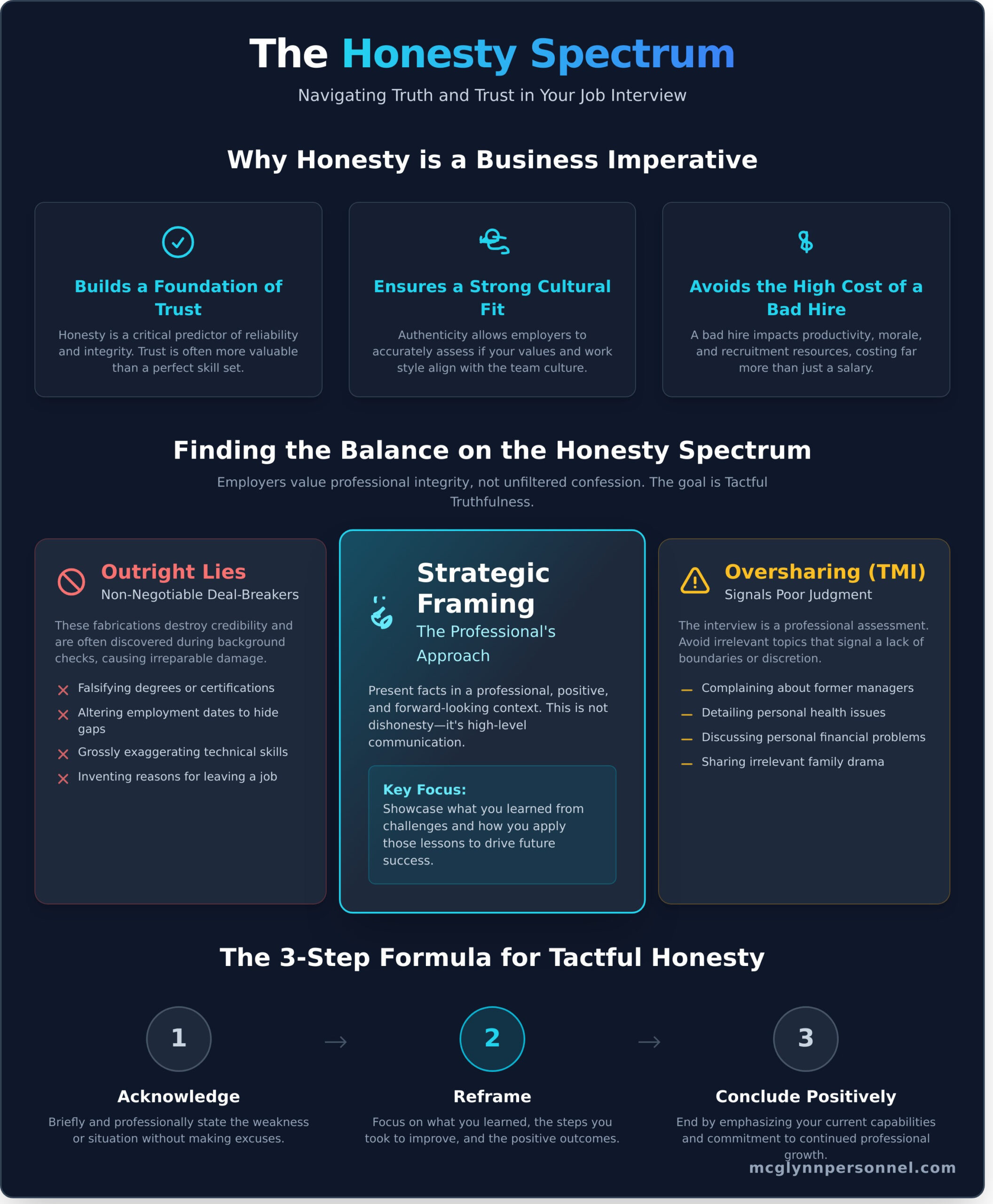
The Employer’s Perspective: Why Honesty is a Business Imperative
When evaluating a candidate, an employer’s decision goes far beyond a simple moral judgment. Hiring is a significant investment of time, capital, and resources. From this business-centric viewpoint, a candidate’s honesty is not just a virtue; it is a critical predictor of future performance, reliability, and risk. So, do employers like honesty in a job interview? From a strategic standpoint, they depend on it to protect their investment and build a resilient, high-performing team.
Building a Foundation of Trust
The job interview is the first official step in a long-term professional relationship. Any dishonesty, from a minor exaggeration about software proficiency to a significant fabrication of experience, erodes the foundation of that relationship before it even begins. While standard interview practices are designed to assess skills, they are fundamentally a test of character. Employers need to trust their team members with sensitive data, client relationships, and operational responsibilities. A candidate who demonstrates integrity is often more valuable than one with a perfect skill set but questionable trustworthiness.
Ensuring a Strong Cultural Fit
Modern recruitment processes prioritize cultural fit alongside technical capability. Companies invest heavily in cultivating a specific work environment, and they hire individuals whose values and work styles align with that culture. Being authentic about your professional preferences, communication style, and career ambitions allows the interviewer to make an accurate assessment of your fit. A mismatch discovered after hiring often leads to disengagement, low morale, and decreased productivity for both the individual and their team.
The High Cost of a Bad Hire
Hiring an employee based on false or misleading information is one of the most costly mistakes a business can make. The financial impact extends far beyond the employee’s salary and includes:
- Recruitment and agency fees
- Costs of training and onboarding
- Lost productivity during the transition period
- Negative impact on team morale and engagement
High turnover resulting from a bad hire disrupts operational continuity and requires the entire costly process to begin again. For this reason, an employer would much rather learn about a manageable weakness upfront than discover a fundamental lack of integrity after an offer has been made.
The Honesty Spectrum: Finding the Balance Between Candor and TMI
When candidates ask, do employers like honesty in a job interview, the answer is a qualified yes. Employers value professional integrity, not unfiltered confession. Honesty is not about disclosing every personal detail or past professional misstep. Instead, the goal is to practice tactful truthfulness-a strategic approach that involves presenting the most accurate, relevant, and effective version of your professional self. Navigating this spectrum correctly demonstrates high-level communication skills and professional judgment.
Understanding the difference between deception, professional framing, and oversharing is critical to building trust and credibility with a potential employer. Your objective is to communicate your value with precision and confidence.
Outright Lies (The Non-Negotiable No’s)
Certain falsehoods are indefensible and will immediately disqualify a candidate. These fabrications are often discovered during routine background and reference checks, causing irreparable damage to your professional reputation. Avoid these at all costs:
- Falsifying degrees, certifications, or professional licenses.
- Altering employment dates to hide gaps or short tenures.
- Grossly exaggerating technical skills or proficiency with essential software.
- Inventing a misleading reason for leaving a previous position.
Strategic Framing (The Professional’s Approach)
This is the cornerstone of effective interview communication. Strategic framing is not about dishonesty; it is about presenting facts in a professional, positive, and forward-looking context. This approach showcases your ability to learn from challenges and focus on solutions. For example, instead of dwelling on a project’s failure, focus on the valuable lessons learned that you now apply to your work. As recruiting experts note regarding The Importance of Honesty in Job Interviews, this level of candor helps ensure a role aligns with your actual skills, leading to better long-term success. Answer the question asked, but do not volunteer unsolicited negative information.
Oversharing (TMI – Too Much Information)
While outright lies destroy credibility, oversharing can signal a lack of professional boundaries and poor judgment. The interview is a professional assessment, not a personal therapy session. Keep your answers concise and centered on the job requirements. Avoid discussing sensitive or irrelevant topics such as complaining about former managers or colleagues, or detailing personal health, financial, or family issues. Oversharing can make interviewers uncomfortable and question your ability to maintain confidentiality and professionalism in the workplace.
How to Answer Tough Interview Questions with Tactful Honesty
When candidates ask, do employers like honesty in a job interview?, the answer is yes-when it is framed with self-awareness and a focus on growth. Interviewers are not seeking flawless candidates; they are assessing your accountability, problem-solving skills, and professional maturity. Navigating these questions requires a specific approach, and understanding how to be honest in an interview without raising red flags is a critical skill. We recommend a simple, effective formula for your answers: Acknowledge, Reframe, and Conclude Positively.
What is your biggest weakness?
Avoid clichés like “I’m a perfectionist.” Instead, choose a real, manageable weakness that you are actively improving. This demonstrates self-awareness and a commitment to professional development.
- Bad Answer: “I work too hard and sometimes I just care too much about the results.”
- Good Answer: “In the past, I found that I wasn’t as confident with public speaking as I wanted to be. Recognizing this was a key area for growth, I enrolled in a local workshop six months ago and have since taken the lead on presenting our team’s weekly progress reports, which has significantly improved my skills and confidence.”
Why did you leave your last job? (Or ‘Why were you let go?’)
Your response must always be professional and forward-looking. Never speak negatively about a former employer, manager, or colleague. Frame your departure as a structured decision based on your career goals or a business reality.
- Bad Answer: “My manager was impossible to work with and the company had no direction.”
- Good Answer (If Fired): “Unfortunately, my role was eliminated due to a departmental restructuring. While unexpected, it has given me the opportunity to focus my job search on roles like this one, which aligns even better with my long-term goals in quality assurance.”
Tell me about a time you failed.
The goal here is to demonstrate resilience and the ability to learn from mistakes. Use the STAR method (Situation, Task, Action, Result) to structure your answer, focusing more on the positive outcome and what you learned than on the failure itself.
- Bad Answer: “I can’t think of any major failures. I’m very careful in my work.”
- Good Answer: “In a previous project, I misjudged the timeline for a critical deliverable. Once I realized my error, I immediately communicated the issue to my manager, re-prioritized my tasks, and worked with a colleague to get the project back on track. We only had a minor delay, and I learned the importance of building a buffer into project planning, a practice I’ve used ever since.”
Honesty Beyond Words: Authenticity in Your Demeanor
While truthful answers are fundamental, true credibility is established through both verbal and non-verbal communication. Experienced hiring managers are adept at spotting inconsistencies between your words, your body language, and the information presented in your professional profiles. They understand that they are hiring a person, not just a list of qualifications. An authentic demeanor creates a genuine connection that a rehearsed, canned answer simply cannot replicate.
The Power of Genuine Enthusiasm
Authentic interest in a company or role is impossible to fake. When you are genuinely passionate about your field and have thoroughly researched the opportunity, it shows. This enthusiasm is a powerful indicator to employers that you are self-motivated, will be an engaged team member, and are invested in contributing to their success. Demonstrate this by:
- Asking insightful questions about the company’s challenges, projects, or team dynamics.
- Connecting your passion for your industry-whether it’s advanced manufacturing or civil engineering-to the specific responsibilities of the role.
- Allowing your natural energy and interest to come through when discussing your past achievements.
Consistent Messaging Across Platforms
Your professional narrative must be consistent across all touchpoints. An interviewer will almost certainly have your CV and LinkedIn profile in front of them, and any discrepancies are immediate red flags. Mismatched employment dates, conflicting job titles, or an inability to speak confidently about a listed skill will instantly undermine your credibility. Be prepared to elaborate on every point in your resume with precision and confidence. A meticulously prepared CV is the foundation of this consistency. Let us help you craft a clear, effective CV. Learn about our services.
Reading the Room and Being Yourself
Authenticity does not mean a lack of professionalism. It means adapting your genuine personality to the context of the interview. Pay close attention to the interviewer’s communication style and the overall energy of the company culture. The interview is a two-way assessment; you are also determining if the environment is the right fit for you. Ultimately, the question of do employers like honesty in a job interview is best answered here: the right employer will value your genuine character and see it as an asset. A successful placement is built on mutual respect and authentic alignment.
The Final Verdict: Honesty as a Strategic Career Asset
Navigating the interview process requires a strategic approach to honesty. As we’ve explored, employers value integrity not just as a virtue, but as a critical component of a reliable and effective team. The key is to strike a professional balance-presenting your authentic self and answering difficult questions with tactful candor, without veering into unprofessional oversharing. So, to answer the central question, do employers like honesty in a job interview? The answer is a definitive yes-when it is framed by professionalism, self-awareness, and a clear focus on your value to the company.
Finding an organization where this level of integrity is not just welcomed but expected is the next crucial step. At McGlynn Personnel, we are specialists in Manufacturing & Engineering recruitment, dedicated to connecting top talent with leading companies built on a foundation of trust. We provide expert career support and guidance to help you find a role where your contributions and character are truly valued. Your next career milestone begins with a partner committed to precision and profound results. Ready to find a company that values your skills and integrity? View our open positions.
Frequently Asked Questions
Is it ever okay to lie in a job interview?
No. Lying in a job interview is never an acceptable strategy. Integrity is a foundational trait that employers value above almost all others. A fabrication, no matter how small, can permanently damage your professional credibility and lead to a rescinded offer or termination if discovered later. Employers build teams based on trust and accountability; dishonesty fundamentally undermines this process and signals a significant risk to the organization, making it a critical misstep in any professional context.
How do I explain a long gap in my employment history honestly?
Address employment gaps directly and professionally. Provide a concise, truthful reason for the time away, such as continuing education, family responsibilities, or personal projects. The key is to pivot quickly to the skills and experiences you gained during that period. Frame the gap as a productive time that has better prepared you for your next career milestone. This demonstrates resilience, a proactive mindset, and an ability to create value under any circumstance.
What should I do if I don’t know the answer to a technical question?
Admit that you do not have the specific answer, but do not stop there. Demonstrate your problem-solving capabilities by articulating the precise process you would follow to find the solution. You can reference similar challenges you have successfully navigated. This approach showcases intellectual honesty, analytical skill, and a commitment to quality and process-highly valued traits in technical and engineering environments. It proves your competence is in your methodology, not just your memory.
Should I be honest about my salary expectations, even if they’re high?
Yes, honesty combined with market awareness is the most effective approach. Research the industry standard for the role, location, and your experience level. Present your expectation as a well-researched figure based on the value you deliver. When considering do employers like honesty in a job interview, salary is a key area where transparency builds a foundation for a strong, long-term partnership and ensures that expectations are aligned from the start for all stakeholders.
Can I be ‘too honest’ and share something that will hurt my chances?
Honesty must be filtered through professional judgment. Focus on transparency regarding your qualifications, skills, and work history. Avoid sharing overly personal information or negative opinions about past employers, as this can be perceived as unprofessional. The objective is to provide relevant information that demonstrates your suitability for the role. Strategic honesty builds trust, while indiscriminate oversharing can detract from your core message of competence and professionalism, which should always remain the focus.
How do I admit I was fired without it being an automatic disqualification?
Address the termination with a structured, accountable narrative. State the facts briefly and without emotional language. Take ownership for your role in the situation and immediately pivot to what you learned from the experience. Detail the concrete steps you have taken to improve your skills or professional conduct since. Candidates often wonder do employers like honesty in a job interview regarding termination, and the answer is yes-when it demonstrates self-awareness, growth, and a commitment to future performance.