
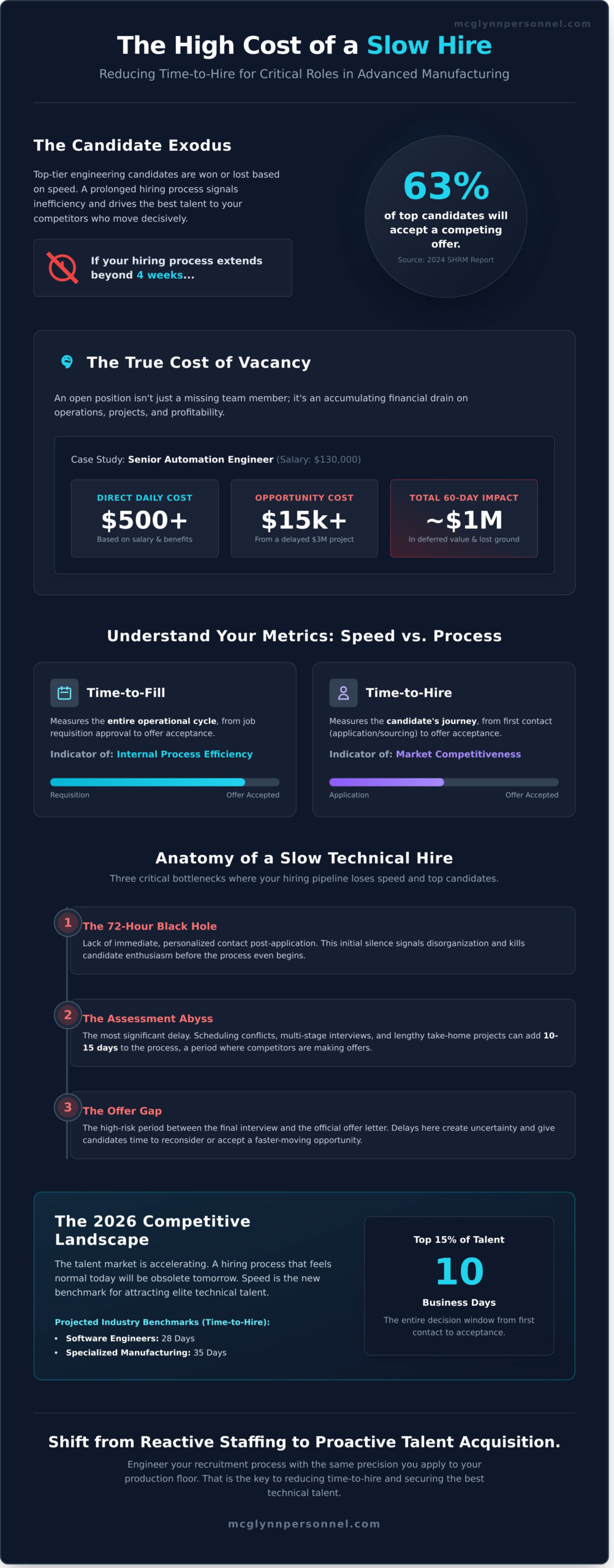
According to a 2024 SHRM report, 63% of top-tier engineering candidates will accept a competing offer if a hiring process extends beyond four weeks. For production-critical roles, that’s not just a lost candidate; it’s a direct impact on operational efficiency and your bottom line. It’s a familiar and costly cycle for hiring managers in advanced manufacturing. You invest significant resources to identify the perfect candidate, only to see them withdraw mid-process due to internal bottlenecks and a slow, cumbersome vetting stage.
This article delivers a precision strategy to break that cycle. You will gain a clear, actionable framework for how to reduce time to hire for technical roles, ensuring your offer is the first one your ideal candidate receives and accepts. We will detail proven methods for optimizing stakeholder alignment, implementing lean interview structures, and leveraging data to shrink your average hiring timeline from 60 days to under 30.
Key Takeaways
- Understand the true financial and operational impact of a prolonged vacancy by quantifying the ‘Cost of Vacancy’ for critical engineering and manufacturing positions.
- Differentiate between Time-to-Hire and Time-to-Fill to gain a more accurate view of your recruitment pipeline’s efficiency against 2026 industry benchmarks.
- Discover why a faster, more decisive hiring process is the key to attracting top-tier talent and learn how to reduce time to hire for technical roles without compromising on quality.
- Implement specific tactical shifts, from creating precision job profiles to consolidating interviews, that immediately streamline your technical assessment process.
The Real Cost of Slow Hiring in Technical Sectors
In advanced manufacturing and engineering, an open position isn’t just a line on an HR report; it’s a direct and accumulating drain on your bottom line. While many organizations track standard recruiting metrics like ‘Time-to-Fill’, few calculate the direct financial impact of a prolonged vacancy. This oversight can be catastrophic. Understanding these escalating costs is the critical first step for any leader focused on how to reduce time to hire for technical roles. It transforms talent acquisition from a support function into a core operational strategy.
The ‘Cost of Vacancy’ is a tangible figure. For a specialized role like a Senior Automation Engineer with a $130,000 salary, the direct cost is over $500 per day. When that engineer is pivotal to a $3 million production line upgrade, the opportunity cost from project delays can exceed $15,000 daily. A 60-day hiring cycle, therefore, doesn’t just represent two months of searching; it represents nearly $1 million in deferred value and lost competitive ground. This isn’t theoretical. It’s a direct threat to profitability and project governance.
Production Downtime and Project Delays
The ripple effect of a single vacancy can paralyze an entire value stream. Consider a missing CNC programmer in a lean manufacturing environment. Their absence doesn’t just delay one task; it halts the entire production line, jeopardizing delivery schedules and eroding stakeholder confidence. We’ve seen cases where a 45-day delay in hiring a single Metrology specialist postponed a product launch by an entire quarter, incurring six-figure penalties. Rapid response isn’t a luxury; it’s a requirement for maintaining operational integrity and accountability.
The Competitive Landscape in 2026
The talent market is accelerating. By 2026, industry analysis projects that the top 15% of technical professionals will receive and accept offers in under 10 business days. Your 30-day review period is their entire decision window. During these ‘wait periods,’ AI-driven competitors are actively poaching your top candidates with streamlined, decisive processes. A slow process sends a clear signal to high-caliber talent: the company is inefficient, bureaucratic, or indecisive. This perception permanently damages your employer brand. In this environment, ‘Precision Velocity’-the ability to identify, engage, and secure elite talent with both speed and accuracy-is the new benchmark for industry leaders.
Ultimately, the challenge of how to reduce time to hire for technical roles is not about rushing decisions. It’s about engineering a recruitment process with the same precision you apply to your production floor. The shift must be from reactive staffing, where a role is filled after it becomes a problem, to proactive talent acquisition, where a pipeline of qualified, vetted candidates is continuously cultivated. This strategic mindset is the only sustainable defense against the compounding costs of a slow hire.
Defining Time-to-Hire vs. Time-to-Fill for Technical Roles
In the competitive arenas of engineering and manufacturing, speed is a strategic advantage. Yet, many organizations use hiring metrics interchangeably, obscuring critical inefficiencies. To truly accelerate your recruitment, it’s essential to distinguish between two core measurements: Time-to-Fill and Time-to-Hire.
- Time-to-Fill measures the entire operational cycle, from the moment a job requisition is approved to when a candidate accepts the offer. This metric reflects internal process efficiency, stakeholder alignment, and overall resource planning.
- Time-to-Hire measures the candidate’s journey, beginning when a qualified individual applies or is sourced and ending when they accept the offer. This metric is a direct indicator of the candidate experience and your competitiveness in the talent market.
For technical roles, a long Time-to-Fill may indicate bureaucratic delays, but a long Time-to-Hire is a direct threat. The best engineers and manufacturing specialists are often off the market in 10 business days. By 2026, industry benchmarks project an average Time-to-Hire of just 28 days for software engineers and 35 days for specialized manufacturing roles. Waiting longer means you are not just slow; you are actively losing top-tier talent to faster competitors.
The Anatomy of a Technical Hiring Pipeline
Most technical hiring pipelines bleed efficiency at three predictable stages. The first ‘black hole’ is the 72-hour window post-application; a lack of immediate, personalized contact signals disorganization. The second, and most significant, delay occurs during the technical assessment, where scheduling conflicts and lengthy take-home projects can add 10-15 days to the process. Finally, the gap between the final interview and the official offer represents a high-risk period where a candidate’s enthusiasm can wane or a competing offer can land. Closing these gaps is fundamental to learning how to reduce time to hire for technical roles effectively.
Benchmarking Your Current Process
You cannot optimize what you don’t measure. A rigorous audit of your recruitment lifecycle provides the objective data needed to identify your specific bottlenecks. Begin by mapping every stage, from requisition approval to onboarding, and calculate the average time spent in each for your last 10 technical hires. This analysis almost always reveals that over 60% of delays are internal, with slow hiring manager feedback being a primary cause.
This lag between interview and feedback is more than just a delay; it’s a critical breakdown that damages your employer brand and undermines a streamlined hiring process. Top candidates interpret this silence as a lack of interest and quickly move on. Setting a strict KPI, such as requiring stakeholder feedback within 48 hours, is a non-negotiable step. If your internal audit reveals persistent bottlenecks that are difficult to resolve, partnering with a specialist recruitment firm can introduce the external accountability needed to enforce process discipline. This commitment to speed and quality is best defined as Precision Velocity.
Precision Velocity is the strategic optimization of every candidate touchpoint, from initial contact to final offer, to ensure no high-value talent is lost to process friction or delay.
The Speed vs. Quality Paradox: Why Faster Hiring Leads to Better Talent
A persistent myth in talent acquisition suggests that a protracted hiring process is a necessary crucible for ensuring quality. This assumption is not only outdated; it’s actively detrimental in the competitive tech landscape. The top 10% of technical candidates are off the market in just 10 days, according to a 2022 Glassdoor report. A slow process doesn’t vet them. It loses them to competitors who operate with precision and urgency.
High-caliber candidates interpret your hiring process as a direct reflection of your company’s operational efficiency. A disorganized, multi-month interview cycle signals bureaucracy and indecision. Conversely, a swift, structured, and decisive process demonstrates a dynamic organization that values talent and respects their time. A 2023 IBM study found that a positive candidate experience makes applicants 38% more likely to accept a job offer. Speed, when combined with professionalism, becomes your most compelling recruitment tool.
This efficiency extends beyond the offer letter. A streamlined hiring process directly correlates with ‘First-Day Readiness.’ When onboarding logistics are integrated into the final hiring stages, new team members arrive prepared to contribute, not to chase paperwork. This seamless transition is critical, as research from the Brandon Hall Group shows that a strong onboarding process can improve employee retention by 82%.
Reactive vs. Proactive Recruitment Models
The traditional ‘Post-and-Pray’ model, where a role is posted only when a need arises, is inherently slow and unpredictable. In contrast, a proactive ‘Talent Pipelining’ strategy involves continuously identifying, vetting, and engaging with high-potential candidates. This approach, often managed by an Executive Search partner, builds a ready reserve of talent, ensuring that when a need arises, you are already 75% of the way to a hire. Precision matching becomes the standard, dramatically reducing the need for excessive interview rounds.
Ensuring Compliance and Governance at Speed
The core question for many leaders is how to reduce time to hire for technical roles without sacrificing due diligence. The solution lies in process integration, not corner-cutting. By using modern HR technology, background checks and certification verifications can be initiated automatically upon a contingent offer. This transforms a week-long administrative delay into a 24-hour parallel process. Maintaining ‘Best-in-Class’ standards is about building efficient, repeatable systems that automate administrative hurdles while preserving the essential human touch in final negotiations and candidate care.
5 Tactical Strategies to Reduce Time-to-Hire for Technical Roles
An extended hiring cycle in the technical sector doesn’t just delay projects; it bleeds resources and risks losing top-tier candidates to more agile competitors. The average time to fill a tech role now stands at 66 days, a costly delay in a fast-moving market. The solution is not to cut corners, but to implement a more structured, strategic process. Below are five proven tactics designed to bring efficiency and precision to your recruitment cycle, transforming it from a reactive necessity into a competitive advantage.
Precision Job Profiling
The foundation of an efficient hiring process is an impeccably defined job profile. Vague descriptions attract a high volume of unqualified applicants, creating unnecessary screening work. We advise collaborating directly with engineering managers and key stakeholders to create a clear hierarchy of skills. Distinguish between non-negotiable ‘must-have’ competencies and desirable ‘nice-to-have’ qualifications. This alignment ensures all interviewers use the same evaluation criteria, reducing subjective feedback and shortening deliberation time by up to 50%.
The Role of Specialized Headhunters
Generalist recruitment agencies often begin their search at zero, costing you valuable time. In contrast, specialized headhunters, particularly those focused on niches like Advanced Manufacturing or Real Estate technology, maintain curated networks of passive, high-caliber talent. They don’t just post and pray; they engage directly with proven professionals. This is a core component of how to reduce time to hire for technical roles. A specialist partner can reduce the initial sourcing phase from several weeks to as little as 48-72 hours. Our dedicated Engineering Recruitment Services provide this immediate access, connecting you with candidates who are not actively looking but are a perfect fit for the role.
A streamlined interview process respects the candidate’s time and accelerates your decision-making. Instead of a drawn-out series of four or five separate interviews, consolidate them into a single, intensive ‘Super Day’. This session can include the technical assessment, a behavioral interview, and a meet-and-greet with the team. This compressed format can shrink the interview-to-offer timeline from an average of 22 days down to just 5, providing a superior candidate experience and securing talent before competitors can make a counteroffer.
Proactive talent acquisition is always more efficient than reactive hiring. We recommend building and maintaining a ‘pre-vetted’ talent pool for your most critical roles. This involves continuously identifying, engaging, and qualifying potential candidates even when you don’t have an immediate opening. By nurturing these relationships, your talent acquisition team can build a shortlist of qualified individuals within 24 hours of a new role being approved, effectively eliminating the initial sourcing stage entirely.
Finally, in a competitive market, a slow or uninspiring offer process is a primary reason top candidates walk away. Your Candidate Value Proposition (CVP) must be compelling and clearly communicated from the first point of contact. A 2024 LinkedIn Talent Solutions report found that candidates are 50% more likely to accept an offer if the CVP is consistently reinforced. Go beyond salary and highlight specific project challenges, career development paths, and the quality of the engineering team. A strong CVP makes the decision easy and the acceptance swift.
Ready to implement these strategies and bring precision to your technical hiring? Partner with McGlynn Personnel to access our pre-vetted talent network and cut your hiring time.
The McGlynn Personnel Approach: Precision Placements, Profound Results
Implementing strategies to shorten your hiring cycle is critical, but executing them requires expertise and a dedicated system. At McGlynn Personnel, we don’t just advise on best practices; we embody them. Our entire process is engineered to deliver specialized technical talent with unparalleled speed and accuracy, transforming your recruitment function from a cost center into a strategic advantage.
Our ‘Rapid Response’ methodology is our direct answer to the challenge of how to reduce time to hire for technical roles. By leveraging a proprietary, pre-vetted network of professionals and a dedicated project management approach for every search, we consistently slash time-to-hire by 30-50% compared to industry averages. This isn’t a vague promise. It’s a system built on:
- Immediate Mobilization: Your search begins within hours, not days, with a dedicated team of specialists in your sector.
- Proactive Sourcing: We don’t wait for applicants. We actively engage our curated network of passive and active candidates who possess the niche skills you require.
- Streamlined Communication: We establish a clear, consistent reporting rhythm, ensuring all stakeholders have real-time visibility and can make decisions without delay.
Speed without quality is meaningless. That is why our commitment to ‘Structure’ and ‘Accountability’ is absolute. For us, ‘Structure’ means a disciplined, repeatable search process that ensures no detail is overlooked, from initial brief to final offer negotiation. ‘Accountability’ means we take complete ownership of the outcome. We provide transparent metrics and guarantee our placements, ensuring the talent you hire is not just qualified, but poised to deliver immediate impact. With global reach and deep local insight, we understand the unique compliance, cultural, and operational demands of your specific technical environment, whether it’s a lean manufacturing facility in the Midwest or a real estate development project in Europe.
This disciplined approach yields tangible results. We recently partnered with an advanced aerospace manufacturer facing a critical production bottleneck. Their urgent need for a senior CNC Machinist with specific 5-axis programming experience had gone unfilled for 67 days. After engaging McGlynn Personnel, we sourced, screened, and placed a fully qualified candidate in just 14 days, preventing a costly production shutdown.
Connecting Talent with Opportunity
Our specialized focus in the Manufacturing, Engineering, and Real Estate sectors gives us an unmatched depth of understanding. Our ‘Comprehensive Screening’ process goes beyond keywords, assessing proven capability and quality discipline to protect your high standards. We don’t aim for a quick fill; we build long-term partnerships by ensuring every placement aligns with your company’s strategic goals for sustained success.
Ready to Streamline Your Technical Hiring?
The first step to solving the problem of how to reduce time to hire for technical roles is a professional assessment. A McGlynn consultant can audit your current process to identify immediate opportunities for optimization. For your most business-critical vacancies, we can initiate a confidential Executive Search to secure the leadership talent you need to move forward. Let’s bring structure and efficiency to your recruitment.
Contact McGlynn Personnel to optimize your recruitment process today.
Accelerate Your Technical Hiring for 2026 and Beyond
The path to securing elite technical talent is clear. It requires abandoning the outdated belief that speed compromises quality; top candidates are often off the market in just 10 days. By implementing a precision-driven strategy, the question is no longer if you should optimize, but how to reduce time to hire for technical roles with maximum efficiency. This proactive approach eliminates vacancy costs that can exceed $500 per day and builds a decisive competitive advantage for your organization.
McGlynn Personnel delivers this efficiency. With our specialized expertise in Engineering & Manufacturing and a proven track record of reducing client time-to-hire by an average of 35%, we connect you with premier candidates through our global executive search. Our process is built on precision and structure, ensuring you don’t just hire faster, you hire better. Don’t let your next critical hire slip away. Partner with McGlynn Personnel for Precision Placements and transform your recruitment process into a powerful strategic asset. Your next milestone hire is within reach.
Frequently Asked Questions
What is a good time-to-hire benchmark for technical roles in 2026?
A competitive time-to-hire benchmark for technical roles in 2026 is projected to be between 30 and 45 days. Data from the 2024 Global Talent Report indicates roles like Senior Software Engineer averaged 42 days, while specialized manufacturing positions averaged 38 days. Exceeding 50 days puts your organization at a significant disadvantage, as top candidates often receive competing offers within three weeks. Aiming for this 30-45 day window ensures you remain competitive and secure best-in-class talent.
How can I reduce time-to-hire without increasing my recruitment budget?
You can reduce time-to-hire without added cost by optimizing your internal processes. Start by creating a structured interview plan with pre-approved questions and a designated interview panel before the job is even posted. This eliminates scheduling delays. We’ve seen clients cut their interview stage by 40% simply by batching all first-round interviews into a single afternoon. A clear, well-defined process provides the structure needed for efficiency and accountability, directly impacting your hiring speed.
Does using a recruitment agency actually speed up the process?
Yes, partnering with a specialized recruitment agency demonstrably speeds up the hiring process. Agencies maintain an active pipeline of pre-vetted, high-caliber candidates, which can reduce sourcing time from weeks to just 2-3 days. Our precision matching process ensures you only see the top 3-5 most qualified individuals, eliminating the need to screen hundreds of applications. This focused approach means our partners typically fill complex technical roles 35% faster than their internal average.
What are the most common bottlenecks in engineering recruitment?
The most common bottlenecks in engineering recruitment are misaligned job descriptions and slow feedback loops from hiring managers. A vague job description attracts unqualified applicants, wasting up to 15 hours per hire on screening. Another critical delay is scheduling; coordinating calendars between a 4-person interview panel can add 5-7 days to the process. Finally, multi-level offer approvals can stall a hire at the final stage, risking the loss of your top candidate.
How do I convince hiring managers to provide faster feedback?
You can secure faster feedback by framing the request around the high risk of losing top candidates. Present data showing that 60% of top engineering candidates are off the market within 14 days. Then, implement a 24-hour feedback Service Level Agreement (SLA) for all interviews to create accountability and structure. When managers understand that a 48-hour delay could mean losing their first-choice candidate to a competitor, they become key stakeholders in maintaining momentum.
Can AI tools help reduce time-to-hire for specialized manufacturing roles?
Yes, AI tools can significantly reduce time-to-hire for specialized manufacturing roles. AI-powered sourcing platforms can scan millions of profiles to identify candidates with niche skills, like expertise in lean environments or metrology, in under an hour. Automated interview schedulers eliminate the back-and-forth communication that adds 3-4 days to the process. Integrating these tools for top-of-funnel activities allows your team to focus on high-value tasks like candidate engagement and assessment.
What is the difference between time-to-hire and time-to-fill?
Time-to-hire measures the time from when a candidate applies to when they accept an offer, reflecting the efficiency of your interview and selection process. In contrast, time-to-fill is a broader metric. It tracks the entire duration from the day a job requisition is approved to the day the offer is accepted. Understanding both is crucial; a short time-to-hire but a long time-to-fill points to bottlenecks in sourcing or internal approvals.
How does candidate experience affect the time-to-hire metric?
A poor candidate experience directly increases time-to-hire by causing top candidates to withdraw from the process. When candidates face poor communication or disorganized interviews, they disengage. A 2023 Talent Board survey found 45% of tech candidates drop out if they don’t receive feedback within one week. This forces you to restart your search, extending your timeline. Improving candidate experience is a foundational strategy when learning how to reduce time to hire for technical roles.