
Manufacturing employs 8.7 million workers in production occupations alone, making it one of the most varied and opportunity-rich sectors in the US economy. Yet many job seekers treat it as a single category, missing the real picture. The field spans everything from hands-on machine operation to precision engineering, quality assurance, and senior management. Understanding where you fit, and where you can grow, is the first step toward building a career with real momentum. This guide breaks down the major manufacturing job types so you can make a smarter, more confident move.
Table of Contents
- Hands-on manufacturing jobs: Core roles and entry-level opportunities
- Engineering in manufacturing: Design, optimization, and technical problem-solving
- Management positions: Supervisors, production managers, and leadership roles
- Specialized and emerging manufacturing jobs: New opportunities and expert pathways
- Beyond job titles: What manufacturers and engineers wish they knew about career choices
- Accelerate your career with specialized manufacturing recruitment
- Frequently asked questions
Key Takeaways
| Point | Details |
|---|---|
| Diverse job types | Manufacturing offers hands-on, engineering, management, and specialized roles to fit various interests and skillsets. |
| Advancement via certification | Certifications such as Lean or Six Sigma unlock leadership and higher-paying opportunities in manufacturing. |
| High demand industries | Automotive, aerospace, and automation are growth sectors with frequent hiring and strong advancement potential. |
| Entry-level accessibility | Many manufacturing jobs require minimal education, providing accessible career paths for a wide range of candidates. |
| Tech trends reshape jobs | Emerging roles like robotics operator and data analyst are expanding as automation changes the manufacturing workforce. |
Hands-on manufacturing jobs: Core roles and entry-level opportunities
If you are new to manufacturing or looking to get started quickly, hands-on production roles are your entry point. These positions form the backbone of every factory floor, and they offer a direct path into the industry without requiring a four-year degree.
The four most common hands-on roles include:
- Assemblers and fabricators: They put together components and finished products. Miscellaneous assemblers and fabricators represent the largest production group at 1.5 million workers.
- Welders, cutters, solderers, and brazers: They join metal parts using heat and pressure. 424,000 workers hold these roles nationally.
- Inspectors, testers, sorters, and weighers: They verify product quality at every stage. This group employs 591,000 workers across industries.
- First-line supervisors of production workers: They manage floor-level teams and coordinate daily output, with 685,000 employed in this capacity.
Many of these roles have low barriers to entry. Entry-level manufacturing jobs such as hand cutters, grinding and polishing workers, painting and coating operators, sewing machine operators, cabinetmakers, and chemical equipment operators require a high school diploma or less. Skills are typically developed on the job, making these positions accessible to a wide range of candidates.
The core skills you will build in these roles include machine operation, manual dexterity, attention to detail, and the ability to read work orders and technical specifications. These are not dead-end skills. They are transferable across industries and serve as a foundation for advancement into technical or supervisory positions.
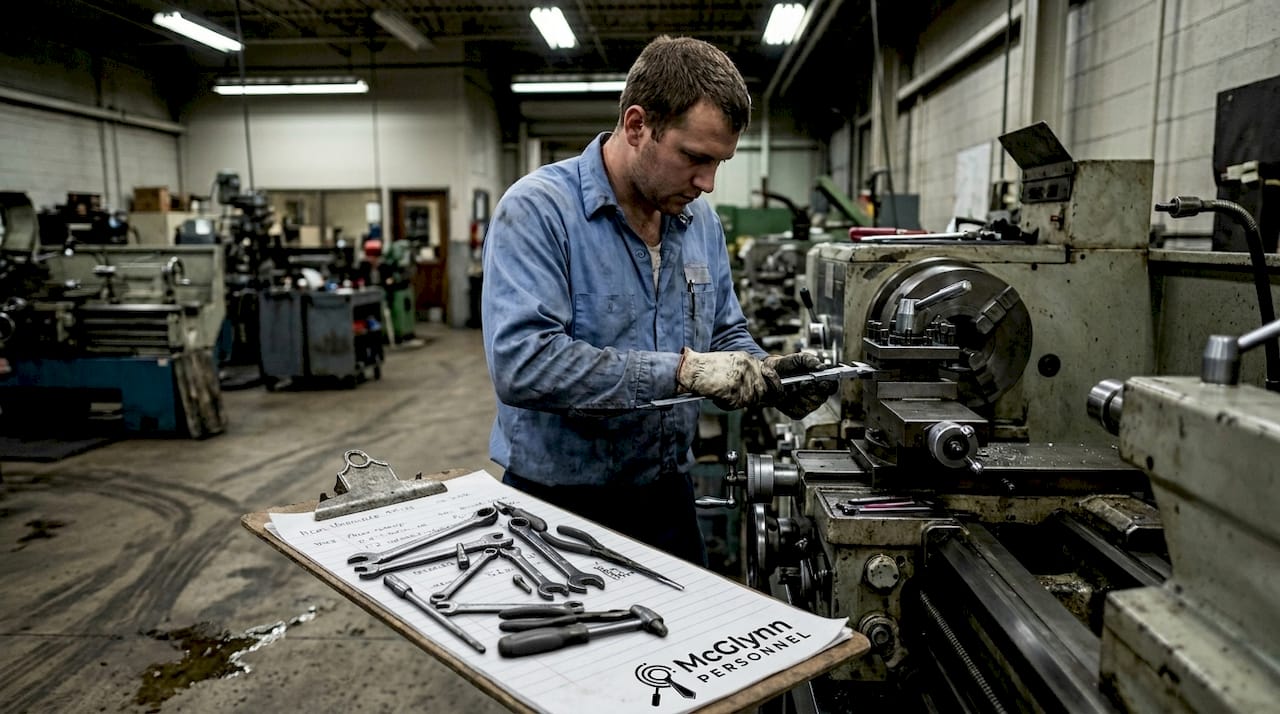
Understanding manufacturing staffing challenges can also help you position yourself strategically. Employers are actively competing for reliable production workers, which gives skilled candidates real negotiating power. Working with a manufacturing agency can accelerate your placement into the right role faster than applying cold.
Tracking your own performance using manufacturing KPIs like output rate and defect frequency also signals to employers that you think beyond the task at hand.
Pro Tip: Earning a Lean certification while working in a production role signals to employers that you understand waste reduction and process efficiency, two qualities that open doors to advancement fast.
Engineering in manufacturing: Design, optimization, and technical problem-solving
Engineering roles sit above the production floor in terms of technical complexity, but they are deeply connected to it. Where hands-on workers operate and maintain, engineers design, analyze, and optimize. This distinction shapes everything from your daily tasks to your long-term earning potential.
Key engineering roles in manufacturing include:
- Industrial engineers (SOC 17-2112.00): They analyze workflows, reduce waste, and improve production efficiency.
- Manufacturing engineers (SOC 17-2112.03): They design and refine manufacturing processes and equipment.
- Industrial engineering technologists and technicians (SOC 17-3026.00): They support engineers with data collection, testing, and process documentation.
- Mechanical engineering technologists and technicians (SOC 17-3027.00): They assist in designing and testing mechanical systems on the production floor.
These engineering roles in manufacturing require a different toolkit than hands-on positions. You will work with CAD software, robotics systems, statistical process control (SPC), geometric dimensioning and tolerancing (GD&T), and overall equipment effectiveness (OEE) metrics.
| Role | Primary focus | Key tools |
|---|---|---|
| Industrial engineer | Workflow and efficiency | Lean, Six Sigma, time studies |
| Manufacturing engineer | Process and equipment design | CAD, robotics, GD&T |
| Engineering technician | Testing and data support | SPC, measurement tools |
| Mechanical technologist | Mechanical system support | CAD, prototyping, OEE |
Career progression in engineering is structured and reward-driven. You typically move from junior engineer to senior engineer, then to principal or staff engineer, with each step requiring deeper technical expertise and often a formal certification. Industries like automotive and aerospace are especially active in hiring engineers, and they pay accordingly.
Exploring precision recruitment in engineering can help you understand how top employers evaluate engineering candidates. For those who need placement quickly, rapid manufacturing recruitment services match your technical profile to live vacancies without the usual delays.
Pro Tip: A Six Sigma Green Belt or Black Belt certification is one of the fastest ways to differentiate yourself as an engineering candidate. Employers in high-volume manufacturing treat it as proof that you can deliver measurable results.
Management positions: Supervisors, production managers, and leadership roles
Management in manufacturing is where operational strategy meets people leadership. If you thrive on accountability, team motivation, and driving performance across a production environment, these roles are built for you.
The typical progression through manufacturing management looks like this:
- Line leader or team leader: Coordinates a small group of production workers on a specific line or shift.
- Floor supervisor: Oversees multiple lines, monitors safety compliance, and resolves production issues in real time.
- Production manager: Manages entire departments or facilities, sets output targets, and reports to senior leadership.
- Industrial production manager (SOC 11-3051): A senior role covering plant-wide operations, budget management, and strategic planning.
Industrial production managers also include specialized variants such as quality control systems managers and biofuels production managers, reflecting the diversity of manufacturing sectors. Each specialty demands a different knowledge base, but all require the same core leadership competencies: clear communication, data-driven decision-making, and the ability to motivate teams under pressure.
Here is a quick comparison of management levels by responsibility scope:
| Role | Team size | Primary focus |
|---|---|---|
| Line leader | 5 to 15 workers | Daily task coordination |
| Floor supervisor | 15 to 50 workers | Safety, quality, throughput |
| Production manager | 50 to 200+ workers | Department performance, KPIs |
| Industrial production manager | Plant-wide | Strategy, budgets, compliance |
“Nuclear power reactor operators are among the highest-paid production workers in the US, with a mean annual wage of $122,000, illustrating how specialization and responsibility command premium compensation in manufacturing.”
For senior leadership roles, working with specialists in executive search for manufacturing gives you access to opportunities that are rarely advertised publicly. Partnering with manufacturing leadership recruiters also ensures your profile reaches decision-makers at the right level.
Specialized and emerging manufacturing jobs: New opportunities and expert pathways
The manufacturing sector is not standing still. Automation, data analytics, and advanced materials are reshaping job categories at a rapid pace. If you want to future-proof your career, understanding these emerging roles is essential.
The most in-demand specialized roles right now include:
- Automation technicians: They program, maintain, and troubleshoot automated production systems and robotic cells.
- Robotics operators and integrators: They work directly with robotic arms and collaborative robots (cobots) on the production floor.
- Manufacturing data analysts: They interpret production data to identify inefficiencies, predict equipment failures, and optimize output.
- Quality control engineers: They use advanced measurement tools and SPC to maintain product standards in high-precision environments.
- Biofuels and renewable energy production specialists: A fast-growing niche driven by sustainability mandates across industrial sectors.
The pay gap between generalist and specialist roles is significant. Nuclear power reactor operators earn $122,000 annually on average, while specialized automation and quality engineers consistently command salaries well above the production occupation mean. The skills that unlock these roles include CAD proficiency, robotics programming, GD&T knowledge, and advanced certifications.
Career progression in these fields follows a clear path. You can move from entry-level positions with no degree all the way to principal or staff engineer by combining hands-on experience with targeted certifications in Lean, Six Sigma, or automation systems. Automotive and aerospace remain the highest-demand industries for these skills.
Exploring opportunities through a manufacturing recruitment agency gives you an edge when targeting these niche roles, since many are filled through specialist networks rather than job boards. Refining your approach with proven manufacturing recruitment strategies helps you position your skills where demand is highest.
Pro Tip: Automation and data analytics roles in manufacturing are growing faster than most traditional production jobs. If you are early in your career, even a basic understanding of PLC programming or data visualization tools puts you ahead of most applicants.
Beyond job titles: What manufacturers and engineers wish they knew about career choices
Here is what most career guides get wrong about manufacturing: they treat job titles as destinations. In reality, titles are just snapshots. What actually drives long-term success is your ability to adapt, cross-train, and build skills that transfer across roles and industries.
The professionals who advance fastest in manufacturing are rarely the ones who stayed in their lane. They are the welders who learned SPC, the production supervisors who earned a Six Sigma belt, and the engineers who understood the business case behind every process change. Cross-functional knowledge is your real competitive advantage.
Technology is accelerating this shift. Automation and data analytics are not replacing manufacturing workers wholesale. They are redefining what those workers need to know. A machinist who understands CNC programming and basic data interpretation is worth significantly more than one who does not.
Our perspective at McGlynn Personnel, shaped by years of tailored recruitment for manufacturing, is this: focus less on the title you want and more on the skills gap you can close. The candidates who land the best roles are the ones who show up with a learning mindset and a track record of proactive upskilling.
Accelerate your career with specialized manufacturing recruitment
Navigating the full range of manufacturing job types is easier when you have the right support behind you. Whether you are targeting your first production role or pursuing a senior engineering or management position, precision matching matters.

At McGlynn Personnel, we connect manufacturing and engineering professionals with leading employers across the US, UK, EU, Middle East, and APAC regions. Our engineering staffing solutions are built around your technical profile, not just your job title. If you are ready to move, working with a recruiter who specializes in your sector cuts through the noise and gets you in front of the right opportunities faster. Take the next step with a team that understands what manufacturing careers actually demand.
Frequently asked questions
What education do I need for an entry-level manufacturing job?
Most entry-level manufacturing roles require a high school diploma or less, with skills typically developed through on-the-job training. Positions like hand cutter, coating worker, and sewing machine operator are accessible without prior formal qualifications.
Which manufacturing jobs pay the most?
Specialized roles command the highest wages, with nuclear reactor operators averaging $122,000 annually. Advanced engineers in automation and quality control also consistently earn above the sector average.
What is the difference between hands-on and engineering manufacturing jobs?
Hands-on roles focus on operating machines and assembling products, while engineering positions center on designing and optimizing the manufacturing processes themselves. Engineering typically requires more formal education and technical certification.
What career advancement opportunities exist in manufacturing?
You can progress from entry-level production work all the way to principal or staff engineer or senior management by combining experience with certifications like Lean and Six Sigma. Automotive and aerospace sectors offer particularly strong advancement tracks.
Which US states have the highest concentration of manufacturing jobs?
Indiana leads with the highest manufacturing concentration at 11.3% of state employment, making it a strong target market for production and engineering job seekers.
Recommended
- Manufacturing Jobs for Expats in Europe: The 2026 Career Guide – Mcglynn Personnel
- Career Advice for Manufacturing Professionals: Navigating Industry 5.0 – Mcglynn Personnel
- 2026 Salary Guide for Manufacturing Supervisors: Compensation Trends & Industry Insights – Mcglynn Personnel
- Avoiding Common Hiring Mistakes in Manufacturing: A 2026 Precision Guide – Mcglynn Personnel