
You promote your most skilled operator to supervisor, only to watch them struggle with leadership. Your hiring process drags on for months, yielding candidates who lack the critical balance of technical expertise and people management skills. This cycle of promoting top performers who fail, enduring high turnover, and facing prolonged vacancies is a direct threat to operational efficiency. These are the persistent challenges in hiring production supervisors that can stall growth and erode team morale, costing manufacturing leaders valuable time and resources.
The issue, however, often lies not with the talent pool, but with an outdated or misaligned recruitment strategy. This guide is engineered to bring structure and precision to your hiring process. We provide a comprehensive, actionable framework designed to help you diagnose the root causes of your recruitment difficulties. You will learn how to effectively identify, attract, and secure the high-caliber supervisors who drive performance, ensuring you build the dependable leadership your production floor requires to excel in 2026 and beyond.
Key Takeaways
- Identify the primary reason production supervisor roles are difficult to fill and learn how to avoid the common ‘best operator’ promotion trap.
- Discover how to structure your hiring process to accurately assess both critical leadership competencies and essential technical knowledge.
- Overcome the primary challenges in hiring production supervisors by shifting from generic job posts to targeted attraction strategies and behavior-based interviews.
- Implement a specialist-led recruitment strategy to secure high-caliber supervisors who can drive shop floor efficiency and team performance.
The Core Dilemma: Why the Production Supervisor Role Is So Hard to Fill
In any advanced manufacturing or production environment, the Production Supervisor serves as the critical linchpin connecting high-level corporate strategy with tangible shop floor execution. They are tasked with ensuring that production targets, quality standards, and safety protocols are met with precision and efficiency. This is where one of the most significant challenges in hiring production supervisors emerges: the position is a demanding hybrid. At its core, the production supervisor role requires a rare blend of deep technical expertise and highly developed emotional intelligence to navigate a high-pressure environment of tight deadlines and diverse personalities.
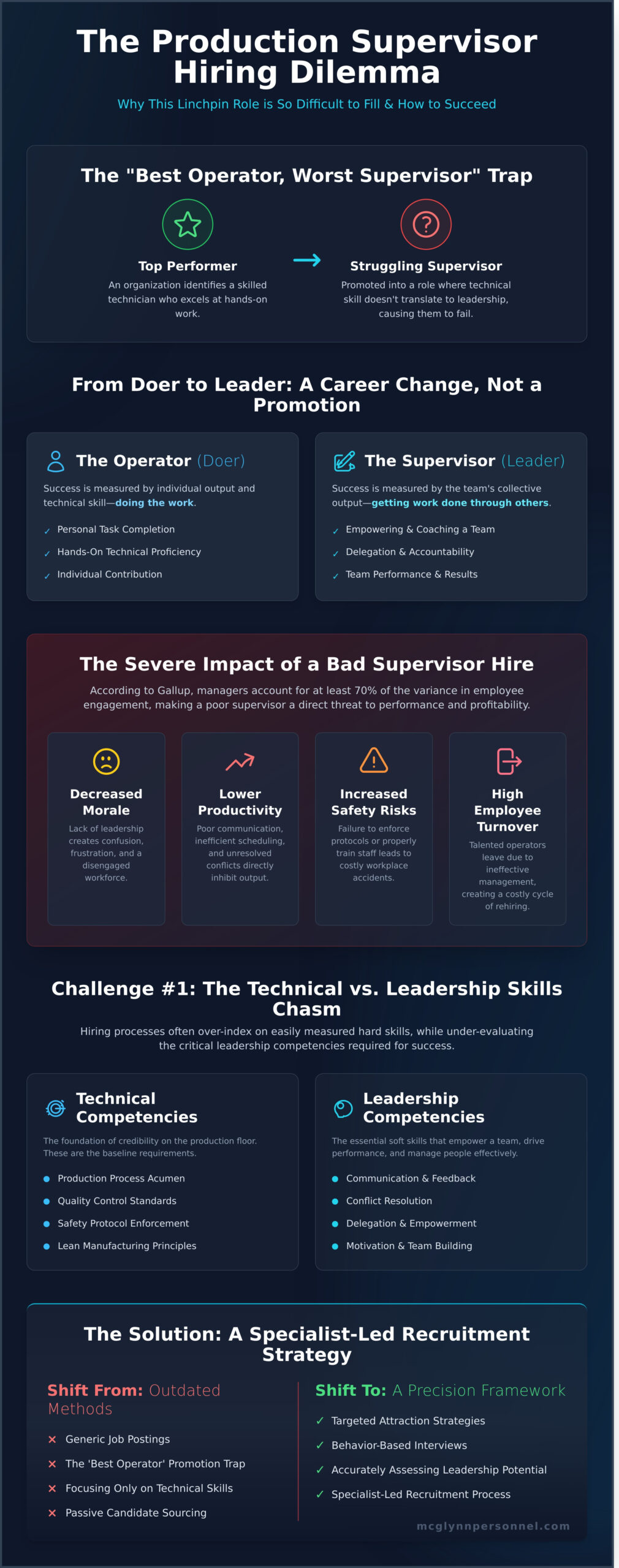
Too often, organisations fall into the “Best Operator, Worst Supervisor” trap. They identify a top-performing technician-someone who excels at the hands-on work-and promote them into a leadership position. While seemingly logical, this approach frequently overlooks the fundamental shift in skills required for the new role. Technical proficiency does not automatically translate to leadership capability, creating a critical failure point in talent management.
From Doer to Leader: The Fundamental Shift
The transition from operator to supervisor is not a promotion; it is a career change. An operator’s success is measured by their individual output and technical skill-doing the work. A supervisor’s success, however, is measured by the team’s collective output-getting work done through others. This requires a profound mindset shift from personal task completion to empowering, coaching, and holding a team accountable. This transition is where many new supervisors falter without proper training and support.
Impact of a Bad Supervisor Hire
The consequences of placing the wrong person in this role are immediate and severe, impacting the entire production line. According to extensive research by Gallup, managers account for at least 70% of the variance in employee engagement scores. A poor supervisor hire directly erodes team performance and profitability, with costs that extend far beyond recruitment fees.
- Decreased Morale: A lack of leadership creates confusion and frustration, leading to a disengaged workforce.
- Lower Productivity: Inefficient scheduling, poor communication, and unresolved conflicts directly inhibit output.
- Increased Safety Risks: A failure to enforce protocols or properly train staff can lead to costly and dangerous workplace accidents.
- High Employee Turnover: Talented operators will not stay long under ineffective management, leading to a cycle of rehiring and retraining.
Addressing the core challenges in hiring production supervisors is not just a recruitment goal; it is a strategic imperative for operational excellence and long-term business stability.
Challenge #1: The Technical vs. Leadership Skills Chasm
One of the most significant challenges in hiring production supervisors is navigating the wide chasm between technical expertise and leadership acumen. All too often, hiring processes over-index on tangible, easily measured hard skills-like a candidate’s knowledge of lean principles or their ability to operate specific machinery. This focus is understandable, but it creates a critical imbalance where leadership, communication, and other essential soft skills are either assumed or poorly evaluated.
This oversight leads to a common and costly problem: promoting a skilled technician into a management role they are not equipped for. The result is a supervisor who can expertly troubleshoot a machine but cannot resolve team conflict, provide motivating feedback, or effectively delegate tasks. The root of this issue often lies in flawed evaluation methods. To identify candidates with true leadership potential, hiring managers must move beyond technical questionnaires. As experts at the Illinois Manufacturing Excellence Center note, mastering the interview process is a critical step toward learning how to assess these less tangible, yet vital, competencies.
Essential Technical Competencies
A supervisor’s credibility on the production floor is built upon a solid foundation of technical knowledge. These competencies represent the baseline requirements for ensuring operational integrity, safety, and efficiency.
- Production Process Acumen: Deep understanding of the specific manufacturing workflows, equipment, and materials used on their line.
- Quality Control Standards: Proficiency in quality assurance protocols, such as ISO 9001, and the ability to conduct inspections and implement corrective actions.
- Continuous Improvement Methodologies: Knowledge of Lean Manufacturing principles, Six Sigma, and 5S to drive waste reduction and process optimization.
- Safety and Compliance: Thorough understanding of safety protocols, including OSHA regulations, to maintain a secure work environment.
- Operational Planning: Skills in production scheduling, resource allocation, and generating basic performance reports.
Crucial Leadership & Soft Skills
While technical skills keep the line running, leadership skills are what elevate a team’s performance and foster a culture of accountability and growth. These abilities are the true engine of productivity and are non-negotiable for a successful supervisor.
- Communication: The ability to provide clear, direct instructions and deliver constructive feedback that encourages improvement rather than discourages effort.
- Conflict Resolution: The capacity to mediate disputes between team members professionally and find mutually agreeable solutions.
- Coaching and Delegation: Skill in developing employees’ capabilities through effective coaching and entrusting them with responsibility to foster ownership.
- Problem-Solving: The aptitude for making sound, timely decisions under pressure to resolve unexpected production issues.
Challenge #2: Sourcing & Attraction in a Tight Labor Market
The current manufacturing landscape presents a significant hurdle: a small pool of qualified, experienced supervisors who are typically passive candidates. These high-performers are not actively scanning job boards; they are already employed and delivering results. Relying on traditional recruitment methods in this environment is inefficient and often leads to a high volume of unqualified applicants, compounding the challenges in hiring production supervisors. A strategic, targeted approach is essential for success.
Your company’s reputation and culture are foundational to this approach. Top leadership talent is not just looking for a job; they are seeking an environment where they can make a tangible impact, develop their skills, and be part of a forward-thinking organization. Your ability to articulate and demonstrate this value proposition is what will set you apart from competitors vying for the same limited talent.
Moving Beyond Standard Job Postings
Passive candidates, the most desirable leaders, must be actively sought out. They will not respond to generic advertisements on saturated platforms like Indeed or LinkedIn. To connect with this hidden talent, companies must leverage channels where these professionals congregate. This requires proactive outreach through professional networks, engagement in industry-specific online forums, and a presence at key trade events. A specialized recruiter’s network is a critical asset, providing direct access to a pre-vetted pool of leaders that would otherwise remain inaccessible.
Crafting a Compelling Job Description
Your job description is your primary marketing document. A generic list of duties fails to differentiate your company or inspire a top-tier leader to consider a change. Instead, frame the role around impact and opportunity. Answer these key questions for the candidate:
- What critical challenges will this supervisor solve?
- How will they contribute to the company’s strategic goals?
- What does career progression look like from this role?
This approach transforms the description from a passive notice into a compelling career proposition. To attract leadership talent, you must clearly articulate what makes your company a superior place to work. Detail your company culture, leadership philosophy, and commitment to development. Rather than creating artificial barriers with rigid requirements, focus on demonstrated competencies. For instance, a Harvard Business School study on degree inflation revealed a significant gap where 67% of production supervisor postings require a degree, while only 16% of incumbents hold one. Highlighting opportunities for growth based on performance over credentials will significantly widen your qualified applicant pool.
Challenge #3: Rethinking the Interview to Assess True Potential
One of the most significant challenges in hiring production supervisors is relying on an interview process that fails to reveal true leadership potential. Standard questions like “tell me about yourself” often elicit rehearsed answers that do little to demonstrate a candidate’s ability to manage a team, solve problems under pressure, or drive accountability on the shop floor.
To gain genuine insight, the process must be engineered to test for behavior and situational judgment, not just recited experience. Past behavior is the most reliable predictor of future performance. This requires a structured approach that involves multiple stakeholders, including a potential direct report, to provide a well-rounded perspective on the candidate’s interpersonal and leadership style.
Behavioral and Situational Interview Questions
Deploying targeted questions forces candidates to move beyond theory and provide concrete evidence of their capabilities. Instead of asking what they would do, ask what they did. Examples include:
- “Describe a specific time you managed a conflict between two team members. What was the situation, and what was the outcome?”
- “Walk me through how you would address a sudden and significant drop in your team’s quality metrics.”
Evaluate answers with precision using the STAR method to ensure a complete picture: Situation (set the scene), Task (describe the objective), Action (detail what they did), and Result (explain the outcome with metrics, if possible).
Practical Assessments and On-Site Tours
To validate claimed competencies, supplement interviews with practical evaluations. A brief, relevant test-such as asking a candidate to analyze a daily production report to identify potential issues and propose solutions-provides a clear window into their analytical skills.
Furthermore, a guided tour of the shop floor is invaluable. Observe how the candidate interacts with the environment. Do they notice safety protocols? Do they ask insightful questions about workflow? This exercise allows you to gauge their observational skills and how they engage with potential team members in a real-world setting, offering insights that a conference room conversation never could. Overcoming the challenges in hiring production supervisors requires this level of detailed, practical assessment.
Our structured recruitment process is designed to uncover these critical leadership traits. Learn how McGlynn Personnel can help you build a more effective hiring framework.
The Solution: A Specialist Approach to Production Supervisor Recruitment
Overcoming the persistent challenges in hiring production supervisors requires more than a standard recruitment strategy; it demands a focused, expert-led process. Generalist approaches often miss the critical nuances of the role, leading to a cycle of mismatched hires. A production supervisor is not just a manager-they are a vital link between the plant floor and senior leadership, requiring a unique combination of technical acumen, process discipline, and inspirational leadership.
A specialist manufacturing recruiter brings an immediate and decisive advantage. We possess a deep, ingrained understanding of modern production environments, from lean manufacturing principles to quality control systems. More importantly, we cultivate and maintain an extensive network of high-caliber, passive candidates. These are the proven leaders who are currently driving results for their employers and are not found on public job boards. Our structured vetting process is specifically designed to rigorously assess both the technical competencies and the critical leadership qualities that define a successful supervisor.
How McGlynn Personnel Finds True Leaders
Our process begins by deeply understanding your company culture, production goals, and specific operational needs. We then leverage our exclusive network to identify proven leaders, not just active job seekers. Our comprehensive screening moves beyond resumes to focus on verified accomplishments in:
- Team development and employee retention
- Process improvement and efficiency gains
- Maintaining quality and safety compliance
Gaining a Competitive Advantage in Hiring
Partnering with a specialist saves significant time and, crucially, reduces the substantial financial risk of a bad hire. We deliver a meticulously curated shortlist of highly qualified, pre-vetted candidates who align with your requirements. This allows your hiring managers to invest their time where it matters most: making the final strategic decision from a pool of exceptional talent, confident in the quality and fit of each individual presented.
By engaging an expert partner, you transform your hiring process from a resource-draining challenge into a strategic function that secures top-tier leadership. Discover how our precision approach can bring structure and accountability to your team by visiting mcglynnpersonnel.com today.
A Strategic Solution to Production Supervisor Recruitment
The modern manufacturing environment has intensified the challenges in hiring production supervisors, demanding a nuanced blend of technical expertise and strong leadership. As we’ve explored, overcoming the skills chasm and sourcing high-caliber talent from a competitive market requires a more deliberate and strategic approach than ever before. Relying on outdated methods is no longer a viable path to securing the leaders who drive operational excellence.
This is where a specialist partner provides a decisive advantage. McGlynn Personnel brings precision and structure to this complex process. As dedicated specialists in manufacturing and engineering recruitment, we utilize a proven process for vetting both leadership and technical skills with meticulous detail. Our access to an extensive network of passive, high-performing candidates means we connect you with professionals who are not just actively searching, but are the proven leaders ready to make a profound impact.
Stop letting recruitment hurdles impede your facility’s success. Let us help you build the accountable, efficient leadership team your operations deserve. Secure your next production leader. Contact McGlynn Personnel today.
Frequently Asked Questions
What are the key qualities of a good production supervisor?
An effective production supervisor possesses a strong blend of leadership and technical acumen. Key qualities include exceptional communication for motivating teams, strong problem-solving skills for addressing operational issues, and a deep understanding of lean manufacturing principles and safety compliance. They must demonstrate accountability, manage production schedules efficiently, and maintain a steadfast focus on quality control. These individuals bring structure and order to the production floor, ensuring targets are met consistently and safely.
What is the average salary for a production supervisor in 2026?
While market conditions fluctuate, we project the average salary for a production supervisor in 2026 to be between $75,000 and $95,000 annually. This estimate accounts for inflation and the growing demand for skilled leaders in advanced manufacturing. Compensation will vary significantly based on geographic location, industry complexity, company size, and the candidate’s specific experience with technologies like automation and ERP systems. A competitive package remains crucial for attracting top-tier talent.
How do you effectively train a newly promoted production supervisor?
Effective training for a new supervisor requires a structured, multi-faceted approach. We recommend a formal program that combines mentorship from a seasoned manager with targeted skills development in areas like conflict resolution, delegation, and performance management. This should be supplemented with in-depth instruction on key operational systems, including production scheduling software, quality assurance protocols, and budget oversight. This comprehensive process ensures they are fully equipped to lead with confidence and competence.
What are the most important interview questions to ask a production supervisor candidate?
To assess proven capability, focus on behavioral and situational questions. Ask, “Describe a time you identified and implemented a process improvement that increased efficiency.” Another critical question is, “How have you managed a safety incident or a near-miss on your shift?” Also, inquire, “Walk me through your experience using production data to manage team performance and meet KPIs.” These questions reveal a candidate’s real-world problem-solving skills and leadership style.
How can I improve retention for my manufacturing supervisors?
Improving supervisor retention requires a strategic focus on career development and workplace culture. Provide a clear path for advancement and invest in continuous training to enhance their leadership skills. Ensure compensation is competitive and recognize strong performance. Fostering an environment where supervisors feel empowered and supported by senior management is essential to reducing turnover and mitigating the common challenges in hiring production supervisors in a competitive market. Simple additions, like creating custom team apparel with a service like RAW Merch, can also help build a cohesive and proud workforce.
Is it better to promote a supervisor from within or hire externally?
The decision depends on your organization’s immediate needs and long-term goals. Promoting from within leverages existing institutional knowledge and can significantly boost team morale. However, an external hire can introduce new skills, fresh perspectives, and valuable experience from different operational environments. A balanced strategy is often most effective, involving a robust internal development pipeline supplemented by external recruitment to fill specific skill gaps or drive transformative change.
What technical skills are most in-demand for production supervisors today?
Today’s production supervisors require proficiency beyond basic line management. High-demand technical skills include experience with Enterprise Resource Planning (ERP) and Manufacturing Execution Systems (MES) for real-time tracking and scheduling. A strong understanding of data analysis to interpret production metrics is critical. Furthermore, familiarity with lean manufacturing methodologies, Six Sigma principles, and the fundamentals of industrial automation is increasingly essential for driving efficiency and quality in modern facilities.
How long does it typically take to hire a qualified production supervisor?
The typical hiring timeline for a qualified production supervisor ranges from four to eight weeks. This duration covers sourcing, comprehensive screening, multiple interview rounds, and final offer negotiation. The process can be extended by highly specific technical requirements or a limited talent pool in your geographic area. A structured and dedicated recruitment process is key to overcoming the challenges in hiring production supervisors and securing the right talent efficiently.