
Recruitment process outsourcing (RPO) isn’t just a vendor relationship; it’s a strategic partnership that reduces time-to-fill by 30-55% while slashing costs. For HR leaders in engineering, manufacturing, and property sectors struggling with prolonged vacancies and high recruitment expenses, RPO offers a proven framework to streamline hiring without sacrificing quality or control. This article clarifies how RPO transforms recruitment efficiency through technology integration, sector-specific expertise, and measurable performance gains.
Table of Contents
- Introduction To Recruitment Process Outsourcing (RPO)
- Quantifiable Benefits: Cost, Time, And Quality Gains With RPO
- Tackling Sector-Specific Recruitment Challenges With RPO
- The Role Of Technology And AI In Enhancing RPO Effectiveness
- Common Misconceptions About RPO Debunked
- Framework For Evaluating And Implementing RPO In Your Organization
- Conclusion: Transforming Recruitment For Competitive Advantage
- Streamline Your Recruitment With Expert Outsourcing Solutions
- Frequently Asked Questions
Key takeaways
| Point | Details |
|---|---|
| Speed advantage | RPO reduces time-to-fill by 30-55%, completing placements in 27-64 days versus 44-100+ days internally. |
| Cost efficiency | Organizations achieve 25-50% cost-per-hire reduction through pay-for-results pricing models. |
| Quality improvement | RPO delivers 77% offer acceptance rates compared to 62% internal, with 18-20% higher retention. |
| Technology edge | AI integration reduces resume screening time by 85% while maintaining human oversight. |
| Sector expertise | Specialized RPO providers access niche talent pools critical for technical roles in manufacturing and engineering. |
Introduction to recruitment process outsourcing (RPO)
Recruitment process outsourcing transfers specific hiring responsibilities to specialized external providers who function as strategic extensions of internal HR teams, not simple vendors. Unlike traditional staffing agencies that fill individual requisitions, RPO partners assume ownership of entire recruitment workflows, from sourcing through onboarding, while maintaining alignment with your organizational culture and strategic hiring goals.
This model suits engineering, manufacturing, and property sectors exceptionally well because technical roles demand specialized sourcing strategies that generalist internal teams often lack capacity to execute. Manufacturing faces a talent shortage projected to reach 2.1 million unfilled positions by 2030, while engineering roles require recruiters who understand complex technical certifications and industry-specific skill sets.
RPO services scale recruitment capacity to match project cycles and seasonal demands without the fixed overhead of maintaining large internal recruiting teams year-round. Key characteristics include:
- Process ownership transfer: RPO providers manage complete recruitment workflows, not just candidate submission
- Scalable infrastructure: Recruitment capacity expands or contracts based on hiring volume needs
- Sector specialization: Providers bring deep networks in technical disciplines and hard-to-fill roles
- Technology platforms: Advanced applicant tracking systems and AI tools streamline candidate management
- Performance accountability: Metrics-driven contracts tie provider compensation to hiring outcomes
Traditional recruitment struggles in technical sectors because internal teams lack specialized talent networks, operate with limited bandwidth during high-volume hiring periods, and can’t justify advanced recruitment technology investments for fluctuating needs. HR outsourcing in recruitment addresses these gaps by providing dedicated expertise and infrastructure without permanent headcount expansion.
Quantifiable benefits: cost, time, and quality gains with RPO
The financial and operational case for RPO rests on documented performance improvements across multiple recruitment metrics. Organizations implementing RPO achieve 27-64 day time-to-fill compared to 44-100+ days for internal teams, representing a 30-55% acceleration in hiring velocity. This speed advantage directly reduces revenue loss from unfilled positions, particularly critical in manufacturing where production delays cascade through supply chains.
Cost reductions prove equally compelling. RPO delivers 25-50% lower cost-per-hire by converting fixed recruiting expenses into variable costs aligned with actual hiring needs. Instead of maintaining year-round internal recruiting staff during slow periods, organizations pay only for active requisitions filled.
Quality metrics reveal RPO’s impact on hiring outcomes beyond speed and cost:
| Metric | Internal Recruitment | RPO Performance | Improvement |
|---|---|---|---|
| Time-to-fill | 44-100+ days | 27-64 days | 30-55% faster |
| Cost-per-hire | $4,700 average | $2,350-3,525 | 25-50% reduction |
| Offer acceptance | 62% | 77% | 24% higher |
| 1-year retention | 70% | 84-88% | 18-20% improvement |
Offer acceptance rates of 77% versus 62% for internal recruiting indicate RPO providers present better-matched candidates who align with role requirements and organizational culture. Higher retention rates (84-88% versus 70%) demonstrate this quality advantage persists beyond initial placement, reducing costly turnover cycles.
Pro Tip: Negotiate pay-for-performance RPO contracts that tie provider fees to placement longevity, not just initial hires. This aligns incentives toward candidate quality and retention rather than volume.
The financial model shift from fixed to variable costs creates budgetary flexibility particularly valuable in cyclical industries like manufacturing and property development. During expansion phases, recruitment scales rapidly without lengthy internal hiring and training cycles. When projects complete or market conditions soften, costs decline proportionally without layoff expenses or idle capacity.
Detailed RPO market data shows these performance improvements hold consistent across industries, with technical sectors often seeing amplified benefits due to specialized talent scarcity. Organizations leveraging HR outsourcing in recruitment report reduced administrative burden on internal HR teams, allowing focus on strategic workforce planning rather than transactional hiring tasks.
Tackling sector-specific recruitment challenges with RPO
Engineering, manufacturing, and property sectors face distinct hiring obstacles that RPO directly addresses through specialized expertise and expanded talent access. Technical skill shortages top the challenge list, with manufacturing facing 2.1 million unfilled positions by 2030 as experienced workers retire faster than new talent enters the pipeline.
Role complexity compounds scarcity issues. Engineering positions often require niche certifications, specialized software proficiency, and hands-on experience with specific manufacturing processes or property management systems. Internal recruiters rarely possess the technical knowledge to accurately assess candidate qualifications in these domains, leading to mismatched hires or extended search timelines.
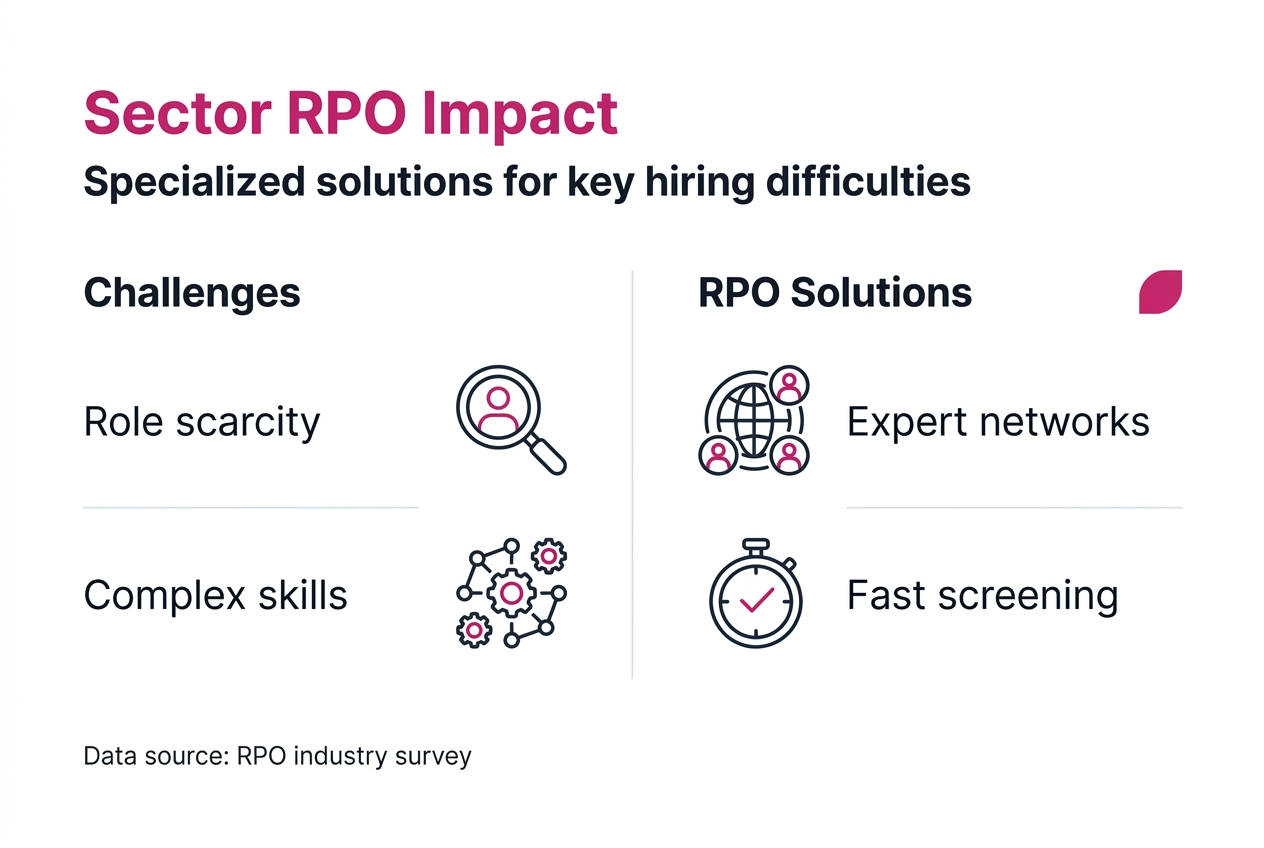
Fluctuating demand creates additional pressure. Property development projects generate intensive hiring needs during construction phases followed by reduced staffing requirements at completion. Manufacturing operations scale production based on order volumes, requiring rapid workforce expansion or contraction. Traditional internal recruiting teams sized for average demand either lack capacity during peaks or carry excess overhead during valleys.
RPO providers solve these challenges through:
- Specialized talent networks: Established relationships with passive candidates in technical disciplines who aren’t actively job searching
- Industry expertise: Recruiters who understand sector-specific terminology, certifications, and skill requirements
- Scalable capacity: Ability to rapidly deploy additional recruiters during high-volume hiring periods
- Geographic reach: Access to talent pools across multiple regions for roles requiring relocation or international placement
- Competitive intelligence: Market knowledge about compensation trends and talent availability in niche specializations
Practical examples illustrate RPO’s sector impact. A precision engineering firm reduced time-to-fill for CNC machinists from 90 days to 35 days by partnering with an RPO provider maintaining active relationships with vocational school graduates and experienced operators. A commercial property management company scaled from 12 facility managers to 47 across three states in four months to support portfolio expansion, something impossible with their three-person internal HR team.
RPO’s flexibility proves particularly valuable for project-based hiring. Construction and development cycles create predictable but temporary talent needs. Manufacturing retooling for new product lines requires specialized skills for 6-12 month implementation periods. RPO converts these irregular demands into manageable variable costs without maintaining permanent recruiting infrastructure.
Manufacturing staffing challenges require solutions beyond traditional job posting and screening. RPO providers actively source passive candidates, leverage industry networks, and maintain talent pipelines that deliver qualified candidates within days rather than months.
The role of technology and AI in enhancing RPO effectiveness
Artificial intelligence transforms RPO from labor-intensive manual processes into data-driven efficiency engines while preserving essential human judgment. AI reduces resume screening time by 85% by automatically parsing applications against role requirements, eliminating obvious mismatches before human review. This acceleration doesn’t sacrifice quality; it redirects recruiter time toward relationship building and candidate assessment rather than administrative sorting.

The Human-in-the-Loop model balances automation with expertise. AI handles initial screening, interview scheduling, and routine candidate communications. Recruiters focus on evaluating cultural fit, conducting technical assessments, and building relationships with passive candidates who require personalized outreach. This division maximizes both efficiency and hiring quality.
Key technology capabilities in modern RPO include:
- Predictive analytics: Historical hiring data identifies which candidate attributes correlate with long-term success in specific roles
- Automated communications: Chatbots handle routine candidate questions and schedule interviews without recruiter involvement
- Skills matching: Natural language processing analyzes resumes and job descriptions to identify compatibility beyond simple keyword matching
- Workflow automation: Application tracking systems route candidates through screening stages automatically based on assessment results
- Real-time reporting: Dashboards provide continuous visibility into pipeline health, time-to-fill trends, and recruiter productivity
Administrative task reduction of 45% through automation allows RPO teams to manage higher requisition volumes without proportional cost increases. This productivity gain translates directly to lower cost-per-hire for client organizations.
Pro Tip: When evaluating RPO providers, prioritize those using AI for efficiency but maintaining human oversight for final hiring decisions. Technology should augment recruiter judgment, not replace it entirely.
Workforce planning benefits from predictive analytics that forecast future talent needs based on business growth projections, seasonal patterns, and historical turnover rates. This foresight enables proactive pipeline development rather than reactive scrambling when positions open.
Integration between RPO platforms and client applicant tracking systems creates seamless data flow and unified reporting. Hiring managers access candidate information through familiar interfaces while benefiting from RPO provider expertise operating behind the scenes.
AI enhancing human insight in recruitment represents the future of talent acquisition. Organizations gain both technological capability and human expertise without building internal infrastructure. Automation and human touch in recruitment work together to optimize outcomes. Top AI applications in 2026 extend beyond recruitment into candidate experience enhancement and retention prediction.
Common misconceptions about RPO debunked
Several myths prevent HR leaders from seriously evaluating RPO despite its documented benefits. Addressing these misconceptions directly helps organizations make informed decisions based on facts rather than outdated assumptions.
Misconception: RPO means surrendering all hiring control to external vendors.
Reality: Modern RPO operates as a partnership where clients maintain approval authority over candidate selection, compensation decisions, and hiring timelines. RPO providers manage process execution while clients retain strategic control.
Misconception: Outsourcing recruitment compromises candidate quality to reduce costs.
Reality: Data shows RPO improves quality metrics with 77% offer acceptance versus 62% internal and 18-20% higher retention rates. Cost savings come from process efficiency and technology leverage, not quality shortcuts.
Misconception: RPO replaces internal HR teams entirely.
Reality: RPO complements internal teams by handling transactional recruiting tasks, freeing HR professionals for strategic workforce planning, employee development, and organizational culture initiatives. Internal teams maintain oversight and relationship ownership.
Misconception: Only large enterprises benefit from RPO economics.
Reality: Scalable RPO models serve organizations of all sizes. Small companies access enterprise-grade recruiting technology and expertise without capital investment. Mid-size firms scale capacity for growth without permanent headcount additions.
Misconception: RPO providers lack understanding of specialized technical roles.
Reality: Sector-focused RPO firms develop deep expertise in specific industries, often employing recruiters with backgrounds in engineering, manufacturing, or property management who understand technical requirements and industry dynamics.
These myths often stem from experiences with traditional staffing agencies that operate on transactional models fundamentally different from strategic RPO partnerships. Tailored recruitment for specialized sectors requires providers who invest time understanding organizational culture, technical requirements, and long-term talent strategies.
Open-minded evaluation based on current RPO capabilities rather than historical perceptions reveals opportunities to solve persistent recruitment challenges. Request performance data from potential providers, speak with current clients in similar industries, and pilot RPO for specific role categories before full implementation.
Framework for evaluating and implementing RPO in your organization
Successful RPO adoption requires systematic evaluation of organizational needs and structured implementation to ensure seamless integration with existing HR processes.
Prerequisites for RPO consideration:
Identify specific recruitment pain points you need solved. Common triggers include consistently missing time-to-fill targets, high cost-per-hire relative to industry benchmarks, difficulty sourcing specialized technical talent, or insufficient internal recruiting capacity for growth plans. Document current metrics to establish baseline performance for later comparison.
Assess internal HR bandwidth honestly. If recruiting consumes so much time that strategic initiatives suffer, RPO creates capacity for higher-value work. Calculate the opportunity cost of senior HR leaders spending time on transactional hiring rather than workforce planning.
Implementation steps:
-
Define scope and objectives: Determine which roles or departments will initially use RPO services and establish specific performance targets for time-to-fill, cost-per-hire, and quality metrics.
-
Select sector-experienced providers: Prioritize RPO firms with proven track records in engineering, manufacturing, or property sectors who understand your specialized talent requirements and maintain relevant candidate networks.
-
Negotiate performance-based contracts: Structure agreements tying provider compensation to measurable outcomes like placement longevity, time-to-fill achievement, and hiring manager satisfaction scores.
-
Integrate technology platforms: Ensure RPO systems connect seamlessly with your applicant tracking system and HRIS to maintain data consistency and reporting visibility.
-
Establish communication protocols: Define regular touchpoints between RPO recruiters, hiring managers, and internal HR to maintain alignment and address issues quickly.
-
Train stakeholders: Educate hiring managers on working effectively with RPO recruiters and clarify decision authority at each recruitment stage.
-
Monitor and optimize: Track agreed KPIs monthly, conduct quarterly business reviews with providers, and adjust processes based on performance data.
| Common Failure Point | Best Practice Fix |
|---|---|
| Unclear role boundaries | Document detailed responsibility matrix showing RPO vs internal HR tasks |
| Misaligned incentives | Use pay-for-performance contracts tied to retention, not just placements |
| Poor stakeholder communication | Establish weekly status meetings and shared dashboards |
| Technology integration gaps | Require API connections between systems, not manual data transfers |
| Insufficient provider oversight | Implement monthly KPI reviews and candidate quality audits |
Pro Tip: Start with a pilot program covering 20-30% of hiring volume before full RPO implementation. This limited scope allows relationship building, process refinement, and performance validation before broader rollout.
Leadership buy-in proves critical for RPO success. Demonstrate the business case through projected cost savings, productivity gains from freed internal capacity, and competitive advantages from faster talent acquisition. Address concerns transparently and involve skeptical stakeholders in provider selection.
Tailored recruitment for manufacturing requires specialized implementation approaches different from general administrative hiring. Ensure your RPO partner understands these nuances.
Conclusion: transforming recruitment for competitive advantage
Recruitment process outsourcing delivers quantifiable improvements across every key hiring metric: 30-55% faster time-to-fill, 25-50% cost reduction, and 18-20% higher retention rates. These gains stem from specialized expertise, technology leverage, and scalable capacity that internal teams struggle to replicate cost-effectively.
RPO functions as a strategic partner empowering HR teams rather than replacing them. Internal professionals shift focus from transactional recruiting to workforce planning, talent development, and organizational culture initiatives while RPO providers handle sourcing, screening, and pipeline management.
For HR leaders in engineering, manufacturing, and property sectors facing critical skill shortages and competitive talent markets, RPO provides proven solutions to persistent challenges. The model’s flexibility accommodates fluctuating hiring demands without maintaining excess internal capacity during slow periods.
Technology integration through AI and predictive analytics positions RPO as a future-ready solution that continuously improves through data-driven optimization. Organizations gain enterprise-grade recruiting capability without capital investment in systems or specialized headcount.
The competitive advantage from superior talent acquisition grows increasingly critical as skill shortages intensify across technical sectors. Organizations that optimize recruitment through strategic RPO partnerships fill positions faster with higher-quality candidates, directly impacting operational performance and business outcomes. Explore RPO options tailored to your sector-specific challenges and evaluate providers based on documented performance data rather than assumptions.
Streamline your recruitment with expert outsourcing solutions
Navigating the complexities of technical recruitment requires specialized expertise and scalable infrastructure aligned with your industry’s unique demands. McGlynn Personnel delivers tailored RPO and contract recruitment solutions specifically designed for engineering, manufacturing, and property sectors across the UK, EU, US, Middle East, and APAC regions.
Our flexible staffing solutions adapt to project cycles and seasonal demands while maintaining consistent candidate quality. We combine deep sector knowledge with advanced recruitment technology to access niche talent pools and accelerate your hiring timelines. Whether you need tailored recruitment for manufacturing roles or integrated recruitment solutions across multiple departments, our team brings proven expertise in solving complex talent challenges. Contact us to discuss how we can optimize your recruitment processes and deliver measurable hiring improvements.
Frequently asked questions
What is recruitment process outsourcing (RPO)?
RPO transfers part or all recruitment responsibilities to an external specialist who integrates closely with your internal HR team to improve hiring efficiency and quality. It functions as a strategic partnership rather than a transactional vendor relationship, with the provider assuming ownership of recruitment workflows from sourcing through onboarding.
How does RPO reduce recruitment costs in technical sectors?
RPO converts fixed internal recruiting expenses into variable pay-for-performance costs aligned with actual hiring volume. Specialized talent networks reduce time-to-fill, minimizing revenue loss from vacant positions. AI integration cuts administrative overhead by 45%, allowing providers to deliver lower cost-per-hire without sacrificing quality.
What role does AI play in modern recruitment outsourcing?
AI automates resume screening and candidate communications, reducing screening time by 85% while freeing recruiters for strategic activities. Predictive analytics forecast future talent needs and identify candidate attributes correlated with long-term success. Technology handles routine tasks while human recruiters focus on relationship building, cultural assessment, and final hiring decisions.
How can I evaluate if RPO suits my organization?
Assess current recruitment pain points like extended time-to-fill, high costs, or difficulty accessing specialized talent. Evaluate whether internal HR capacity limits strategic initiatives due to transactional recruiting workload. Look for RPO providers with documented success in your industry and robust technology platforms. Establish clear KPIs for time-to-fill, cost-per-hire, offer acceptance, and retention to measure ROO provider performance objectively.
Recommended
- The Growing Importance of HR Outsourcing in Streamlining Recruitment Processes – Mcglynn Personnel
- Contract Recruitment: Achieving Flexibility and Efficiency in Project-Based Roles – Mcglynn Personnel
- Creating a Seamless Recruitment Process: A Comprehensive Guide for Success – Mcglynn Personnel
- Innovative HR Outsourcing Solutions: Transforming Recruitment with Bolt-On Personnel – Mcglynn Personnel
- Employee Relocation Services | Jigsaw Conferences