
Sourcing the right talent in manufacturing, engineering, real estate, and property sectors remains one of the toughest challenges recruiters face in 2026. Unlike traditional recruiting, talent sourcing focuses on proactively identifying and engaging passive candidates who constitute 70% of the workforce, requiring specialized strategies and tools. This guide walks you through every step of building an effective talent sourcing process tailored to your industry’s unique demands.
Table of Contents
- Introduction To Talent Sourcing In Specialized Sectors
- Prerequisites And What You Need Before Starting Talent Sourcing
- Step-By-Step Talent Sourcing Process
- Common Mistakes And Troubleshooting In Talent Sourcing
- Expected Outcomes And Success Metrics For Effective Talent Sourcing
- Conclusion And Next Steps For Recruiters
- Discover Tailored Recruitment Solutions With McGlynn Personnel
Key takeaways
| Point | Details |
|---|---|
| Proactive sourcing targets passive talent | 70% of the workforce consists of passive candidates, making proactive engagement essential for competitive hiring. |
| Clear candidate profiles improve efficiency | Defining technical skills, experience levels, and cultural fit requirements with hiring managers reduces sourcing time and improves match quality. |
| Personalized outreach increases engagement | Customized messages boost candidate response rates by up to 40%, significantly improving pipeline quality. |
| Technology reduces sourcing costs | AI-powered platforms and Boolean search tools streamline candidate identification and screening processes. |
| KPIs measure continuous improvement | Tracking time-to-hire, engagement rates, and retention metrics ensures ongoing sourcing optimization. |
Introduction to talent sourcing in specialized sectors
Talent sourcing differs fundamentally from recruiting. While recruiting manages the entire hiring process from job posting to offer acceptance, sourcing specifically identifies and engages potential candidates before active vacancies exist. This proactive approach becomes critical in specialized sectors where talent shortages create intense competition.
Manufacturing and engineering sectors face unique challenges in 2026. These industries require candidates with highly specific technical certifications, hands-on equipment experience, and safety compliance knowledge that general recruiters often struggle to evaluate. Real estate and property management demand professionals who understand local regulations, property technologies, and market dynamics that vary significantly by region.
The specialized recruitment tailored approach recognizes these sector-specific demands. Effective sourcing in these fields requires understanding industry terminology, recognizing transferable skills, and identifying passive candidates who aren’t actively job hunting but might consider the right opportunity.
Key sourcing challenges in specialized sectors include:
- Limited talent pools with niche technical skills
- High competition from multiple employers targeting the same candidates
- Passive candidates who require strategic engagement approaches
- Geographic constraints for roles requiring on-site presence
- Rapidly evolving technology skills that outpace traditional training programs
Successful sourcers in these industries combine deep sector knowledge with advanced sourcing technologies to build robust talent pipelines that reduce time-to-hire and improve candidate quality.
Prerequisites and what you need before starting talent sourcing
Effective talent sourcing starts with thorough preparation. Before reaching out to potential candidates, you need clear parameters, appropriate tools, and market intelligence to guide your efforts strategically.
Start by developing detailed candidate profiles through collaborative sessions with hiring managers. These profiles should specify technical requirements, experience levels, certification needs, and cultural fit criteria. For manufacturing roles, this might include specific machinery expertise or lean manufacturing certifications. Property management positions may require knowledge of particular property management systems or local regulatory frameworks.
Essential sourcing tools in 2026 include LinkedIn Recruiter for professional network access, Boolean search capabilities for precision candidate searches, and AI-powered sourcing platforms that automate candidate identification. These technologies dramatically reduce manual search time while improving candidate match accuracy.

| Preparation Element | Purpose | Sector Application |
|---|---|---|
| Candidate profiles | Define ideal qualifications and fit | Manufacturing: CNC programming, Six Sigma; Real estate: Commercial property experience |
| Market intelligence | Understand talent availability and salary ranges | Engineering: Regional shortage analysis; Property: Local market dynamics |
| Sourcing technology | Automate identification and screening | AI platforms for skill matching across sectors |
| Hiring manager alignment | Ensure shared understanding of requirements | Technical skill verification and cultural fit assessment |
Conduct market research to understand talent availability in your target sectors and regions. This includes analyzing competitor hiring patterns, identifying where qualified candidates currently work, and understanding compensation benchmarks. Tailored recruitment for manufacturing roles requires knowing which companies employ skilled machinists or automation specialists you might approach.
Pro Tip: Create a sourcing checklist that includes all required certifications, software proficiencies, and experience levels before launching your search. This prevents wasted time pursuing candidates who don’t meet baseline requirements and ensures consistency across your sourcing team.
Align closely with hiring managers on both technical requirements and soft skills. A mechanical engineer with perfect technical credentials may still fail if they lack the communication skills needed for cross-functional project teams. Document these nuanced requirements clearly to guide your sourcing decisions.
Step-by-step talent sourcing process
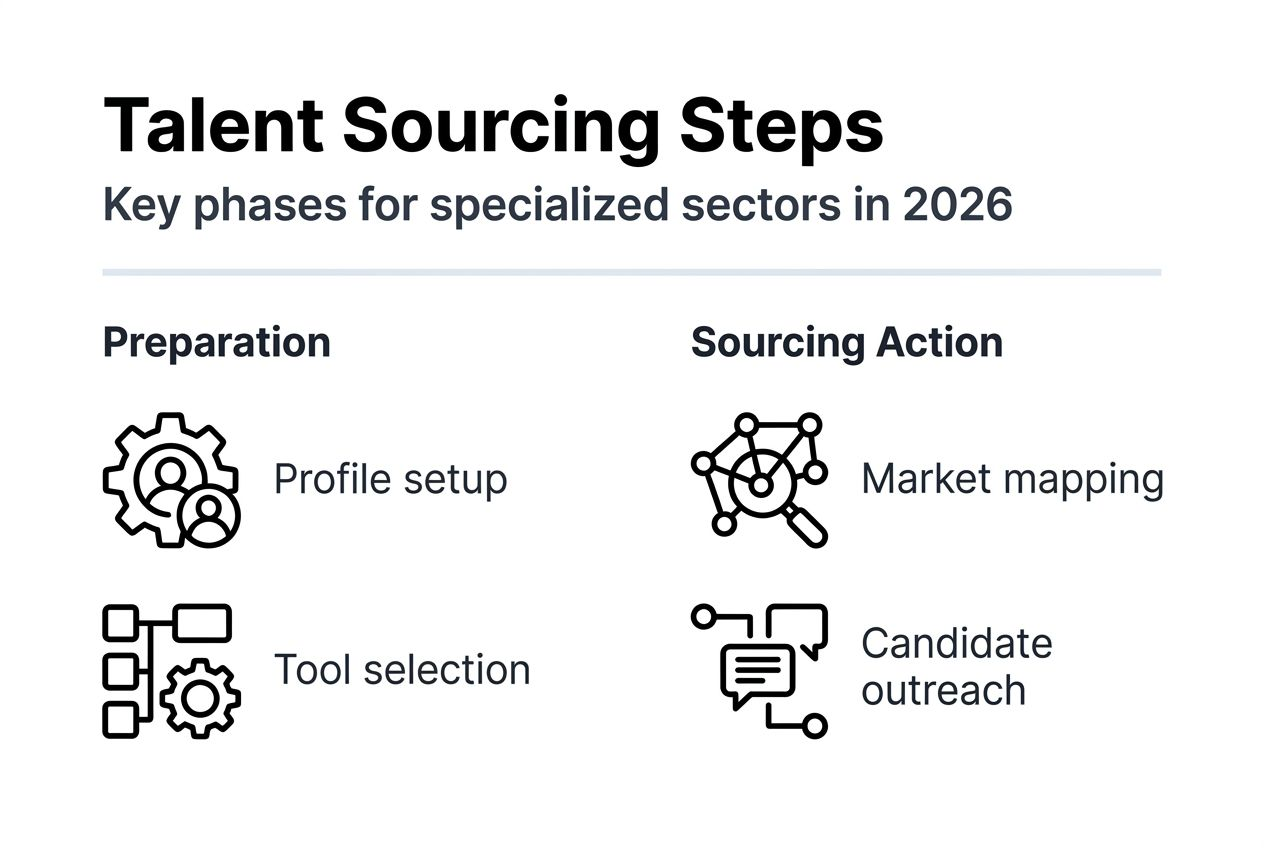
Building an effective talent sourcing process requires systematic execution across multiple stages. Follow these steps to create a repeatable framework that consistently identifies high-quality candidates.
1. Define your ideal candidate profile clearly
Work directly with hiring managers to document specific technical skills, years of experience, educational requirements, and cultural attributes. For engineering roles, specify required CAD software expertise or particular industry experience. Property management positions need clear parameters around portfolio size experience and property types managed.
2. Conduct thorough talent market mapping
Identify where your target candidates currently work. Research companies with similar roles, industry associations where professionals gather, and educational institutions producing qualified graduates. Map out talent concentrations geographically to understand where sourcing efforts should focus.
3. Develop compelling job descriptions and outreach materials
Create accurate position descriptions that emphasize unique aspects of the role, company culture, and growth opportunities. Highlight specific projects, technologies, or development opportunities that differentiate your opportunity from competitors. Generic descriptions fail to engage passive candidates who need compelling reasons to consider a change.
4. Leverage multiple sourcing channels strategically
- LinkedIn and professional networks for experienced professionals
- Industry-specific job boards and forums
- Technical conferences and trade shows
- Employee referral programs
- Alumni networks from relevant educational programs
- Competitor intelligence and strategic relationship building
5. Engage passive candidates with personalized outreach
Personalized messages increase candidate engagement by up to 40% compared to generic templates. Reference specific aspects of the candidate’s background, explain why you’re reaching out to them specifically, and focus on opportunities rather than immediate job openings. Passive candidates respond to relationship-building, not transactional recruiting pitches.
6. Implement AI-powered candidate identification
Global recruitment solutions increasingly rely on artificial intelligence to screen resumes, match candidates to requirements, and predict candidate success. These tools analyze thousands of profiles to identify matches human reviewers might miss. AI and human expertise in recruitment work together to improve both speed and quality.
7. Build and maintain an active talent pipeline
Don’t limit sourcing to immediate openings. Continuously identify and engage potential candidates for future roles. Maintain relationships through regular touchpoints, industry news sharing, and periodic check-ins. This pipeline approach means you have pre-qualified candidates ready when positions open.
| Sourcing Stage | Key Actions | Success Metrics |
|---|---|---|
| Profile definition | Hiring manager interviews, requirement documentation | Complete candidate persona with 10-15 specific criteria |
| Market mapping | Company research, talent pool analysis | Identified target companies and candidate locations |
| Outreach execution | Personalized messaging, multi-channel engagement | 25-40% response rate from targeted candidates |
| Pipeline development | Relationship nurturing, ongoing engagement | 3-6 month pipeline of qualified prospects |
Pro Tip: Schedule quarterly pipeline reviews with hiring managers to update candidate profiles based on evolving business needs and technology changes. Manufacturing automation and property technology evolve rapidly, requiring regular sourcing strategy adjustments.
Track all sourcing activities in your applicant tracking system to measure channel effectiveness, message performance, and conversion rates. Data-driven sourcing decisions consistently outperform intuition-based approaches.
Common mistakes and troubleshooting in talent sourcing
Even experienced recruiters make sourcing mistakes that waste time and reduce hiring quality. Recognizing these pitfalls helps you avoid costly errors and improve sourcing outcomes.
Vague or incomplete candidate profiles
Failing to define ideal candidate profiles clearly leads to misaligned sourcing and longer hiring times. Without specific technical requirements and cultural fit criteria, sourcers waste time on candidates who ultimately don’t match manager expectations. Fix this by creating detailed profiles before starting any search.
Over-reliance on active candidate pools
Posting jobs and waiting for applications limits your access to the strongest talent. The best candidates in specialized sectors are typically employed and not actively searching. Shift focus to proactive outreach targeting passive candidates through direct engagement strategies.
Neglecting sourcing technology and automation
Manual resume screening and candidate research consumes excessive time while introducing human error and bias. Optimizing recruitment with AI tools automates repetitive tasks, allowing recruiters to focus on relationship building and candidate assessment. Invest in modern sourcing platforms to remain competitive.
Generic, impersonal outreach messages
Templated messages that could apply to anyone receive low response rates. Passive candidates ignore generic recruiting pitches. Customize every message to reference specific aspects of the candidate’s background and explain precisely why this opportunity suits their career trajectory.
Ignoring cultural fit and soft skills
Focusing exclusively on technical qualifications creates hiring mistakes when candidates lack communication skills, adaptability, or team collaboration abilities. Higher turnover results from poor cultural matches. Balance technical screening with behavioral assessment to ensure comprehensive candidate evaluation.
Pro Tip: Implement a two-stage sourcing review where one team member evaluates technical fit and another assesses cultural alignment and soft skills. This reduces bias and improves overall candidate quality.
Inconsistent candidate engagement and follow-up
Sporadic communication damages candidate relationships and reduces conversion rates. Establish consistent touchpoint schedules and respond promptly to candidate inquiries. Passive candidates have options and will pursue opportunities where they feel valued and prioritized.
Expected outcomes and success metrics for effective talent sourcing
Measuring sourcing effectiveness requires tracking specific metrics that demonstrate both efficiency improvements and quality outcomes. Understanding realistic expectations helps you set appropriate goals and demonstrate value to stakeholders.
Time-to-hire reductions
Effective talent sourcing can reduce time-to-hire by more than 50% when leveraging AI tools and maintaining active pipelines. Manufacturing and engineering roles that previously took 60-90 days to fill can drop to 30-45 days with proactive sourcing. Property management positions benefit similarly from pre-qualified candidate pools.
Improved candidate engagement rates
Strong sourcing strategies achieve 25-40% response rates from targeted outreach campaigns. This compares favorably to 5-10% response rates from generic job postings. Higher engagement means more qualified candidates entering your pipeline and more hiring manager options.
Lower cost-per-hire through efficiency gains
Automated sourcing tools and strategic pipeline management reduce recruiting costs by minimizing time spent on unqualified candidates. Technology investments pay for themselves through faster fills and reduced agency fees. Internal sourcing capabilities decrease dependence on expensive external recruiters.
Enhanced quality of hire and retention
When sourcing focuses on both technical fit and cultural alignment, first-year retention rates improve significantly. Better candidate matches reduce turnover costs and improve team performance. Global talent acquisition trends show organizations with structured sourcing processes report 20-30% higher retention rates.
| Success Metric | Target Range | Measurement Method |
|---|---|---|
| Time-to-hire | 30-50% reduction | Track days from requisition to offer acceptance |
| Response rates | 25-40% | Monitor outreach messages to positive responses |
| Pipeline depth | 3-6 qualified candidates per role | Count pre-screened candidates for anticipated openings |
| Cost-per-hire | 20-35% reduction | Calculate total recruiting costs divided by hires |
| First-year retention | 85-90% | Track percentage of hires remaining after 12 months |
Track these metrics consistently to identify trends, optimize sourcing strategies, and demonstrate recruiting ROI. Share results with hiring managers and leadership to build support for sourcing investments and process improvements.
Conclusion and next steps for recruiters
A structured talent sourcing process transforms reactive hiring into proactive talent acquisition. By defining clear candidate profiles, leveraging modern sourcing technologies, engaging passive candidates strategically, and measuring outcomes consistently, you build competitive advantages in specialized sectors where talent scarcity challenges every organization.
The manufacturing, engineering, real estate, and property sectors demand recruiters who understand industry-specific requirements and maintain active talent pipelines. Generic recruiting approaches fail in these specialized fields. Success requires combining deep sector knowledge with advanced sourcing tools and relationship-building skills.
Start implementing these sourcing steps immediately. Begin with one open role, develop a detailed candidate profile, identify target companies where qualified candidates work, and launch personalized outreach campaigns. Track your results, refine your approach based on data, and gradually scale your sourcing capabilities across all recruiting activities.
Continuous improvement separates good sourcers from great ones. Regularly update your sourcing strategies based on technology advances, market changes, and performance data. Invest in your sourcing skills through training, industry research, and networking with other recruiting professionals. The competitive talent landscape rewards those who adapt quickly and execute consistently.
Discover tailored recruitment solutions with McGlynn Personnel
Navigating complex talent sourcing challenges in specialized sectors requires expert partnership and proven methodologies. McGlynn Personnel brings decades of experience connecting skilled professionals with leading employers across manufacturing, engineering, real estate, and property management industries globally.
Our tailored recruitment for specialized sectors combines deep industry knowledge with emerging technologies in talent sourcing to deliver candidates who meet both technical requirements and cultural fit criteria. We maintain extensive talent pipelines in niche markets where qualified professionals are scarce.

Whether you’re building internal sourcing capabilities or need immediate access to pre-qualified candidates, our team provides strategic guidance and execution support. Explore global talent acquisition best practices that drive measurable improvements in your hiring outcomes and competitive positioning.
FAQ
How can I define an ideal candidate profile for specialized sectors?
Collaborate directly with hiring managers to document specific technical skills, certifications, years of experience, and cultural fit requirements. For manufacturing roles, this includes machinery expertise and safety certifications, while property positions require specific software proficiencies and local market knowledge. Tailored recruitment for manufacturing roles demonstrates how detailed profiles improve sourcing precision and reduce time-to-hire.
What technologies and tools are essential for effective talent sourcing in 2026?
LinkedIn Recruiter provides access to professional networks and advanced search capabilities. Boolean search software enables precise candidate filtering based on multiple criteria. AI-powered sourcing platforms automate candidate identification, resume screening, and match scoring. Emerging technologies in talent sourcing streamline repetitive tasks while improving candidate quality.
How can recruiters effectively engage passive candidates in specialized sectors?
Personalize every outreach message by referencing specific aspects of the candidate’s background and explaining why this opportunity matches their career goals. Build relationships through industry networking, professional associations, and regular touchpoints before active job opportunities arise. Specialized recruitment tailored approach emphasizes relationship building over transactional recruiting to engage passive talent successfully.
What key performance indicators should be tracked to measure sourcing success?
Track time-to-hire reductions, candidate response and engagement rates, cost-per-hire metrics, and first-year retention rates. Monitor pipeline depth to ensure adequate pre-qualified candidates for anticipated openings. Key talent acquisition trends show organizations using data-driven sourcing metrics achieve consistently better hiring outcomes and demonstrate clear recruiting ROI.
Recommended
- Navigating the Future: Key Trends Shaping Global Talent Acquisition – Mcglynn Personnel
- Preparing Your Company for Emerging Market Talent Needs: A Strategic Guide – Mcglynn Personnel
- Navigating Global Recruitment Challenges: Strategic Solutions for Success – Mcglynn Personnel
- Why Specialised Recruitment Demands a Tailored Approach, Not One-Size-Fits-All – Mcglynn Personnel