
The term ‘Rust Belt’ often evokes images of industrial decline, but for today’s engineering and manufacturing professionals, this historical perception can be misleading and obscure significant opportunities. Conflicting information about the region’s economic state can make it difficult to assess its viability for career growth. Understanding what is the Rust Belt in the 21st century-beyond the outdated narratives-is essential for identifying where the future of American industry is being forged. The region, once defined by its economic challenges, is now undergoing a powerful revitalization driven by innovation in advanced manufacturing and technology.
This definitive guide is designed to provide the clarity you need. We will explore the historical significance and geographical boundaries of the Rust Belt, outlining its key states and the economic forces that shaped them. More importantly, we will provide a detailed analysis of the region’s modern job market, highlighting the economic revival that is creating new, high-value roles for skilled professionals. Our focus is to equip you with the precise information required to determine if your next career milestone awaits in America’s industrial heartland.
Key Takeaways
- Gain a comprehensive understanding of what is the Rust Belt by examining its historical roots in American industry and the economic shifts that shaped its identity.
- Identify the key states that form the industrial heartland and learn how its boundaries are defined more by economic history than strict state lines.
- Discover the ongoing economic transformation within the region, as innovation and investment fuel a modern industrial renaissance.
- Pinpoint high-demand career opportunities for manufacturing and engineering professionals emerging from the region’s revitalization.
Defining the Rust Belt: More Than Just a Map
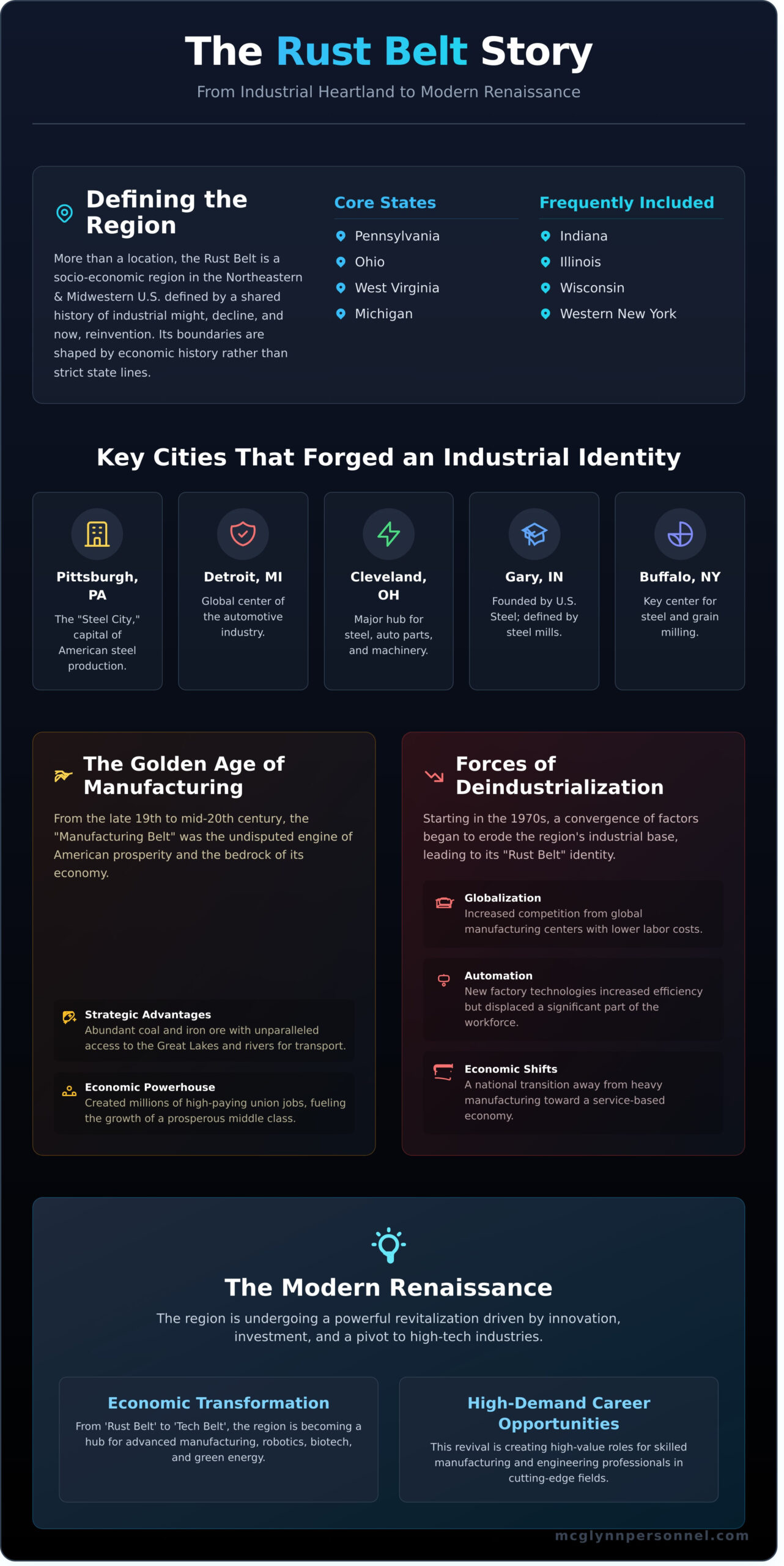
To understand the potential for a manufacturing resurgence, one must first answer the question: what is the rust belt? The term defines a socio-economic region across the Northeastern and Midwestern United States, characterized by a history of heavy industry and subsequent economic decline. The name itself, coined in the 1980s, paints a vivid picture of factories left to rust after a period of intense deindustrialization. This stands in stark contrast to the region’s former identity as the “Manufacturing Belt” or “Steel Belt”-the powerful engine of American industrial might for much of the 20th century. The Rust Belt is therefore more than a location; it represents a shared economic narrative of prosperity, decline, and the ongoing pursuit of reinvention.
Which States Are Considered Part of the Rust Belt?
While the exact boundaries are often debated, the Rust Belt is generally understood to encompass a core group of states whose economies were historically dominated by industrial manufacturing. The composition of this region is defined more by economic history and industrial concentration than by strict geographical lines.
[A map graphic illustrating the general Rust Belt region, highlighting the core states.]
- Core States: Pennsylvania, Ohio, West Virginia, and Michigan are universally included.
- Frequently Included States: Parts of Indiana, Illinois, Wisconsin, and Western New York are also central to the region’s identity and economic story.
Key Cities That Shaped the Region’s Identity
The identity of the Rust Belt was forged in its major industrial hubs, each a titan in its respective sector. These cities were the epicenters of innovation and production, drawing workers from across the nation and the world. Their industrial legacies continue to influence their modern economies and workforce composition.
- Pittsburgh, Pennsylvania: The undisputed capital of American steel production, earning it the nickname “Steel City.”
- Detroit, Michigan: The global center of the automotive industry, home to the “Big Three” automakers.
- Cleveland, Ohio: A major manufacturing hub for steel, automotive parts, and heavy machinery.
- Gary, Indiana: Founded by the U.S. Steel Corporation, its identity was intrinsically linked to steel mills.
- Buffalo, New York: A key center for steel manufacturing and grain milling, benefiting from its strategic location on Lake Erie.
The Rise and Fall: A Brief History of America’s Industrial Heartland
To understand what is the rust belt, we must first examine its origins as the undisputed engine of American prosperity. From the late 19th century through the mid-20th century, this region was a global hub of industrial innovation and production. Fueled by strategic advantages like abundant coal, iron ore, and unparalleled access to the Great Lakes and major rivers for transport, cities from Pittsburgh to Detroit became synonymous with progress and economic power.
The Golden Age of American Manufacturing
This era represented the zenith of American industrial might. The steel forged in Pennsylvania and Ohio built the nation’s skyscrapers and bridges, while the automotive plants in Michigan and Indiana put the world on wheels. This industrial dominance created a remarkably stable economic structure, offering millions of workers high-paying union jobs that fueled the growth of a prosperous middle class. For decades, the region was not just a manufacturing center; it was the bedrock of the American economy, projecting strength and dependability worldwide.
Forces of Deindustrialization
The economic landscape began a dramatic and challenging transformation in the 1970s. A confluence of powerful global and domestic forces started to erode the region’s industrial base, a process that would ultimately redefine its identity. The decline was not caused by a single event but by a convergence of factors that fundamentally altered the demand for American industrial labor and gave rise to the term that helps define what is the Rust Belt today.
- Globalization: Increased competition from manufacturing centers in Europe and Asia, which could often produce goods with lower labor costs, placed immense pressure on American industries.
- Automation: The integration of new technologies and robotics into factory processes increased efficiency and output but simultaneously displaced a significant portion of the workforce.
- Economic Shifts: A national transition away from a heavy manufacturing-based economy toward one centered on services, finance, and information technology left many industrial communities behind.
The consequences were profound. As factories closed, communities faced widespread job losses, leading to significant population decline and urban decay in once-thriving cities. This period of deindustrialization left a complex legacy of economic and social challenges. Overcoming these hurdles requires a deep understanding of the ongoing economic transformation in the Rust Belt, where new strategies are essential to connect regional talent with emerging opportunities.
The Rust Belt Today: A Story of Economic Transformation
The narrative of the American Rust Belt is undergoing a profound transformation. While the historical answer to what is the Rust Belt has long been associated with industrial decline and economic hardship, today’s reality is increasingly defined by innovation, diversification, and a strategic resurgence. This comeback is not about returning to the past but about forging a new, resilient economic identity built on modern strengths and forward-thinking investment. The region is actively shedding its old moniker, proving that its industrial legacy can serve as a foundation for future growth.
From Steel Mills to Tech Hubs
A key driver of this renaissance is the diversification away from a singular reliance on heavy industry. Major cities are now anchored by powerful “Eds and Meds”-world-class universities and medical centers. These institutions foster innovation and attract high-skilled talent. Pittsburgh, for example, has leveraged its academic prowess to become a global leader in robotics, artificial intelligence, and biomedical engineering, demonstrating a successful pivot from steel production to high-tech enterprise.
The Evolution of Modern Manufacturing
Manufacturing has not disappeared; it has evolved. The focus has shifted from mass production to high-value, advanced manufacturing. This new paradigm emphasizes:
- Precision Engineering: Creating complex components for aerospace, medical devices, and defense.
- Automation and Robotics: Implementing smart technologies to increase efficiency and quality control.
- Research & Development: Driving innovation in materials science and sustainable production methods.
This evolution, coupled with a growing reshoring trend, is creating demand for a new generation of skilled technicians and engineers.
Investment and Government Initiatives
This transformation is supported by significant public and private investment. Strategic initiatives are revitalizing former industrial sites for new commercial and technological use. Federal programs, such as the CHIPS and Science Act, are channeling billions of dollars into the region to bolster semiconductor manufacturing and scientific research. These efforts, combined with state and local tax incentives, create a competitive environment that attracts new businesses and fuels sustainable economic development. This evolving landscape requires specialized talent to maintain momentum, and McGlynn Personnel is committed to connecting companies with the experts needed to lead this industrial resurgence.
Career Opportunities in the Revitalized Rust Belt
The manufacturing resurgence across America’s industrial heartland is more than an economic headline; it is a profound shift creating high-value career paths for skilled professionals. For those asking what is the rust belt in the 21st century, the answer is a hub of innovation where legacy industry expertise merges with advanced technology. This transformation has opened a dynamic job market for talent ready to drive the next wave of industrial excellence.
In-Demand Roles for Engineering Professionals
The backbone of this revitalization is advanced engineering. Companies are actively recruiting professionals who can design, implement, and optimize the sophisticated systems that define modern production. Opportunities are expanding rapidly in high-growth sectors like electric vehicle (EV) manufacturing, battery technology, and renewable energy components. Key roles include:
- Mechanical & Industrial Engineers focused on process improvement, plant layout, and efficiency in lean manufacturing environments.
- Robotics & Automation Specialists who develop and maintain the automated systems crucial for global competitiveness.
- Electrical Engineers with expertise in power systems, controls, and the integration of smart technologies on the factory floor.
Advanced Manufacturing and Production Careers
Today’s manufacturing facilities are clean, high-tech environments that demand a new level of skill and precision. The demand is high for talent that can manage complex operations and ensure quality discipline. Critical positions include CNC Machinists, Quality Control Specialists with metrology experience, and Plant Managers who can lead teams effectively. Expertise in lean manufacturing principles and resilient supply chain management is highly valued, as companies prioritize efficiency and accountability in their day-to-day operations.
Why Consider a Career in the Rust Belt?
Beyond the professional opportunity, the region offers a compelling lifestyle advantage. Professionals benefit from a significantly lower cost of living compared to coastal tech hubs, allowing for greater financial stability and homeownership. The quality of life is enhanced by vibrant cities, world-class cultural institutions, and accessible outdoor recreation. Choosing a career here means more than just a job; it is a chance to be a vital part of a significant American economic comeback story.
As these industries continue to expand, the demand for top-tier talent will only increase. Navigating this dynamic landscape requires specialized insight. Our experts specialize in connecting talent with opportunity in these evolving industries, ensuring you are positioned for profound results in America’s industrial heartland.
The Rust Belt Reimagined: A Future Forged in Innovation
Ultimately, the answer to what is the rust belt is no longer confined to its historical identity as an industrial powerhouse. Today, the region is a compelling testament to American resilience, defined by profound economic diversification and a powerful resurgence. Sectors like advanced manufacturing, robotics, and biomedical engineering are not just emerging-they are thriving, creating a landscape rich with high-value career paths for skilled professionals.
Navigating this evolving industrial landscape requires a partner with dedicated expertise. At McGlynn Personnel, our specialized recruiters for advanced manufacturing and engineering possess a deep, firsthand understanding of this transformation. We are committed to delivering precision placements, connecting top-tier talent with the leading companies that are forging the Rust Belt’s innovative future. Our focus on quality and structure ensures we find the right fit for your long-term success.
Find your next career milestone in manufacturing or engineering. Explore our services.
Your next career milestone awaits in America’s revitalized industrial heartland. Let us help you build it.
Frequently Asked Questions About the Rust Belt
Why is it called the Rust Belt?
The term “Rust Belt” originated in the 1980s to describe the economic decline experienced by a region once dominated by heavy industry. The “rust” is a powerful metaphor for the shuttered factories, decaying steel mills, and abandoned industrial infrastructure that resulted from widespread deindustrialization. This name captures the transition from a thriving industrial powerhouse to a period of significant economic challenge, plant closures, and population loss that reshaped the American Midwest and Northeast.
Is the Rust Belt still in decline or is it recovering?
The narrative of decline is outdated. Today, the Rust Belt is undergoing a significant economic resurgence, driven by innovation and diversification. While some areas still face challenges, many cities are successfully transitioning their economies. This recovery is built on a foundation of advanced manufacturing, technology, healthcare, and logistics. Investment in new facilities and a highly skilled workforce are transforming the region into a hub for modern industrial and technological growth, marking a clear shift toward recovery.
What are the main industries in the Rust Belt today?
While traditional manufacturing remains a cornerstone, the region’s industrial landscape has evolved significantly. Key sectors now include advanced manufacturing, incorporating automation and robotics, as well as automotive R&D and electric vehicle (EV) production. Additionally, the “med-tech” and biotechnology industries are booming, particularly in cities like Cleveland and Pittsburgh. Logistics and e-commerce distribution have also become major economic drivers, leveraging the region’s central location and transportation infrastructure to ensure efficient supply chain operations.
Which major cities are located in the Rust Belt?
The Rust Belt encompasses a broad geographic area across the Upper Midwest and Great Lakes region. Understanding what is the rust belt involves recognizing its key urban centers. Prominent cities historically and currently associated with the region include Pittsburgh, Pennsylvania; Cleveland and Cincinnati, Ohio; Detroit, Michigan; Buffalo, New York; and Milwaukee, Wisconsin. Many smaller cities like Gary, Indiana, and Youngstown, Ohio, are also integral parts of the region’s industrial identity and ongoing transformation.
Are there good engineering and manufacturing jobs in the Rust Belt now?
Yes, the demand for skilled talent is robust. The resurgence is creating high-value roles in advanced manufacturing, process engineering, robotics, and supply chain management. Companies are actively seeking professionals with expertise in lean environments, quality assurance, and industrial automation. These are not the factory jobs of the past; they are sophisticated, technology-driven positions that offer competitive compensation and significant career growth opportunities for qualified candidates ready to drive the next wave of industrial innovation.
How has the population of the Rust Belt changed over time?
Historically, the region experienced significant population decline from the 1970s onward as deindustrialization led to widespread job loss and out-migration. However, this trend is reversing in many metropolitan areas. Revitalized urban cores, a lower cost of living, and new economic opportunities are now attracting young professionals, families, and immigrants. While some rural areas continue to face demographic challenges, the overall population trend in key economic hubs is stabilizing and, in some cases, showing modest growth.