
The cycle of high turnover, the challenge of finding candidates with the right technical skills, and a time-consuming screening process can feel like a constant battle for any production manager. These persistent issues not only disrupt operational efficiency but also directly impact your bottom line. In today’s competitive labor market, a reactive approach is no longer sufficient. A strategic, well-defined framework for production recruitment is essential to move from simply filling vacancies to building a dependable, high-performing team that drives results.
This comprehensive guide delivers that proven, step-by-step framework. We provide the structure and insight needed to attract, assess, and secure skilled professionals who are not just capable, but committed to your company’s long-term success. By implementing this process, you can reduce time-to-hire, significantly improve the quality of new hires, and build the stable production team required to meet and exceed your business objectives.
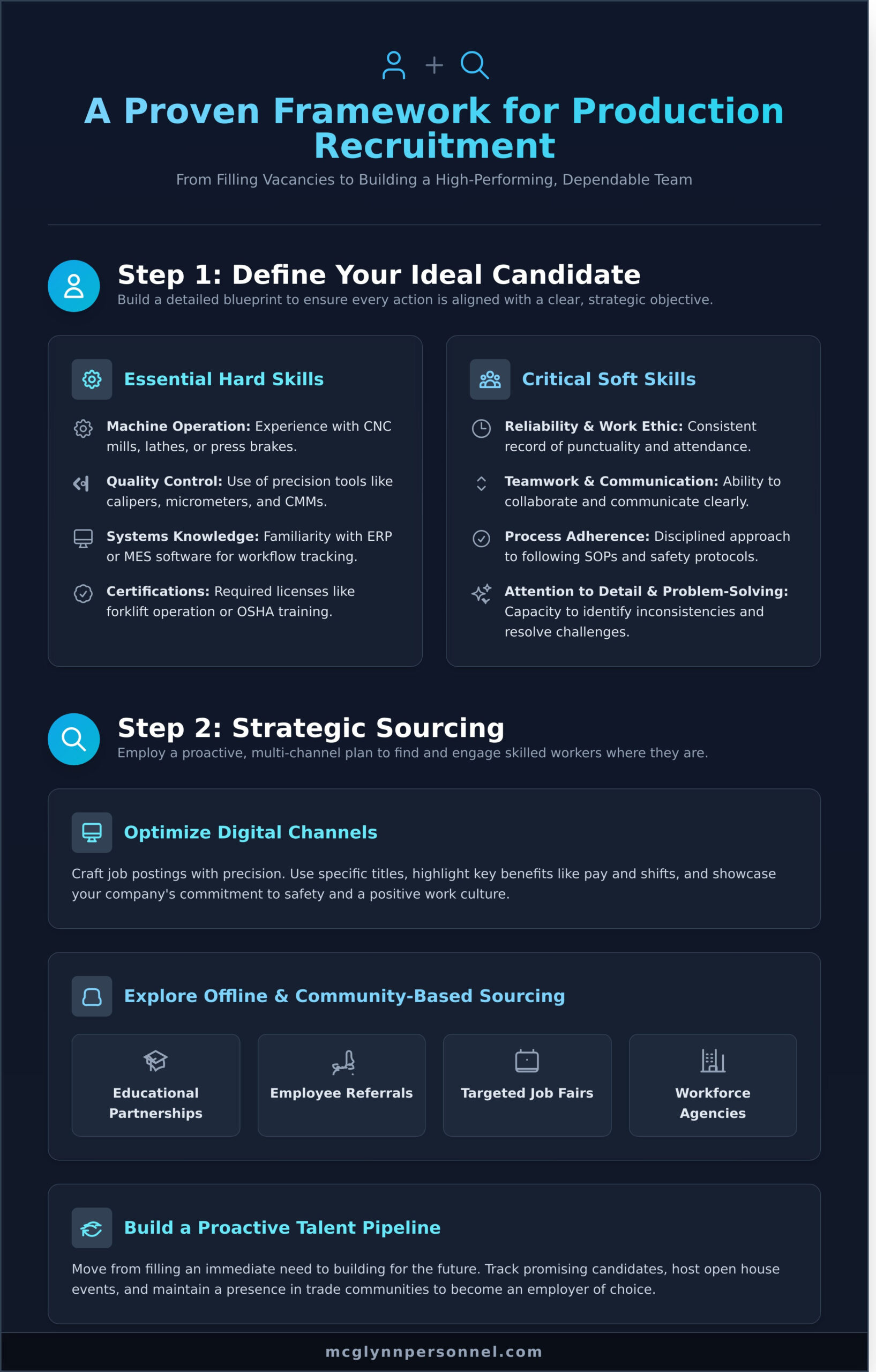
Defining Your Ideal Candidate: The Foundation of Production Recruitment
A successful production recruitment strategy begins not with sourcing candidates, but with a precise and comprehensive definition of the ideal hire. Moving beyond a simple list of daily tasks is critical; the goal is to build a detailed candidate profile that serves as the blueprint for the entire engagement. This foundational stage of the recruitment process ensures that every subsequent action, from screening to interviewing, is aligned with a clear, strategic objective. To achieve this clarity, we prioritise collaboration with current team leads and supervisors. Their firsthand knowledge of the production floor provides invaluable insight into the specific competencies that drive success and efficiency.
A truly effective profile clearly differentiates between non-negotiable requirements and beneficial qualifications. This distinction allows for a more flexible yet targeted search, widening the talent pool without compromising on core capabilities. We structure this profile around two key pillars: essential hard skills and critical soft skills.
Essential Hard Skills for Modern Production
Technical proficiency is the baseline for performance in any advanced manufacturing environment. We screen for proven capability in the specific operational demands of the role. This includes:
- Machine Operation: Verifiable experience with relevant machinery, such as CNC mills, lathes, or press brakes.
- Quality Control: Demonstrated use of precision measurement tools, including calipers, micrometers, and CMMs, to ensure compliance with quality standards.
- Systems Knowledge: Familiarity with essential software like Enterprise Resource Planning (ERP) or Manufacturing Execution Systems (MES) for tracking workflow and inventory.
- Certifications: Required licenses or safety credentials, such as forklift operation certification, OSHA training, or specific welding qualifications.
Critical Soft Skills for a Cohesive Team
While technical skills are essential, the right behavioural traits determine a candidate’s long-term value and integration into the team. Our screening focuses on the attributes that support a structured, high-accountability workplace:
- Reliability and Work Ethic: A consistent record of punctuality, attendance, and a commitment to fulfilling job responsibilities with diligence.
- Teamwork and Communication: The ability to collaborate effectively with colleagues and communicate clearly to ensure seamless operations.
- Process Adherence: A disciplined approach to following controlled processes, standard operating procedures (SOPs), and safety protocols precisely.
- Attention to Detail and Problem-Solving: The capacity to identify inconsistencies, maintain high standards of quality, and contribute to resolving operational challenges.
Strategic Sourcing: Where to Find Skilled Production Workers
In today’s competitive manufacturing landscape, a reactive approach to hiring is no longer sufficient. A successful production recruitment strategy depends on a proactive, multi-channel sourcing plan that moves beyond standard job boards. To secure best-in-class talent, companies must identify and engage candidates where they are, tapping into often-overlooked local pools and building a sustainable pipeline for future needs.
This disciplined approach ensures a steady flow of qualified individuals, reducing time-to-hire and enhancing operational efficiency. The key is to combine precise digital targeting with authentic community engagement.
Optimizing Job Postings and Digital Channels
Your digital presence is the frontline of your sourcing efforts. Craft job postings with precision, using specific titles like ‘Welder’ or ‘CNC Machinist’ instead of generic terms. Clearly articulate the role’s value by highlighting key benefits such as competitive pay rates, defined shift patterns, and opportunities for professional development. Use the description to showcase your company’s commitment to safety and a positive work culture, which are critical decision factors for production professionals.
Exploring Offline and Community-Based Sourcing
Deepen your talent pool by building strong local connections. A robust sourcing strategy integrates several offline channels to find skilled workers who may not be active on major job boards. We recommend focusing on four key areas:
- Educational Partnerships: Collaborate with local vocational schools and community colleges to connect with emerging talent at the start of their careers.
- Employee Referrals: Implement a structured referral program with clear incentives. Your current high-performing employees are your best source for finding others with a similar work ethic.
- Targeted Job Fairs: Prioritize attendance at local job fairs focused specifically on manufacturing, engineering, and the skilled trades.
- Workforce Agencies: Build relationships with local workforce development agencies that offer specialized manufacturing workforce development services to connect with vetted, job-ready candidates.
Building a Proactive Talent Pipeline
The ultimate goal of strategic sourcing is to move from filling an immediate need to building a long-term talent pipeline. Create a system to track promising candidates who were a strong fit but not hired for a previous role. Consider hosting factory tours or ‘open house’ events to engage passive candidates and showcase your facility. Maintaining a presence in online forums and trade communities also allows you to build a reputation as an employer of choice, making your future production recruitment efforts more effective.
The Interview Process: Assessing for Skill, Safety, and Fit
A structured interview process is fundamental to successful production recruitment. While a CV outlines experience, a multi-stage interview uncovers a candidate’s true capability, safety mindset, and cultural alignment. Each step must be deliberately designed to move beyond qualifications on paper and predict actual on-the-job performance. By involving key team members, such as shift supervisors or lead operators, you gain a more holistic evaluation and ensure the new hire integrates seamlessly into your existing operational structure.
Conducting an Effective Technical Screening
The initial phone screen is a critical efficiency tool. It allows you to quickly verify that a candidate meets the non-negotiable requirements before investing further time. This brief conversation should confirm their essential qualifications, experience with specific machinery or controlled processes, and alignment on salary expectations. We recommend asking targeted questions to gauge their technical acumen, such as their understanding of key production metrics like Overall Equipment Effectiveness (OEE) or scrap rates.
Behavioral Questions for Production Roles
Behavioral questions provide insight into a candidate’s past performance, which is a strong predictor of future behavior. Focus on scenarios directly relevant to a manufacturing environment to assess soft skills, problem-solving abilities, and a commitment to quality and safety. Key areas to explore include:
- Safety and Compliance: “Describe a time you identified and addressed a potential safety hazard.”
- Quality Control: “Tell me about a situation where you caught a quality defect. What steps did you take?”
- Teamwork and Accountability: “Give an example of how you worked with your team to meet a challenging production deadline.”
- Focus and Diligence: “How do you maintain accuracy and focus while performing repetitive tasks for an entire shift?”
Implementing Practical Skills Assessments
For technical roles, a hands-on assessment is the most reliable way to validate a candidate’s skills. This step moves from theoretical discussion to practical application, confirming they possess the proven capability your operation requires. Depending on the role, these assessments can take several forms, from blueprint reading exercises to a work simulation that tests their ability to follow a multi-step process with precision. A well-designed practical test is the final layer of assurance in any rigorous production recruitment strategy. Let our experts handle the screening process for you.
From Offer to Onboarding: Securing Talent and Ensuring Retention
A successful recruitment process does not conclude when a candidate accepts your offer; that is merely the transition point. The final stages-the offer and onboarding-are where top talent is either secured for the long term or lost due to a lack of structure and follow-through. A methodical approach in this phase is critical for maximizing retention and ensuring your new hire becomes a productive, integrated member of the team from day one. This is a crucial final step in any effective production recruitment strategy.
Executing these final steps with precision validates the promises made during the hiring process and sets a professional tone for the employment relationship ahead.
Crafting a Competitive Job Offer
In a competitive market, speed and clarity are paramount. A compelling offer demonstrates your commitment and leaves no room for ambiguity. We ensure our clients present offers that are not only competitive but also comprehensive, providing the candidate with all the information needed to make a confident decision. A best-in-class offer includes:
- Market-Aligned Compensation: We benchmark salary and benefits against current local data to ensure your offer is attractive and fair.
- Complete Transparency: The offer clearly outlines the job title, responsibilities, shift schedule, direct supervisor, and a full breakdown of the compensation package.
- Decisive Action: Top candidates often have multiple opportunities. Moving quickly from the final interview to a formal offer minimizes the risk of losing them to a competitor.
- Personalized Communication: A direct, personal phone call to extend the offer reinforces your interest and makes the candidate feel valued as your top choice.
Designing a Structured Onboarding Program
Effective onboarding is the bridge between a new hire and a fully productive employee. A structured program reduces uncertainty and accelerates integration, directly impacting long-term retention. The focus should be on creating an environment of safety, clarity, and support. A strong onboarding process links the promises made during production recruitment to the reality of the role.
Key components include preparing their workstation and credentials before arrival, dedicating significant time to safety training and procedures in the first week, and assigning a mentor or buddy to guide them. Setting clear 30, 60, and 90-day expectations with scheduled check-ins provides a roadmap for success and demonstrates your investment in their professional development. This structured approach ensures every new team member is equipped to contribute effectively and safely. To learn more about building a workforce with precision, visit mcglynnpersonnel.com.
Leveraging a Specialist Agency for Precision Placements
While an internal team is invaluable, managing the complexities of hiring for production roles can divert significant time and resources from core operational duties. The pressure to fill vacancies quickly often leads to a rushed process, increasing the risk of a costly mis-hire that can disrupt productivity and quality control.
A specialist recruitment partner mitigates these risks by providing dedicated expertise and a structured, efficient process. These firms possess deep market knowledge and maintain extensive networks of qualified talent, including passive candidates who are not actively searching but are open to the right opportunity. This access accelerates hiring timelines and elevates the quality of candidates presented for consideration.
When to Partner with a Recruitment Specialist
Engaging a firm is most effective when your organization faces specific, high-stakes hiring challenges. Consider a partnership in the following scenarios:
- Urgent or Multiple Roles: When you need to scale your team quickly without compromising on quality.
- Specialized Technical Skills: For positions requiring niche expertise in areas like lean manufacturing, metrology, or advanced automation.
- Limited Internal Resources: If your HR or management team lacks the bandwidth or specific expertise for a thorough talent search.
- Confidential Searches: When discretion is paramount for filling a critical leadership or strategic position.
The Value of a Firm like McGlynn Personnel
Partnering with a dedicated firm like McGlynn Personnel transforms your production recruitment strategy from a resource drain into a strategic advantage. We provide a clear, dependable framework for securing best-in-class talent.
- Access to Vetted Talent: We connect you with a pre-vetted pool of active and passive candidates, significantly reducing your time-to-hire.
- Expert Screening: Our process focuses on the precise technical skills and quality disciplines required to excel on your production line.
- End-to-End Management: We manage the entire process, from targeted sourcing and initial screening to interview coordination and offer negotiation.
- Profound, Long-Term Results: Our commitment to precision placements ensures new hires integrate seamlessly and contribute to your long-term success.
By entrusting your hiring needs to a specialist, you invest in efficiency, quality, and accountability. Discover how McGlynn Personnel delivers the talent that brings structure and order to your operations, ensuring you achieve profound results.
Achieve Production Excellence Through Strategic Recruitment
Mastering the art of hiring top-tier production talent begins with a clearly defined candidate profile and extends through a structured process of sourcing, interviewing, and onboarding. This strategic approach not only identifies skilled individuals but also ensures they are a strong cultural and safety fit, significantly boosting long-term retention. While these strategies provide a robust framework, navigating the competitive landscape of production recruitment demands specialized expertise and a dedicated focus.
This is where a dedicated partner makes a profound difference. As specialists in Manufacturing & Engineering Recruitment, McGlynn Personnel leverages global reach with local insight and a proven process for precision placements. We bring the structure and accountability necessary to connect you with the best-in-class talent your operations depend on.
Ready to build a high-performing team that drives results? Connect with our manufacturing recruitment specialists today. Your next milestone in operational excellence begins with the right people.
Frequently Asked Questions
What are the most important qualities to look for in a production worker?
Beyond technical skills, focus on core attributes that drive efficiency and quality. Key qualities include a strong attention to detail, a commitment to safety protocols, and proven reliability. Look for candidates who demonstrate problem-solving skills and the ability to work collaboratively within a team. A candidate’s capacity to follow controlled processes and maintain high standards of quality discipline is paramount in any lean manufacturing environment. These traits ensure consistency and operational excellence on the production floor.
How can I write a job description that attracts more qualified applicants?
To attract top-tier talent, your job description must be precise and results-oriented. Clearly outline the core responsibilities, required technical skills (e.g., CNC operation, quality control checks), and performance expectations. Use specific, action-oriented language to describe the role’s impact on the company. We also recommend highlighting opportunities for professional development and detailing your company’s commitment to a safe and structured work environment. This approach attracts candidates who value accountability and career growth.
What is the best way to reduce high turnover on my production team?
Reducing turnover begins with a structured recruitment process that ensures a strong cultural and technical fit from the start. Beyond hiring, focus on creating an environment of accountability and support. Implement clear communication channels, provide regular performance feedback, and offer competitive compensation and benefits. Investing in ongoing training and establishing clear pathways for career advancement demonstrates a long-term commitment to your team, fostering loyalty and significantly improving retention rates.
How long does the typical production recruitment process take?
The timeline for a typical production recruitment process can range from two to six weeks, depending on the role’s complexity and the urgency of the need. The process typically includes sourcing, comprehensive screening, interviews, skills testing, and reference checks. Partnering with a specialized agency can significantly accelerate this timeline. Our streamlined processes and pre-vetted talent pools are designed to deliver qualified candidates efficiently, ensuring your production lines remain fully operational with minimal disruption.
Are practical skills tests effective for hiring production staff?
Yes, practical skills tests are highly effective and a critical component of a robust hiring strategy. These assessments provide tangible evidence of a candidate’s technical proficiency, moving beyond resumes to verify real-world capabilities. For example, a simple assembly task for an assembler or a metrology test for a quality inspector can confirm precision and attention to detail. This focus on proven capability ensures new hires can meet performance standards from day one, improving quality outcomes.
How much does it cost to work with a manufacturing recruitment agency?
The cost of partnering with a manufacturing recruitment agency is typically structured as a percentage of the hired candidate’s first-year salary. This fee, which varies based on the role’s seniority and specialization, is an investment in securing best-in-class talent efficiently. A reputable agency provides a significant return by reducing time-to-hire, minimizing hiring risks, and delivering candidates with proven capabilities. This strategic approach ensures you gain a valuable team member who contributes to profound results.