
In a competitive market, finding an engineer with the precise blend of technical expertise and cultural alignment can feel nearly impossible. Too often, the hiring process becomes reactive, leaving you sifting through unqualified applicants while top candidates accept offers elsewhere. This cycle of frustration, however, is not a mandatory part of building a world-class team. Transforming your approach to engineering recruitment from a reactive search into a strategic, structured system is the key to securing the industry’s best talent and achieving dependable, high-quality results.
This comprehensive guide is designed to provide that essential structure. We will navigate the complexities of the 2025 talent landscape, outlining proven strategies to build a predictable hiring pipeline, reduce your time-to-hire, and effectively assess highly technical candidates. You will gain a clear roadmap to confidently identify and attract the engineering professionals who will drive your organization’s innovation forward, ensuring every placement is a profound success.
What is Engineering Recruitment and Why Is It So Challenging?
Engineering recruitment is a highly specialized field of talent acquisition focused on identifying, vetting, and securing professionals for technical engineering roles. Unlike general human resources, this discipline moves far beyond matching keywords on a resume. It elevates the standard recruitment process by demanding a deep, functional understanding of complex engineering principles, software, and industry-specific compliance standards. Success requires recruiters who can speak the language of engineers and accurately assess technical capabilities.
Today’s market is defined by a significant talent paradox: the demand for skilled engineers across sectors like advanced manufacturing, aerospace, and technology is at an all-time high, while the supply of qualified, available candidates remains critically low. This imbalance creates an intensely competitive landscape where leaving a key engineering role vacant can directly impede innovation, delay production, and impact revenue. The cost of inaction is substantial, making efficient and precise engineering recruitment a strategic business imperative.
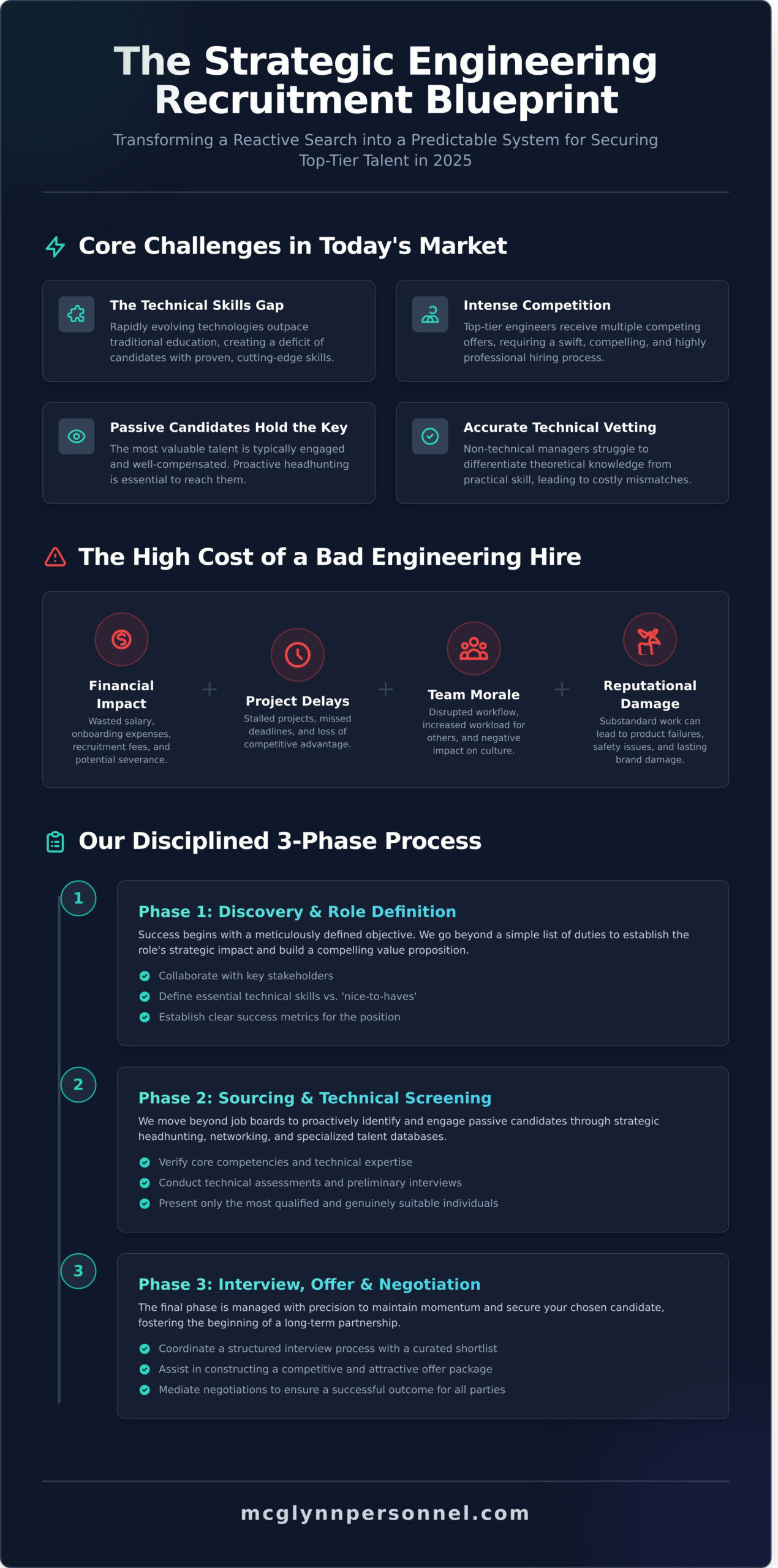
The Core Challenges in Today’s Market
Navigating the engineering talent market requires overcoming several distinct and formidable obstacles. The most successful recruitment strategies are built on a clear understanding of these core challenges:
- The Technical Skills Gap: Rapidly evolving technologies, from AI integration to advanced materials science, often outpace traditional university curricula, creating a deficit of candidates with proven, cutting-edge skills.
- Intense Competition: Top-tier engineers are in high demand and often receive multiple, competing offers. Securing their commitment requires a swift, compelling, and highly professional process.
- Passive Candidates: The most valuable talent is typically well-compensated and engaged in their current role. Proactively identifying and engaging these passive candidates is essential for building a high-performance team.
- Accurate Technical Vetting: Non-technical hiring managers often struggle to differentiate between theoretical knowledge and practical, applied skill, leading to mismatches that surface only after the hire is made.
The High Cost of a Bad Engineering Hire
The consequences of an imprecise hiring decision extend far beyond the initial recruitment fee. A bad hire introduces significant risk and quantifiable costs that can affect every level of the organization.
- Financial Impact: Direct costs include wasted salary, onboarding and training expenses, recruitment fees, and potential severance packages.
- Project Delays: A skills mismatch can stall critical projects, leading to missed deadlines, loss of competitive advantage, and stakeholder dissatisfaction.
- Team Morale: An underperforming team member can disrupt workflow, increase the workload for others, and negatively impact team culture and productivity.
- Reputational Damage: Substandard engineering work can lead to product failures, safety issues, and lasting damage to a company’s brand and market reputation.
The Engineering Recruitment Process: A Step-by-Step Breakdown
Effective engineering recruitment is not an ad-hoc activity; it is a structured framework built on precision, accountability, and a deep understanding of the technical landscape. While many companies approach hiring with reactive urgency, a methodical process eliminates costly errors, saves valuable time, and consistently delivers superior talent. This is the disciplined approach a professional recruitment partner follows to bring order and predictability to the complex challenge of securing best-in-class engineers.
Our process is organized into three distinct, results-oriented phases designed to ensure a seamless and successful outcome.
Phase 1: Discovery and Role Definition
Success begins with a meticulously defined objective. We collaborate closely with your key stakeholders to develop a comprehensive job specification that goes beyond a simple list of duties. This involves a critical analysis of essential technical skills versus ‘nice-to-have’ qualifications. Whether defining requirements across various engineering disciplines or for a niche role, clarity is paramount. We establish the position’s strategic impact, define success metrics, and craft a compelling value proposition to attract the high-caliber professionals who will drive your organization forward.
Phase 2: Sourcing and Technical Screening
Top engineering talent is often not actively looking for a new role. Our methodology moves beyond passive job boards to proactively identify and engage these candidates through strategic headhunting, extensive networking, and our specialized talent databases. Every potential candidate undergoes a rigorous initial screening to verify core competencies, technical expertise, and proven experience. This stage frequently includes technical assessments or preliminary interviews to ensure that only the most qualified and genuinely suitable individuals are presented for consideration.
Phase 3: Interview, Offer, and Negotiation
The final phase is managed with precision to maintain momentum and secure your chosen candidate. We coordinate a structured interview process with your hiring team, presenting a curated shortlist of highly vetted professionals who align with both your technical and cultural requirements. Following your selection, we assist in constructing a competitive offer package designed to attract and retain top talent. Our role extends to mediating negotiations, skillfully managing expectations to ensure a successful outcome for both you and your new hire, fostering the beginning of a long-term partnership.
Key Engineering Disciplines and Specializations We Recruit For
The field of engineering is vast and multifaceted, encompassing a wide spectrum of disciplines that demand highly specialized knowledge and technical proficiency. A generic approach to talent acquisition is insufficient; successful engineering recruitment requires a deep, granular understanding of the unique challenges and skill sets inherent to each specialization. We recognize that sourcing a Quality Engineer for a lean manufacturing environment involves a different strategy than finding a Structural Engineer for a major infrastructure project. This specialized focus is critical for navigating today’s complex engineering workforce challenges and ensuring a precise match between talent and opportunity.
Our expertise is structured across the core pillars of the engineering industry, from traditional roles that form the bedrock of production to the emerging fields driving future innovation.
Core Manufacturing and Industrial Roles
These roles are fundamental to operational excellence and product integrity. We recruit professionals who bring order and efficiency to complex production environments, ensuring that processes are optimized and quality standards are rigorously upheld.
- Mechanical Engineers: Specialists in designing, developing, and testing mechanical and thermal devices, from individual components to large-scale machinery.
- Electrical Engineers: Experts focused on designing, developing, and managing electrical systems, equipment, and components for a wide range of applications.
- Manufacturing & Process Engineers: Professionals dedicated to optimizing production processes, improving workflow efficiency, and implementing lean manufacturing principles.
- Quality Engineers: Meticulous experts who ensure products meet stringent quality and compliance standards through rigorous testing, analysis, and process control.
Civil and Structural Engineering
We connect clients with the talent responsible for designing, building, and maintaining the world’s infrastructure. These roles demand a combination of technical precision, robust project management skills, and a deep understanding of regulatory frameworks.
- Civil Engineers: Planners and overseers for large-scale public and private infrastructure projects, including transportation, water systems, and public works.
- Structural Engineers: Specialists who focus on the integrity and durability of structures, ensuring they are safe, stable, and built to last.
- Project Managers: Leaders who guide engineering projects from initial conception through to completion, managing timelines, budgets, and stakeholders to deliver results.
Emerging Technology and Advanced Engineering
This dynamic sector is at the forefront of technological advancement. Our engineering recruitment services extend to these highly competitive fields, identifying candidates with the forward-thinking expertise needed to drive innovation.
- Aerospace Engineers: Innovators who design and develop aircraft, spacecraft, satellites, and missile systems in a highly regulated industry.
- Biomedical Engineers: Professionals who bridge the gap between engineering and medicine, creating medical devices, diagnostic equipment, and new biological therapies.
- Semiconductor Engineers: Highly specialized experts working on the design, fabrication, and testing of microchips and integrated circuits.
- Controls Engineers: Specialists in designing and implementing advanced automated systems, robotics, and dynamic process controls.
Recruitment Models: In-House vs. Specialist Agency
Selecting the right recruitment model is a strategic business decision that directly impacts your ability to attract and retain top engineering talent. While both in-house teams and specialist agencies have their merits, the optimal choice depends on your company’s scale, hiring velocity, and the technical specificity of the roles you need to fill. Understanding the core strengths and limitations of each approach is fundamental to building a high-performing engineering department.
The In-House Recruitment Approach
Managing recruitment internally grants you complete control over the process and ensures every candidate interaction is aligned with your company culture. This model is often effective for businesses with a consistent, high-volume need for engineers and a robust, well-established HR department capable of managing the entire talent acquisition lifecycle.
- Pros: Deep cultural alignment, direct brand control, and potentially lower cost-per-hire for generalist roles.
- Cons: A limited talent pool often restricted to active job seekers, and internal teams may lack the niche technical expertise to accurately vet highly specialized candidates.
Partnering with a Specialist Engineering Recruitment Agency
A specialist agency functions as a dedicated partner, providing deep market expertise and access to talent that is otherwise out of reach. For critical hires, roles requiring niche skills, or periods of rapid scaling, this model delivers unparalleled efficiency and precision. The associated fees are an investment in speed, quality, and securing the right technical fit the first time.
- Pros: Immediate access to a vast network of passive candidates, expert technical screening, valuable market intelligence, and a significantly faster time-to-hire.
- Cons: Requires a financial investment, typically structured as a contingency or retained search fee.
Why Specialization Matters More Than Ever
In a field as complex as engineering, a generalist recruiter can match keywords on a resume, but a specialist understands the practical difference between a Controls Engineer and an Automation Engineer. True expertise in engineering recruitment involves more than just sourcing; it requires a deep understanding of industry trends, salary benchmarks, and competitor movements. Niche agencies cultivate long-term relationships with top-tier talent, enabling them to make connections based on proven capability and genuine fit, not just availability. This level of focus ensures every placement adds immediate and lasting value. Discover how our precision placements deliver profound results.
How to Choose the Right Engineering Recruitment Partner
Selecting a recruitment partner is a strategic decision that directly impacts your team’s capability and your company’s future success. The right firm acts as an extension of your team, providing market intelligence, access to exclusive talent, and a structured process that ensures quality. To make an informed choice, you must evaluate potential partners on a specific set of criteria that goes beyond surface-level promises.
A successful partnership in engineering recruitment is built on expertise, a proven methodology, and a robust network. Before committing, consider the following key areas to ensure you are aligning with a firm that can deliver superior results.
Evaluate Their Industry Expertise and Focus
Does the firm specialize exclusively in engineering or are they a generalist agency? A specialist understands the nuanced technical requirements and cultural fit necessary for highly specific roles. Their recruiters often have direct industry backgrounds, enabling them to vet candidates with greater precision. Ask for case studies or testimonials from companies with similar challenges to validate their track record and confirm their expertise in your specific sector.
Analyze Their Recruitment Process and Methodology
A top-tier partner utilizes a multi-channel sourcing strategy that extends far beyond public job boards. Inquire about their process for identifying and engaging passive candidates-the high-value professionals who are not actively looking for a new role. A dependable firm should be able to articulate a clear, structured process that includes:
- Comprehensive Sourcing: Proactive headhunting and leveraging proprietary talent networks.
- Rigorous Vetting: In-depth technical screening and competency-based interviews.
- Transparent Communication: A defined structure for reporting, feedback, and stakeholder updates.
Assess Their Network and Market Reach
The strength of a recruitment firm lies in its network. Determine whether their talent pool is local, national, or global, and ensure it aligns with your hiring needs. A great partner not only has access to candidates but actively nurtures their talent community, allowing them to provide valuable insights into current salary benchmarks, market trends, and competitor activity. This intelligence is critical for positioning your offers competitively and securing the best talent.
Ultimately, the right partner brings order and accountability to your hiring process, delivering precision placements that drive profound results. To see how a dedicated approach to technical talent acquisition can benefit your organization, we invite you to explore our specialized services.
Elevate Your Team with a Strategic Recruitment Partner
Navigating the complexities of sourcing elite engineering talent requires a structured, strategic approach. As we’ve explored, a successful engineering recruitment strategy hinges on a well-defined process and the critical decision between an in-house team and a specialist agency. The right partner doesn’t just fill a role; they build the foundation for your organization’s future innovation by delivering candidates who align perfectly with your technical and cultural requirements.
At McGlynn Personnel, we bring structure and accountability to this critical function. As specialists in the Manufacturing, Engineering, and Real Estate sectors, we leverage a proven process that ensures precision placements and profound results. Our global reach, combined with deep local market insight, allows us to connect you with the best-in-class talent that drives your business forward.
Take the next step in building your world-class team. Connect with our engineering recruitment specialists today. We are committed to delivering the superior results your organization deserves.
Frequently Asked Questions About Engineering Recruitment
What is the difference between an engineering staffing agency and a recruitment firm?
While both connect talent with opportunity, their focus differs. A staffing agency typically fills temporary, contract, or temp-to-hire positions, prioritizing speed to meet immediate operational needs. A recruitment firm, like McGlynn Personnel, focuses on strategic, long-term placements. We conduct comprehensive searches for permanent roles, ensuring a precise match for both technical requirements and company culture. Our goal is to build lasting partnerships by securing foundational talent for your organization.
How long does the engineering recruitment process typically take?
The timeline for a successful placement varies based on the role’s complexity and market conditions, but a typical search is completed within 4 to 8 weeks. This process includes an in-depth consultation, targeted candidate sourcing, rigorous screening and vetting, interview coordination, and offer negotiation. We prioritize efficiency and clear communication at every stage, providing regular updates to all stakeholders to ensure a smooth and predictable process from start to finish.
What are the common fee structures for engineering recruitment services?
The two primary models are contingency and retained search. A contingency search means a fee is only paid upon the successful hiring of a candidate we present. This model is effective for many mid-level roles. A retained search involves an upfront commitment and is reserved for senior, executive, or highly specialized positions. This structure secures dedicated resources for a more exhaustive and targeted search, guaranteeing a higher level of service and commitment to filling a critical role.
How do you technically vet candidates for highly specialized engineering roles?
Our vetting process is meticulous and multi-layered to ensure precision. It begins with a deep-dive screening by recruiters who possess specialized industry knowledge. This is followed by customized technical assessments relevant to the role, such as challenges in CAD, FEA, or specific coding languages. Finally, candidates undergo interviews with subject matter experts from our network, confirming their practical capabilities and problem-solving skills. This structured approach ensures only the most qualified individuals are presented.
Can a recruitment agency help us hire for multiple engineering roles at once?
Absolutely. We are equipped to manage multiple, concurrent search assignments, which is a core component of effective engineering recruitment. By handling several roles simultaneously, we can build a robust talent pipeline, streamline the interview process for your hiring managers, and create efficiencies across your talent acquisition efforts. This coordinated approach ensures consistency in candidate quality and accelerates your team’s growth while maintaining our focus on precision placements for each unique position.
What information should we provide to a recruiter to ensure the best results?
To deliver profound results, we require a clear and comprehensive overview of your needs. This should include a detailed job description with key responsibilities, a precise list of “must-have” versus “nice-to-have” technical skills and qualifications, and the approved salary range. Equally important is providing insight into your company culture, team dynamics, and the specific challenges the new hire will address. This information allows us to act as a true partner, ensuring a perfect long-term fit.