
Sourcing talent globally has become essential for manufacturing, engineering, and real estate sectors facing unprecedented skill shortages and competitive hiring pressures in 2026. HR professionals must navigate complex regional markets, cultural differences, and evolving candidate expectations while maintaining efficient recruitment pipelines. This guide provides evidence-based strategies to expand your talent pools beyond local limits, leverage direct hire solutions, and build sustainable global sourcing capabilities. You’ll discover how to prepare your organization, execute effective sourcing strategies, and troubleshoot common challenges that impact candidate flow and hiring success.
Table of Contents
- Preparing To Source Talent Globally: What You Need
- Executing Effective Global Talent Sourcing Strategies
- Verifying Success And Troubleshooting Common Sourcing Challenges
- Partner With Experts For Global Talent Sourcing Success
- Frequently Asked Questions
Key takeaways
| Point | Details |
|---|---|
| Global sourcing expands talent pools | Accessing international candidates overcomes local skill shortages and diversifies your workforce with specialized expertise. |
| Direct hire improves efficiency | Targeted recruitment solutions reduce time to fill and enhance candidate quality for real estate and engineering roles. |
| GCC regions offer strategic value | These markets have evolved from cost centers to capability powerhouses for manufacturing and engineering talent. |
| Manufacturing hiring strengthened | Sector achievement of hiring goals reached multi-year highs in 2025, signaling improved recruitment effectiveness. |
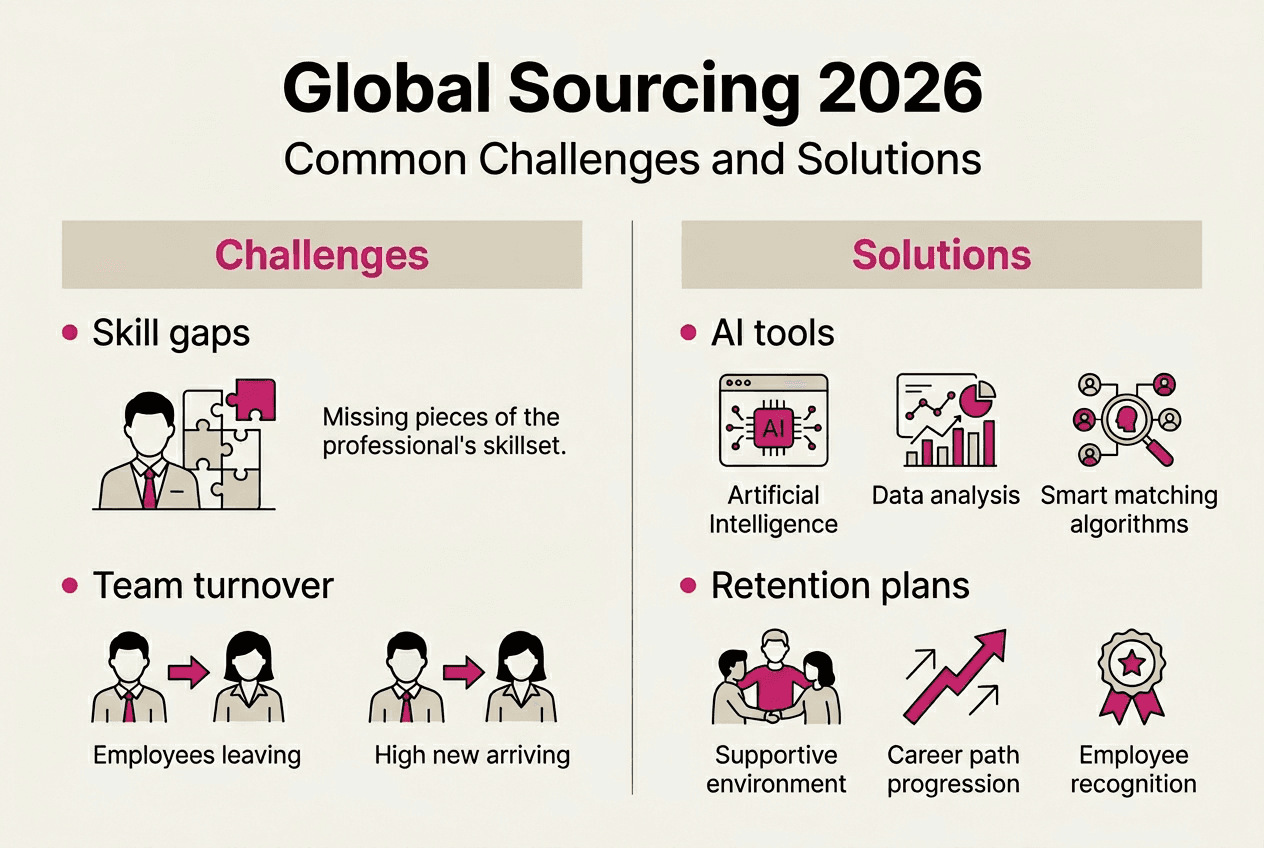
| Team turnover threatens pipelines | Recruitment staff retention directly impacts candidate flow and requires proactive mitigation strategies. |
Preparing to source talent globally: what you need
Before launching global talent sourcing initiatives, you need foundational elements in place to ensure success. Understanding regional talent dynamics is critical. India remains the global leader for GCC growth, while GCCs are no longer cost centers but capability powerhouses that deliver strategic value for manufacturing and engineering firms. These shifts mean HR professionals must view emerging markets through a capabilities lens rather than purely cost reduction.
Your sector determines specific talent requirements. Manufacturing roles demand precision engineering skills, quality control expertise, and automation knowledge. Engineering positions require specialized technical competencies in areas like renewable energy, infrastructure development, and advanced materials. Real estate and property development need project managers, sustainability specialists, and construction professionals who understand regional building codes and market dynamics. Mapping these requirements against regional talent availability helps you identify optimal sourcing locations.
Internal readiness separates successful global sourcing from failed attempts. Assess your recruitment team’s skills in cross-cultural communication, international labor law, and remote candidate engagement. High turnover among recruitment staff creates pipeline disruptions, so retention strategies must be part of your preparation. Stakeholder alignment ensures hiring managers understand timeline differences, visa requirements, and onboarding complexities for international hires. Without executive buy-in on these realities, global sourcing initiatives stall.
Technology infrastructure supports or sabotages your efforts. You need applicant tracking systems that handle multiple currencies, time zones, and compliance requirements. Data analytics capabilities help you track sourcing channel effectiveness, candidate quality metrics, and regional conversion rates. Integration between sourcing platforms and your HRIS streamlines workflows and prevents candidate information loss during handoffs.
Legal and cultural considerations require upfront attention. Research employment laws, tax implications, and visa sponsorship requirements for target markets. Understanding cultural norms around communication styles, negotiation approaches, and decision-making timelines prevents candidate drop-off. For instance, employment insights in GCC regions reveal distinct expectations around contract terms and benefits packages that differ from Western markets. Similarly, navigating talent acquisition in emerging Gulf and APAC markets requires specialized knowledge of regional hiring practices.
Create a readiness checklist covering these areas:
- Regional market intelligence and talent mapping for your specific sectors
- Recruitment team training on international sourcing and cultural competency
- Technology platform capabilities for global candidate management
- Legal compliance framework for target hiring regions
- Budget allocation for international recruitment costs and timeline expectations
This preparation phase typically takes 60 to 90 days but prevents costly mistakes and false starts. Organizations that skip this groundwork often experience poor candidate quality, extended time to fill, and budget overruns. The talent sourcing guide for specialized sectors in 2026 provides additional frameworks for sector-specific preparation.
Executing effective global talent sourcing strategies
Now that we’ve covered essential preparation, let’s walk through practical execution steps to source talent globally. Your sourcing methods must adapt to sector-specific realities. Manufacturing requires deep technical screening to verify specialized skills in areas like CNC machining, industrial automation, and quality systems. Engineering roles demand portfolio reviews, technical assessments, and verification of professional certifications that vary by region. Real estate and property development positions need demonstrated project delivery experience and understanding of local market dynamics.
Direct hire solutions deliver measurable results. Direct hire solutions prove effective for real estate development firms by focusing recruitment efforts on candidates with proven track records and cultural fit. This approach reduces turnover costs and accelerates project delivery timelines. For engineering and manufacturing roles, direct hire enables you to compete for passive candidates who aren’t actively job searching but represent top talent in their fields. The investment in thorough screening and relationship building pays dividends through longer tenure and higher performance.
Technology platforms amplify your sourcing reach and efficiency. AI-powered tools scan global talent databases, identify candidates matching complex skill requirements, and prioritize prospects based on engagement likelihood. Automated outreach sequences maintain candidate interest while your team focuses on high-value interactions. Video interviewing platforms eliminate geography as a barrier, enabling you to assess soft skills and cultural alignment early in the process. Chatbots handle initial screening questions and schedule interviews across time zones without manual coordination.

Cross-border recruitment demands cultural intelligence. Research communication preferences in target markets. Some regions expect formal, hierarchical interactions while others value direct, casual engagement. Timing matters too. Reaching out during local business hours shows respect and increases response rates. Translate job descriptions and recruitment materials into local languages when appropriate, but ensure technical terminology remains clear and accurate. Misunderstandings about role requirements waste everyone’s time.
Follow this execution sequence for optimal results:
- Identify target regions based on talent availability and sector expertise concentrations
- Build relationships with local universities, professional associations, and industry groups
- Deploy multi-channel sourcing combining job boards, social media, employee referrals, and direct outreach
- Implement structured screening processes that assess technical skills, cultural fit, and relocation readiness
- Maintain consistent candidate communication with clear timelines and next steps
- Coordinate with legal and HR teams on visa sponsorship, relocation support, and onboarding logistics
The data supports strategic focus. Manufacturing hiring goal achievement increased in 2025, reaching the strongest level in the multi-year trend. This improvement reflects better alignment between sourcing strategies and sector needs. Organizations that invested in specialized recruitment capabilities and technology platforms saw the greatest gains.
Pro Tip: Create a global talent community even before you have open positions. Regular engagement through industry insights, career development content, and networking opportunities keeps potential candidates warm. When roles open, you have a pre-qualified pool ready to activate, reducing time to fill by 40% or more.
Leverage global talent acquisition best practices to refine your approach. Different regions excel at specific sourcing techniques. European markets emphasize employer branding and employee value propositions. Asian markets respond well to relationship-based recruiting and referral programs. Middle Eastern markets value personal connections and industry reputation. Adapting these regional strengths to your organization’s needs creates competitive advantage.
Direct hire talent solutions provide frameworks for building sustainable pipelines. Rather than transactional recruiting, this approach emphasizes long-term relationship building with candidates, even those not immediately available. The investment in candidate experience and ongoing engagement yields higher acceptance rates and better quality of hire metrics.
Verifying success and troubleshooting common sourcing challenges
After executing sourcing strategies, the next step is to verify results and optimize for ongoing success. Tracking the right metrics separates effective programs from wasteful activities. Time to fill measures efficiency but quality of hire determines long-term value. Monitor offer acceptance rates by region to identify where your value proposition resonates or falls short. Track candidate source effectiveness to allocate budget toward highest-performing channels. Measure new hire performance at 90 days and one year to validate screening processes.
Recruitment team stability directly impacts outcomes. Recruitment team turnover is the most prominent pressure point affecting candidate flow. When recruiters leave, institutional knowledge disappears, candidate relationships deteriorate, and hiring manager confidence erodes. Calculate your recruitment team turnover rate and benchmark against industry standards. If you exceed 20% annual turnover, implement retention initiatives immediately. Career development paths, competitive compensation, and workload management reduce attrition.
Sector-specific challenges require targeted solutions. Manufacturing faces skilled trades shortages in specialized areas like precision machining and industrial maintenance. Engineering struggles to find candidates with emerging technology expertise in renewable energy and smart infrastructure. Real estate and property development compete for project managers and construction professionals in markets with data center projects accounting for about 8.7% of all construction job postings, roughly 10,005 roles, creating intense competition.
| Challenge | Traditional Approach | Optimized Solution | Expected Outcome |
|---|---|---|---|
| High candidate drop-off | Generic follow-up emails | Personalized engagement based on candidate interests and timeline | 35% improvement in pipeline conversion |
| Regional skill shortages | Limit search to familiar markets | Expand to emerging talent hubs with sector expertise | 50% larger qualified candidate pool |
| Recruitment team turnover | Hire replacements reactively | Implement retention programs and process automation | 60% reduction in knowledge loss impact |
| Cultural misalignment | Standard interview process | Structured cultural fit assessment and realistic job previews | 40% decrease in early turnover |
Candidate drop-off often stems from poor communication and unclear processes. Set expectations upfront about timeline, interview stages, and decision criteria. Provide regular updates even when there’s no news. Candidates who feel informed stay engaged longer. Use candidate relationship management tools to automate touchpoints while maintaining personalization. Send relevant industry content, company updates, and role-specific insights that demonstrate ongoing interest.
Common troubleshooting scenarios include:
- Low application rates from target regions: Review job description language for cultural appropriateness and clarity. Verify posting visibility on region-specific platforms.
- High offer decline rates: Assess compensation competitiveness using local market data. Evaluate relocation support adequacy and family considerations.
- Extended time to fill: Identify bottlenecks in approval workflows, interview scheduling, or decision-making processes. Streamline where possible.
- Poor new hire retention: Examine onboarding effectiveness, role clarity, and cultural integration support for international hires.
Pro Tip: Establish quarterly sourcing audits where you review channel performance, candidate quality trends, and recruiter effectiveness metrics. Use this data to reallocate resources toward highest-ROI activities. Organizations that implement data-driven optimization cycles improve cost per hire by 25% while simultaneously reducing time to fill.
Address challenges in recruiting technical talent with specialized assessment methods. Technical skills verification requires more than resume review. Implement practical assessments, portfolio evaluations, and reference checks with former supervisors who can validate specific competencies. For engineering roles, technical interviews with your subject matter experts ensure candidates possess claimed expertise.
Stay ahead of future recruitment trends by monitoring technological advances, regulatory changes, and talent market shifts. The recruitment landscape evolves rapidly, and strategies effective today may underperform tomorrow. Continuous learning and adaptation separate high-performing talent acquisition functions from those that struggle to fill critical roles.
Partner with experts for global talent sourcing success
Having learned how to verify and refine your global talent sourcing, discover how expert recruitment partners can further boost your success. McGlynn Personnel specializes in connecting manufacturing, engineering, and real estate organizations with skilled professionals across UK, EU, US, Middle East, and APAC regions. Our deep sector expertise and established global networks accelerate your talent acquisition while reducing risk and cost.

We understand the unique challenges you face. Atrium Global offers direct hire talent solutions that focus on quality over volume, ensuring candidates align with your technical requirements and organizational culture. Our talent sourcing guide for specialized sectors in 2026 reflects our commitment to staying ahead of market trends and evolving best practices.
Whether you need permanent placements or flexible staffing arrangements, our contract recruitment and flexible staffing solutions adapt to your project timelines and budget constraints. We handle the complexities of international recruitment, from initial sourcing through onboarding, so you can focus on strategic priorities. Partner with us to transform your global talent acquisition from a challenge into a competitive advantage.
Frequently asked questions
How does sourcing talent globally benefit manufacturing and engineering sectors?
Global sourcing expands access to specialized skillsets unavailable in local markets, particularly for emerging technologies and niche engineering disciplines. It enables manufacturing and engineering firms to meet evolving innovation needs by tapping talent pools with cutting-edge expertise. Companies gain competitive advantage through diverse perspectives and problem-solving approaches that international teams bring to complex technical challenges.
What are effective solutions to recruitment team turnover impacting candidate flow?
Implement comprehensive retention initiatives including career development paths, competitive compensation benchmarked against market rates, and workload management through process automation. Recruitment team turnover is the most prominent pressure point affecting candidate flow, making retention a strategic priority. Technology solutions reduce individual recruiter dependency by centralizing candidate relationships and automating routine tasks, ensuring continuity when team changes occur.
How can direct hire solutions improve recruitment for real estate firms?
Direct hire enables faster placement by focusing recruitment efforts on candidates with proven sector experience and cultural alignment. Direct hire solutions prove effective for real estate development firms by reducing long-term turnover through better candidate-role matching. This approach delivers higher quality hires who understand property development complexities and contribute to project success from day one, ultimately lowering total cost of ownership for talent acquisition.
What emerging trends should HR professionals watch in global talent sourcing for 2026?
AI and data analytics are transforming candidate identification, engagement, and screening processes, enabling more precise matching and efficient workflows. Manufacturing organizations are prioritizing efficiency, personalization, and technology upgrades as foundational capabilities for 2026. Personalized candidate experiences have become competitive differentiators, with top employers tailoring communication and opportunities to individual career goals. GCC and APAC markets are gaining strategic importance as talent hubs offering specialized capabilities beyond traditional cost advantages, reshaping global sourcing strategies for forward-thinking organizations.
Recommended
- Talent sourcing guide for specialized sectors 2026
- Sourcing Talent for the Property Technology Sector: The 2026 Recruitment Blueprint – Mcglynn Personnel
- Navigating the Future: Key Trends Shaping Global Talent Acquisition – Mcglynn Personnel
- Preparing Your Company for Emerging Market Talent Needs: A Strategic Guide – Mcglynn Personnel