
The UK real estate sector faces a growing crisis: vacancies rose 0.5% year-over-year while two-thirds of hiring managers report significant skills gaps. For real estate professionals competing to fill critical roles, understanding what talent sourcing truly means and how to execute it effectively has become essential. Real estate talent sourcing is the strategic process of identifying, attracting, and engaging top candidates for property sector positions before vacancies even open. This guide breaks down what talent sourcing entails, current UK and EU market challenges, innovative strategies to win candidates, and actionable steps to enhance your recruitment outcomes.
Table of Contents
- Key takeaways
- Understanding real estate talent sourcing
- Current trends and challenges in UK and EU real estate hiring
- Innovative strategies to source top real estate talent
- Applying real estate talent sourcing best practices
- How McGlynn Personnel supports your talent sourcing success
- Frequently asked questions
Key Takeaways
| Point | Details |
|---|---|
| Proactive talent sourcing | Real estate hiring now requires identifying and engaging candidates before vacancies open to build strong pipelines. |
| Skills gaps and delays | The sector faces persistent skills shortages and longer time to fill, driving higher costs and project delays. |
| Regional hiring shifts | London’s dominance is fading as Scotland, Manchester, Bristol and other regions attract more hiring and investment. |
| Tailored EVP focus | Employers should customize their value proposition to real estate professionals with emphasis on career progression, project variety, and development opportunities not just pay. |
| Sourcing framework adoption | Adopt structured talent acquisition practices with market mapping, candidate identification, engagement, and pipeline building to move from reactive to proactive hiring. |
Understanding real estate talent sourcing
Real estate talent sourcing goes beyond traditional recruitment by focusing on proactive candidate identification rather than waiting for applications. While recruitment encompasses the entire hiring cycle from job posting to onboarding, talent sourcing is a strategic process centered on building pipelines of qualified candidates before positions become urgent. For property sector roles requiring specialized knowledge in valuation, property management, development, or investment, this distinction matters significantly.
The sourcing process involves several critical stages. Market mapping identifies where target candidates work and what motivates them. Candidate identification uses databases, networking, and research to pinpoint individuals with relevant skills. Engagement initiates conversations with passive candidates who aren’t actively job hunting. Pipeline building maintains relationships with potential hires for future opportunities.
Successful real estate talent sourcing requires deep sector knowledge. Sourcers must understand property market dynamics, regulatory requirements, technical competencies for roles like surveyors or asset managers, and the cultural fit factors that predict retention. Without this specialized insight, sourcing efforts often miss the nuances that separate adequate candidates from exceptional ones.
Current challenges complicate sourcing effectiveness. The skills gap means fewer qualified candidates exist for critical positions. Time-to-fill averages stretch recruitment cycles, increasing costs and project delays. Regional demand shifts require sourcers to adapt their geographic focus and understand local market conditions. Negative perceptions about certain real estate subsectors, particularly construction, limit the available talent pool.
Pro Tip: Tailor your employer value proposition specifically to real estate professionals’ priorities like career progression pathways, exposure to diverse property types, and professional development opportunities rather than leading with compensation alone. Candidates in this sector often value growth potential and project variety as much as salary.
For firms seeking to elevate their approach, strategic talent acquisition in real estate frameworks provide structured methodologies to transform sourcing from reactive to proactive.
Current trends and challenges in UK and EU real estate hiring
The UK real estate labor market presents a complex landscape for talent sourcing professionals. Recent data reveals vacancies increased 0.5% year-over-year, with sales roles experiencing particularly dramatic growth of 64.1%. Average time-to-fill ranges from 27 to 40 days depending on role complexity and seniority, creating pressure on hiring teams to accelerate sourcing without sacrificing quality.
| Metric | Current State | Implication for Sourcing |
|---|---|---|
| Vacancy growth | +0.5% YoY overall, +64.1% for sales roles | Increased competition for candidates requires faster, more targeted sourcing |
| Time-to-fill | 27-40 days average | Extended cycles demand stronger pipelines and proactive engagement |
| Skills gap prevalence | Reported by 67% of hiring managers | Sourcing must expand beyond traditional candidate pools |
| Geographic focus shift | London declining, Scotland/Manchester/Bristol rising | Regional sourcing strategies need recalibration |
A fundamental shift in hiring geography has emerged. London no longer dominates real estate recruitment as it once did. Scotland, Manchester, Bristol, and other regional centers now attract significant investment and hiring activity. This redistribution creates both opportunities and challenges for talent sourcers who must understand local market conditions, salary expectations, and candidate motivations across diverse UK regions.

Skills shortages pose critical obstacles, particularly for sales positions and construction-related roles. Two-thirds of hiring managers report difficulty finding candidates with the right competencies. The construction segment faces additional barriers from outdated public perceptions that discourage potential talent from considering property development careers.
Key sourcing challenges include:
- Limited pools of candidates with specialized real estate qualifications like RICS accreditation
- Competition from adjacent sectors like financial services and consulting for analytical talent
- Generational shifts as experienced professionals retire without sufficient junior talent progressing
- Brexit-related restrictions reducing access to EU talent pools for UK firms
- Remote work expectations changing candidate priorities and geographic flexibility
Pro Tip: Focus sourcing efforts on emerging regional hubs where competition for talent remains less intense than in traditional centers. Candidates in these markets often offer strong value, lower salary expectations, and higher retention rates due to local ties.
Understanding these market dynamics helps sourcers develop realistic strategies. For deeper insight into navigating these obstacles, explore approaches for overcoming common challenges in real estate talent acquisition.
Innovative strategies to source top real estate talent
Modern real estate talent sourcing demands evolution beyond traditional methods. The gap between conventional approaches and innovative strategies directly impacts your ability to secure top candidates in a competitive market.
| Traditional Approach | Modern Strategy | Advantage |
|---|---|---|
| Post-and-pray job advertising | Proactive pipeline building with passive candidates | Access to talent not actively searching |
| Sector-only candidate focus | Cross-industry hybrid leader recruitment | Fresh perspectives and transferable skills |
| Salary-led value propositions | Culture and development-focused EVP | Attracts candidates seeking growth over pay |
| Manual candidate research | AI-powered sourcing and screening tools | Faster identification and improved targeting |
Recruiting hybrid leaders represents a transformative strategy. 38% of real estate roles are transforming due to AI and demographic shifts, creating demand for professionals who combine property expertise with skills from adjacent industries. Leaders with backgrounds in FinTech bring data analytics capabilities. Hospitality veterans understand customer experience design. These hybrid profiles drive innovation and help property firms adapt to market disruption.
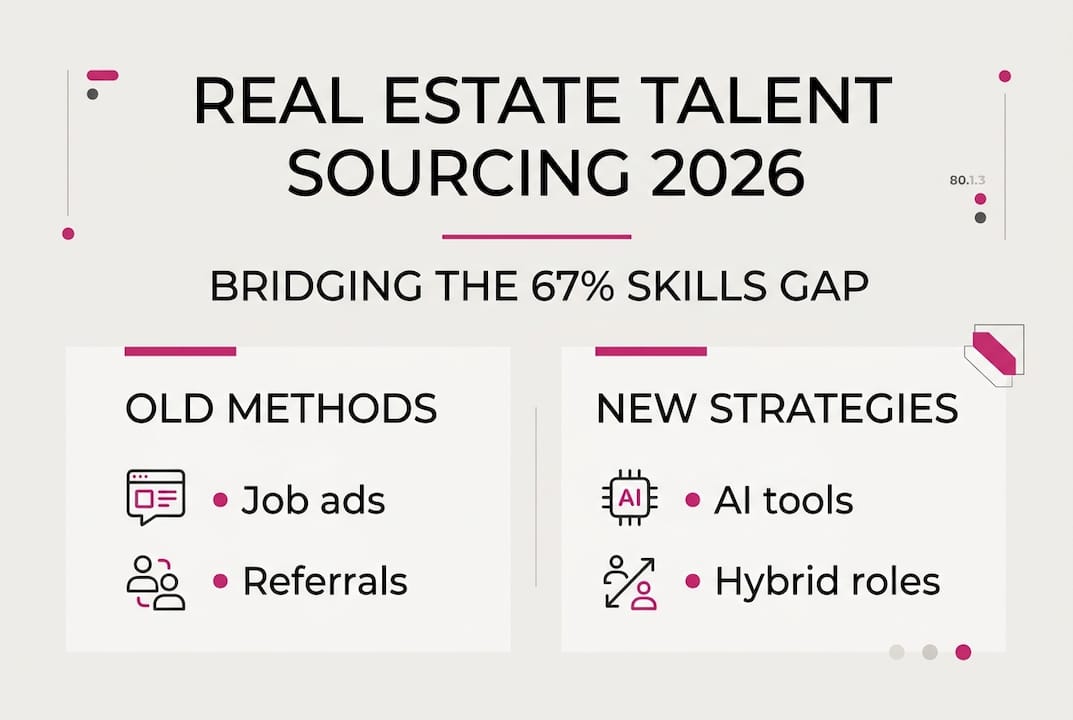
Artificial intelligence streamlines sourcing workflows significantly. AI tools parse thousands of profiles across LinkedIn, industry databases, and professional networks to identify candidates matching specific criteria. Natural language processing evaluates resume content for relevant experience. Predictive analytics score candidates based on likelihood of interest and fit. This technology reduces manual research time while improving targeting precision.
Developing a compelling employer value proposition proves essential when culture-focused EVP is critical to winning talent. Today’s real estate professionals evaluate opportunities through multiple lenses beyond compensation. They seek firms offering clear progression paths, exposure to diverse project types, investment in professional development, flexible work arrangements, and values alignment. Your EVP must articulate these elements authentically to resonate with target candidates.
Practical tactics to enhance sourcing effectiveness:
- Target regional markets experiencing growth but lower competition intensity
- Conduct confidential searches to access candidates currently employed by competitors
- Craft personalized outreach messages referencing specific candidate achievements
- Leverage employee referral networks within your existing real estate team
- Attend industry conferences and professional association events for relationship building
- Partner with real estate educational programs to identify emerging talent early
- Use social media listening to identify thought leaders and engaged professionals
- Implement applicant tracking systems with robust sourcing and pipeline management features
Pro Tip: Integrate AI sourcing tools with highly personalized outreach to maximize response rates. While technology identifies candidates efficiently, human connection in initial contact messages significantly increases engagement. Reference specific projects, publications, or achievements to demonstrate genuine interest rather than mass outreach.
For firms facing persistent challenges in real estate talent acquisition, these innovative approaches provide pathways to competitive advantage. Additionally, understanding how to address skills gaps in real estate through targeted sourcing strategies ensures long-term recruitment success.
Applying real estate talent sourcing best practices
Transforming sourcing strategy into execution requires structured processes and attention to operational details. Follow these steps to implement effective real estate talent sourcing:
- Define precise role requirements including technical competencies, experience levels, cultural fit indicators, and success metrics before beginning candidate research.
- Map the target talent market by identifying companies, geographic locations, and professional networks where ideal candidates congregate.
- Build comprehensive candidate profiles using LinkedIn, industry directories, professional association memberships, and conference attendance lists.
- Develop personalized engagement messages that reference specific candidate accomplishments and clearly articulate opportunity value beyond generic job descriptions.
- Initiate multi-touch outreach campaigns combining email, LinkedIn messages, and phone calls with appropriate timing intervals to respect candidate preferences.
- Qualify candidate interest and fit through exploratory conversations focused on career goals, motivations, and alignment with your opportunity before formal interviews.
- Maintain detailed records in your applicant tracking system documenting all interactions, candidate feedback, and pipeline status for future reference.
- Nurture relationships with promising candidates not ready to move immediately by sharing relevant industry content and maintaining periodic contact.
Ethical recruitment practices form the foundation of sustainable sourcing success. Ethical recruitment enhances trust and reduces turnover by ensuring transparent communication, respecting candidate confidentiality, providing honest role representations, and maintaining professional boundaries. Candidates who experience ethical treatment become brand ambassadors regardless of hiring outcomes, expanding your reputation and future talent access.
Regional market nuances require adaptive approaches across UK and EU territories. Scottish candidates may prioritize work-life balance differently than London professionals. EU markets have distinct labor regulations, cultural communication norms, and compensation expectations. Successful sourcers research local conditions thoroughly and adjust messaging, timing, and value propositions accordingly.
Leveraging recruitment partners extends your sourcing reach and expertise. Specialized agencies bring established networks, market intelligence, and dedicated sourcing resources that complement internal capabilities. They access passive candidates through trusted relationships and provide objective market perspectives on compensation benchmarks and competitive positioning.
Implementation checklist for sourcing excellence:
- Conduct thorough candidate research before any outreach to personalize messaging effectively
- Use multiple engagement channels to reach candidates where they are most responsive
- Implement robust ATS systems to track candidate interactions and maintain organized pipelines
- Establish feedback loops with hiring managers to refine candidate profiles based on interview outcomes
- Monitor key metrics like response rates, conversion ratios, and time-to-fill to identify improvement opportunities
- Invest in ongoing training for sourcing team members on market trends and new tools
- Build relationships with industry influencers who can provide referrals and market insights
- Create candidate experience surveys to gather feedback and enhance your sourcing approach
For comprehensive guidance on balancing recruitment needs in real estate, consider how sourcing integrates with broader talent acquisition strategy. Additionally, review real estate hiring best practices to ensure your sourcing efforts align with industry standards for 2026.
How McGlynn Personnel supports your talent sourcing success
Navigating the complexities of real estate talent sourcing becomes significantly easier with specialized recruitment expertise. McGlynn Personnel brings deep knowledge of UK, EU, and global property markets, connecting you with qualified professionals across real estate management, property development, and investment sectors. Our team understands the nuanced requirements of roles from junior analysts to C-suite executives, ensuring precise candidate matching.

We offer flexible solutions tailored to your specific hiring needs. Our contract recruitment services provide immediate access to skilled professionals for project-based work or interim coverage. For permanent placements and leadership positions, our executive search capabilities identify transformative talent who drive organizational success. Whether you need guidance on working with a recruitment agency effectively or want to understand our real estate executive search process, we partner with you to optimize every aspect of talent acquisition.
Frequently asked questions
What challenges make real estate talent sourcing difficult?
Skills gaps reported by 67% of hiring managers create fundamental sourcing obstacles as qualified candidate pools shrink. Regional hiring shifts from London to emerging hubs require sourcers to adapt geographic strategies and understand diverse local markets. Average time-to-fill of 27 to 40 days extends recruitment cycles, increasing costs and competitive risks. Negative perceptions about construction and development roles discourage potential candidates from considering property sector careers despite attractive opportunities.
How can hybrid leadership benefit real estate recruitment?
Hybrid leaders bring diverse expertise from sectors like FinTech, hospitality, and technology that complement traditional property knowledge. They introduce fresh perspectives on data analytics, customer experience, and digital transformation that drive innovation in real estate firms. These professionals help bridge talent gaps by offering transferable skills applicable to evolving industry demands. Their cross-industry backgrounds position them to lead organizational change as 38% of real estate roles transform due to technological and demographic shifts.
What role does employer value proposition play in talent sourcing?
Employer value proposition highlights what makes your organization attractive beyond salary, including career progression pathways, project diversity, professional development investment, and cultural values. A strong EVP proves essential for winning candidates in competitive real estate markets where top talent evaluates multiple opportunities simultaneously. Culture-focused value propositions resonate more effectively with modern professionals who prioritize growth potential and work environment over compensation alone. Authentic EVP communication during sourcing conversations significantly increases candidate engagement and conversion rates.
How is AI transforming real estate talent sourcing?
Artificial intelligence automates candidate searching and screening by analyzing thousands of profiles across professional networks and databases in minutes rather than hours. AI-powered tools reduce average time-to-fill for real estate roles by identifying qualified candidates faster and with greater precision than manual research methods. Natural language processing evaluates resume content to match specific competency requirements while predictive analytics score candidates based on fit probability. Smart targeting enabled by AI allows personalized engagement at scale, combining efficiency with the human touch that drives candidate relationships.
Recommended
- Strategic Talent Acquisition in Real Estate: The 2026 Framework for High-Performance Firms – Mcglynn Personnel
- Sourcing Talent for the Property Technology Sector: The 2026 Recruitment Blueprint – Mcglynn Personnel
- Real estate hiring best practices for 2026 success
- Real estate development recruitment: your 2026 guide