
Many employers think recruitment agencies simply forward resumes and collect fees. This outdated view misses the strategic value agencies bring to specialized sectors like engineering, manufacturing, real estate, and property development. Recruitment agencies act as expert partners who understand technical requirements, navigate global compliance challenges, and deliver pre-vetted talent faster than traditional hiring methods. For employers operating across the UK, EU, US, Middle East, and APAC regions, choosing the right agency model and building effective partnerships can transform your ability to secure top talent in competitive markets.
Table of Contents
- Key takeaways
- Understanding the role of recruitment agencies in specialized sectors
- How recruitment agencies navigate global and regional hiring complexities
- Comparing recruitment agency models and services for specialized hiring needs
- Maximizing recruitment agency partnerships to secure top talent efficiently
- Partner with McGlynn Personnel for recruitment excellence
- Frequently asked questions
Key Takeaways
| Point | Details |
|---|---|
| End to end talent acquisition | They deliver sourcing, screening, interviewing, and presenting qualified professionals to shorten hiring timelines and improve candidate quality. |
| Specialized sector insight | Industry aware recruiters understand the technical requirements and regulatory landscapes in fields such as engineering and property development. |
| Global regional expertise | Regional recruiters navigate visa, contracts, and compensation across UK, EU, US, Middle East, and APAC to prevent costly missteps. |
| Strategic partnerships | Partnering with agencies enables long term workforce planning, market intelligence, and scalable staffing while reducing administrative burden. |
Understanding the role of recruitment agencies in specialized sectors
Recruitment agencies deliver far more than candidate lists. They provide end-to-end talent acquisition services that include sourcing, screening, interviewing, and presenting only the most qualified professionals for your roles. For specialized sectors, this means working with recruiters who understand the technical requirements of precision engineering roles, the regulatory landscape of property development, or the operational demands of advanced manufacturing environments.
Specialized agencies maintain extensive networks of passive candidates who aren’t actively job hunting but would consider the right opportunity. This access to hidden talent pools gives you a competitive advantage in tight labor markets. Recruitment agencies shorten the hiring timeline and improve candidate quality by pre-screening for both technical skills and cultural fit before you invest interview time.
Beyond candidate delivery, agencies act as strategic workforce planning partners. They provide market intelligence on salary benchmarks, competitor hiring activity, and emerging skill shortages. This insight helps you make informed decisions about compensation packages, role requirements, and timing. When you partner with industry-specific recruitment agencies, you gain advisors who understand your sector’s unique challenges and can anticipate talent needs before they become urgent.
Recruitment agencies also reduce your administrative burden and hiring risks. They handle initial outreach, coordinate interview schedules, conduct reference checks, and manage offer negotiations. For international hires, they navigate visa processes and relocation logistics. This comprehensive support allows your internal team to focus on core business activities while ensuring a professional candidate experience that protects your employer brand.
Key functions specialized recruitment agencies provide:
- Targeted sourcing from passive candidate networks in technical fields
- Multi-stage screening including technical assessments and behavioral interviews
- Market intelligence on compensation trends and competitor activity
- Compliance guidance for regional labor laws and industry regulations
- Employer brand representation throughout the candidate journey
How recruitment agencies navigate global and regional hiring complexities
Hiring across multiple regions introduces layers of complexity that can derail even experienced talent acquisition teams. Labor laws vary dramatically between the UK, EU, US, Middle East, and APAC markets. Visa requirements, tax implications, employment contracts, and worker protections differ by jurisdiction. Cultural expectations around communication styles, interview processes, and compensation discussions require localized knowledge to avoid misunderstandings that cost you top candidates.

Recruitment agencies with regional presence provide strategic solutions to global recruitment challenges by leveraging local expertise in each market. They understand which visa pathways work best for specific roles, how to structure compliant employment contracts, and what salary ranges attract talent without overpaying. This localized knowledge prevents costly mistakes like offering non-competitive packages or missing critical compliance requirements that could expose your organization to legal risks.
Agencies also adapt their sourcing strategies to regional market conditions. In mature markets with low unemployment, they focus on passive candidate outreach and competitor intelligence. In emerging markets with growing talent pools, they tap into university partnerships and professional associations. This flexibility ensures you access the best talent regardless of regional dynamics.
Steps agencies take to manage global hiring complexity:
- Conduct regional market analysis to identify talent availability and competitive landscape
- Develop localized sourcing strategies tailored to cultural norms and candidate preferences
- Navigate visa sponsorship requirements and immigration processes for international placements
- Structure employment contracts that comply with local labor laws and tax regulations
- Manage candidate expectations around relocation support, compensation packages, and cultural integration
Pro Tip: Engage agencies with physical presence or established partnerships in your target regions rather than those offering generic global services. Local boots on the ground provide faster response times, better candidate relationships, and deeper market insights that translate to higher quality placements.
Agencies also help manage your employer brand across diverse cultural contexts. They advise on how to position your organization to appeal to regional candidate priorities, whether that’s work-life balance in European markets, career progression in APAC regions, or compensation packages in North American contexts. This cultural intelligence ensures your opportunities resonate with local talent while maintaining your authentic organizational identity.
Comparing recruitment agency models and services for specialized hiring needs
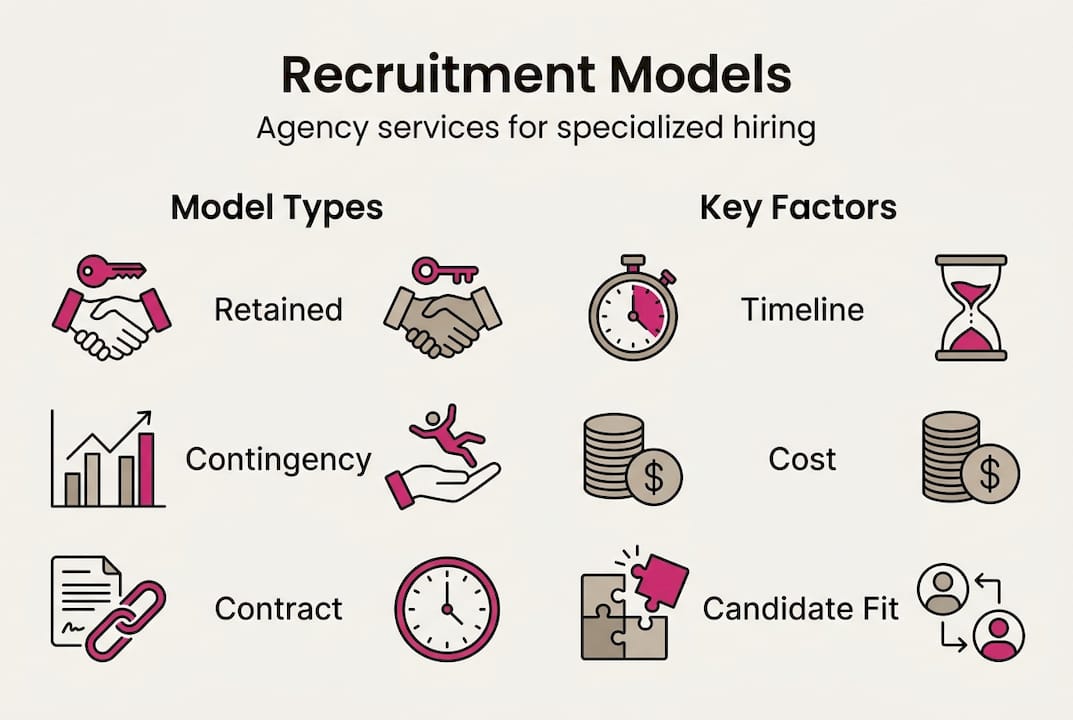
Not all recruitment services operate the same way. Understanding the differences between retained search, contingency, and contract recruitment models helps you select the approach that matches your hiring urgency, budget constraints, and role level. Each model offers distinct advantages and trade-offs that impact your hiring outcomes.
Retained search works best for executive and senior leadership placements where exclusivity and dedicated resources justify higher upfront costs. You pay the agency in stages throughout the search process, typically one-third upfront, one-third at shortlist presentation, and the final third upon placement. This model guarantees the agency’s full attention and commitment to filling your role. Retained recruiters conduct comprehensive market mapping, approach passive candidates who wouldn’t respond to job postings, and provide detailed assessment reports on finalist candidates.
Contingency recruitment suits mid-level technical and managerial roles where you want multiple agencies competing to find the best candidate. You only pay when you hire someone the agency presents. This performance-based model reduces financial risk but may result in agencies prioritizing easier-to-fill roles over challenging searches. Contingency works well for roles with clear requirements and reasonable market availability of qualified candidates.
Contract recruitment offers flexibility for project-based staffing, seasonal demand, or interim coverage while you search for permanent hires. Agencies handle payroll, benefits, and compliance while you direct the contractor’s daily work. This model lets you scale teams up or down quickly without long-term employment commitments.
| Model | Best For | Cost Structure | Timeline | Candidate Quality | Risk Level |
|---|---|---|---|---|---|
| Retained Search | Executive, C-suite, specialized leadership | 25-35% of first-year salary, paid in stages | 90-120 days | Highest, comprehensive vetting | Low, guaranteed completion |
| Contingency | Mid-level technical, managerial roles | 15-25% of first-year salary, paid on hire | 30-60 days | Good, competitive pressure | Medium, no placement guarantee |
| Contract/Temp | Project-based, seasonal, interim coverage | Markup on hourly rate, ongoing | 1-14 days | Variable, speed prioritized | Low, flexible terms |
Pro Tip: Match the agency model to your role’s strategic importance and market scarcity. Use retained search for mission-critical hires where failure costs exceed the upfront investment. Deploy contingency for volume hiring where multiple qualified candidates exist. Leverage contract recruitment to test candidates before permanent offers or cover gaps while searching for ideal long-term fits.
Some agencies offer hybrid models that combine elements of different approaches. For example, you might engage a retained search for the initial market mapping and candidate identification phases, then switch to contingency terms for final placement. These flexible arrangements work well when you want dedicated resources but need to manage budget constraints.
Key considerations when selecting an agency model:
- Role level and strategic importance to your organization
- Urgency of the hire and consequences of leaving the position open
- Market availability of qualified candidates with required skills
- Budget flexibility and approval processes for recruitment fees
- Internal capacity to manage multiple agency relationships simultaneously
Maximizing recruitment agency partnerships to secure top talent efficiently
The quality of your relationship with recruitment agencies directly impacts hiring outcomes. Employers who treat agencies as transactional vendors get transactional results. Those who invest in strategic partnerships built on trust and transparency see better candidate matches, faster placements, and improved retention rates.
Start by clearly defining role requirements beyond the job description. Share context about team dynamics, reporting relationships, growth opportunities, and the specific challenges the new hire will face. The more your agency understands about your organizational culture and strategic objectives, the better they can assess candidate fit beyond technical qualifications. Vague briefs produce generic candidate slates that waste everyone’s time.
Maintain regular communication throughout the search process. Provide timely, specific feedback on presented candidates rather than generic rejections. When you pass on someone, explain exactly what didn’t align with your needs. This feedback loop helps agencies refine their search parameters and improve subsequent candidate quality. Working effectively with recruiters requires viewing them as extensions of your talent acquisition team rather than external vendors.
Leverage your agency’s market intelligence to inform compensation decisions and role positioning. Experienced recruiters talk to dozens of candidates weekly and know what competitors offer, which benefits matter most, and how to position opportunities to attract passive talent. Ignoring this insight because it conflicts with internal pay bands often results in extended searches and lost candidates to competitor offers.
Best practices for productive agency partnerships:
- Schedule kickoff meetings to align on role requirements, ideal candidate profiles, and success metrics
- Establish clear communication protocols including response timeframes and feedback expectations
- Share honest information about compensation ranges, benefits, and any role limitations upfront
- Involve agencies in workforce planning discussions to build proactive talent pipelines
- Recognize that ethical agencies will challenge unrealistic requirements or problematic hiring practices
Agree on ethical standards and transparency from the start. Reputable agencies won’t present candidates without their knowledge, won’t misrepresent your opportunity to generate interest, and won’t pressure candidates to accept offers against their best interests. These ethical recruitment practices protect your employer brand and lead to better long-term retention because candidates enter roles with accurate expectations.
Steps to optimize agency collaboration:
- Provide comprehensive role briefs including technical requirements, cultural fit factors, and growth trajectory
- Respond to candidate submissions within 48 hours with specific, actionable feedback
- Include agencies in interview debriefs to gather candidate impressions and address concerns
- Use agency insights to refine compensation packages and role positioning in real time
- Conduct post-placement reviews to identify what worked and improve future searches
Employers who invest in long-term recruitment strategies with preferred agency partners create continuous talent pipelines that reduce time-to-hire and improve quality-of-hire metrics. Rather than starting from scratch each time a role opens, established relationships mean agencies already understand your needs and maintain warm candidate pools ready for new opportunities.
Partner with McGlynn Personnel for recruitment excellence
Navigating specialized sector recruitment across global markets requires expertise that goes beyond standard hiring practices. McGlynn Personnel delivers tailored recruitment services for engineering, manufacturing, real estate, and property development employers operating in the UK, EU, US, Middle East, and APAC regions. Our sector-specific knowledge ensures we understand your technical requirements and can identify candidates with the precise skills and experience your roles demand.
Whether you need flexible staffing solutions for project-based teams or dedicated executive search for leadership positions, our experienced recruiters provide end-to-end support throughout the hiring process. We handle everything from initial candidate sourcing and technical screening to interview coordination and offer negotiation, saving you time while ensuring quality outcomes. Our proven strategies and commitment to ethical practices help you build teams that drive business results.
Ready to transform your hiring approach? Explore our ultimate recruiter guide or discover how our engineering recruitment expertise can connect you with top technical talent. Contact McGlynn Personnel today to discuss your specific hiring needs and learn how we can support your growth objectives.
Frequently asked questions
What exactly do recruitment agencies do for specialized sectors?
Recruitment agencies source, screen, and connect employers with qualified candidates tailored to sector-specific needs in fields like engineering, manufacturing, real estate, and property development. They conduct technical assessments, verify credentials, and present only pre-vetted professionals who meet your role requirements. Agencies also provide market intelligence, salary benchmarking, and compliance guidance specific to your industry and region.
How do recruitment agencies handle hiring across multiple regions?
Agencies use local market expertise and compliance knowledge to tailor recruitment strategies for each region where you hire. They manage complexities like visa sponsorship, labor law compliance, tax implications, and cultural fit considerations that vary between the UK, EU, US, Middle East, and APAC markets. Regional specialists within agency networks ensure you access the best talent while maintaining full regulatory compliance.
Which recruitment model works best for technical leadership roles?
Retained search is often preferred for leadership roles due to the exclusivity, dedicated resources, and comprehensive vetting process it provides. This model guarantees the agency’s full commitment to filling your position and includes detailed market mapping and passive candidate outreach. Contingency recruitment may suit less senior technical roles or situations where multiple qualified candidates exist and speed matters more than exhaustive market coverage.
How can employers build effective relationships with recruitment agencies?
Communicate clearly about role requirements, team dynamics, organizational culture, and specific challenges the new hire will address. Provide timely, specific feedback on presented candidates so agencies can refine their search parameters and improve subsequent matches. Engage in transparent, ethical partnerships where you share honest information about compensation, growth opportunities, and any role limitations upfront. Treat agencies as strategic partners rather than transactional vendors for best results.
Recommended
- Why Specialised Recruitment Demands a Tailored Approach, Not One-Size-Fits-All – Mcglynn Personnel
- The Competitive Edge of Specialized Recruitment Agencies in Manufacturing and Engineering – Mcglynn Personnel
- Simplifying Contract Recruitment: Your Guide to Flexible Staffing Solutions – Mcglynn Personnel
- The Growing Importance of HR Outsourcing in Streamlining Recruitment Processes – Mcglynn Personnel