
Finding qualified engineers quickly is one of the toughest challenges HR managers face today. Engineering time-to-hire averages 56 to 68 days, causing project delays and lost opportunities. Meanwhile, cost-per-hire hovers around $4,700 to $4,800, straining budgets across manufacturing and engineering sectors. Staffing agencies offer a strategic solution, leveraging specialized expertise, advanced technology, and extensive networks to accelerate hiring while maintaining quality. This guide explores how agencies transform engineering recruitment, helping you overcome skill shortages, reduce turnover, and build high-performing teams faster.
Table of Contents
- Key takeaways
- Understanding the challenges of engineering recruitment
- How staffing agencies address engineering recruitment challenges
- Navigating the nuances: balancing speed, quality, and retention
- Practical steps to maximize your partnership with engineering staffing agencies
- Enhance your engineering recruitment with expert staffing partners
- Frequently asked questions
Key Takeaways
| Point | Details |
|---|---|
| Faster engineering hiring | Staffing agencies accelerate time to hire for engineering roles, reducing project delays and getting critical talent in place faster. |
| AI driven cost savings | AI driven matching and predictive analytics cut hiring costs by 30 to 40 percent while improving candidate quality. |
| Warm candidate pools | Agencies cultivate warm talent pools with passive candidates to present qualified engineers within days. |
| Temporary to permanent | Temporary to permanent arrangements allow quick onboarding for project needs while assessing performance and fit over weeks. |
| Engineering specialist recruiters | Specialized engineering recruiters understand technical requirements and industry trends that generalist HR teams miss. |
Understanding the challenges of engineering recruitment
Engineering recruitment presents unique obstacles that drain resources and delay critical projects. The average time-to-hire for engineering positions spans 56 to 68 days, nearly double the timeline for many other roles. This extended search period creates cascading problems. Projects stall waiting for key technical hires. Existing team members face burnout covering gaps. Competitors snap up top talent while your requisitions languish.
Cost pressures compound these timing challenges. Engineering roles carry price tags between $4,700 and $4,800 per hire, consuming significant portions of recruitment budgets. Manufacturing sectors face additional strain with turnover rates hovering around 29%, meaning you’re constantly refilling positions rather than growing capacity. Each departure triggers another expensive, time-consuming search cycle.
Balancing speed with quality creates a persistent dilemma. Rush to fill positions and you risk poor fits who underperform or leave quickly. Take too long vetting candidates and you lose momentum, frustrate hiring managers, and watch skilled engineers accept offers elsewhere. Specialized technical roles amplify this tension. Finding candidates with niche expertise in precision manufacturing, advanced materials, or emerging technologies requires deep industry knowledge and extensive networks most internal HR teams lack.
These challenges hit hardest when you need rapid placements for critical projects or expansion initiatives. Traditional recruitment methods struggle to deliver both speed and quality simultaneously. Internal teams juggle multiple priorities, lacking bandwidth to maintain robust talent pipelines or leverage cutting-edge sourcing technologies. This reality makes partnering with specialized engineering hiring agencies increasingly essential for competitive advantage.
Pro Tip: Track your current time-to-hire and cost-per-hire metrics before engaging agencies. These baseline numbers help you measure partnership ROI and identify which roles benefit most from external expertise.
How staffing agencies address engineering recruitment challenges
Staffing agencies deploy sophisticated tools and strategies that transform how you find and secure engineering talent. AI matching and predictive analytics reduce hiring costs by 30 to 40% while improving candidate quality. These technologies analyze vast datasets, identifying patterns that predict job success and cultural fit far more accurately than traditional resume screening.
Agencies maintain warm talent pools, cultivating relationships with passive candidates who aren’t actively job hunting but remain open to compelling opportunities. This proactive approach means they can present qualified engineers within days rather than weeks. Their recruiters specialize in engineering disciplines, understanding technical requirements and industry trends that generalist HR teams miss. They speak your language, asking the right questions to uncover true capabilities beyond what appears on paper.
Temporary-to-permanent hiring arrangements offer a practical solution to the speed versus quality dilemma. You bring candidates onboard quickly for immediate project needs while evaluating their performance, work style, and team fit over weeks or months. This trial period dramatically reduces hiring risk. If the engineer excels, you convert them to permanent status. If not, you part ways without the complications of terminating a direct hire.
Agencies leverage extensive networks connecting with universities, technical training programs, and industry associations. These partnerships provide early access to emerging talent and specialists in cutting-edge fields. When you need an engineer with expertise in additive manufacturing or industrial IoT, agencies tap these networks to surface candidates you’d never reach through job postings alone.

Speed capabilities are genuinely impressive. Some sectors report placements within 48 hours for urgent needs, a timeline impossible through traditional channels. This responsiveness proves invaluable when unexpected departures threaten project deadlines or new contracts require immediate team expansion.
Pro Tip: When choosing engineering staffing agencies, ask specifically about their technology stack and sector expertise. Agencies using advanced AI in recruitment deliver measurably better results than those relying solely on manual processes.
Navigating the nuances: balancing speed, quality, and retention
The pressure to fill positions quickly can backfire spectacularly. Rush placements without thorough vetting lead to poor performer hires who drag down team productivity, require excessive management attention, and ultimately leave or get terminated. 77% of companies switch staffing providers after experiencing these quality failures, highlighting how critical this balance is.
High-performing agencies invest heavily in screening processes that maintain quality under tight timelines. They conduct multi-stage technical assessments, verify credentials thoroughly, and perform behavioral interviews that reveal cultural fit indicators. This rigor ensures speed doesn’t compromise hire quality. Their experience helps them spot red flags quickly, filtering out candidates who look good on paper but lack essential soft skills or adaptability.
Network partnerships elevate candidate quality beyond what speed alone delivers. Agencies with deep industry connections access engineers who are successfully employed but interested in better opportunities. These passive candidates often represent higher caliber talent than active job seekers, bringing proven track records and stability. University relationships provide pipelines to top graduates before they hit the general job market.
Different staffing approaches offer distinct advantages and trade-offs:
| Approach | Speed | Quality Control | Cost | Best For |
|---|---|---|---|---|
| Direct hire through agency | Moderate (3-6 weeks) | High (extensive vetting) | Higher upfront fee | Critical long-term positions |
| Temp-to-perm | Fast (1-2 weeks) | Very high (on-job evaluation) | Lower initial, conversion fee later | Roles where fit is uncertain |
| Contract staffing | Very fast (days) | Moderate (focused on skills) | Pay-as-you-go hourly | Project-based or seasonal needs |
| Retained search | Slower (6-12 weeks) | Highest (executive-level) | Premium fees | Senior leadership positions |
Temp-to-perm arrangements deserve special attention for engineering roles. You gain immediate productivity while gathering real performance data. Engineers work on actual projects, revealing problem-solving approaches, communication skills, and team dynamics that interviews can’t uncover. This extended evaluation period dramatically reduces turnover risk, protecting your investment in onboarding and training.
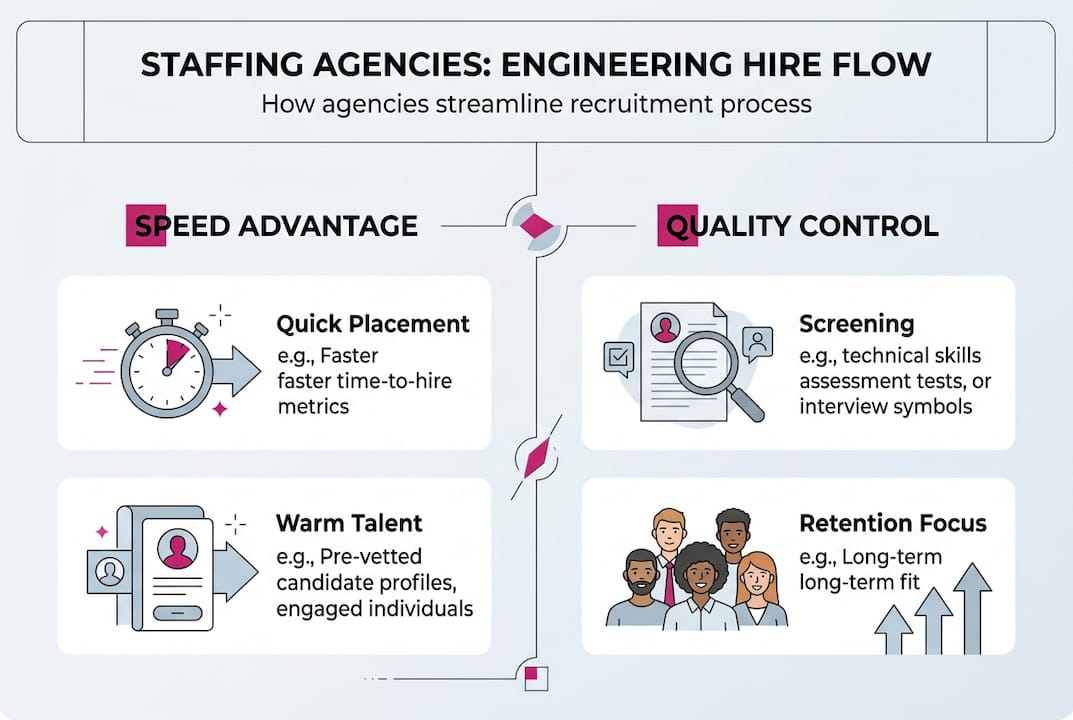
Retention considerations should guide your agency partnership strategy. Agencies focused purely on placement volume may prioritize speed over sustainable matches. Look for partners who track long-term retention metrics and adjust their processes based on which placements succeed over time. Their reputation depends on engineers staying and thriving, aligning their interests with yours.
Pro Tip: Structure contracts with retention guarantees. Quality agencies offer replacement periods, committing to find new candidates at no additional fee if placements leave within 90 days. This shared risk ensures they prioritize fit, not just speed. Apply precision recruitment strategies that emphasize both technical capabilities and cultural alignment.
Practical steps to maximize your partnership with engineering staffing agencies
Successful agency partnerships require deliberate planning and active collaboration. Follow these steps to optimize results:
-
Assess your hiring needs comprehensively. Document technical requirements, soft skills, team dynamics, and growth potential for each role. Specify must-have qualifications versus nice-to-have attributes. Clear requirements enable agencies to target searches precisely, reducing wasted time reviewing mismatched candidates. Include details about your company culture, work environment, and career development opportunities that help agencies sell your opportunity to top engineers.
-
Evaluate agencies thoroughly before committing. Research their industry expertise, client testimonials, and placement success rates in engineering disciplines. Ask about their recruiter backgrounds. Do they have engineering experience or just HR training? Request case studies showing how they’ve filled similar roles. Assess their technology capabilities, particularly AI tools and applicant tracking systems that streamline communication. Choosing the right engineering staffing firm requires examining both their process rigor and cultural fit with your organization.
-
Establish clear communication protocols from day one. Schedule regular check-ins to review candidate pipelines, provide feedback on submissions, and adjust search parameters as needed. Designate a single point of contact on your team to avoid mixed messages. Share honest feedback quickly when candidates don’t fit, explaining specifically what’s missing. This input helps agencies refine their search, improving subsequent candidate quality. Set expectations for response times, interview scheduling, and decision-making timelines.
-
Utilize temp-to-perm arrangements strategically. Start with contract placements for roles where you’re uncertain about exact requirements or team fit. This flexibility lets you adjust as projects evolve. Clearly communicate conversion criteria to both the agency and candidate upfront, avoiding surprises. Track performance metrics during the trial period, documenting specific achievements and areas for development. This data supports informed conversion decisions.
-
Monitor recruitment metrics continuously. Track time-to-hire, cost-per-hire, quality-of-hire scores, and retention rates for agency placements versus internal hires. Review these metrics quarterly with your agency partner, celebrating successes and troubleshooting challenges. Adjust strategies based on data, not assumptions. If certain roles consistently take longer or show higher turnover, dig into root causes and refine requirements or screening processes accordingly.
Additional partnership best practices include:
- Involve hiring managers early in candidate reviews to ensure technical assessments align with actual job demands
- Provide competitive compensation data so agencies can position your offers effectively against market rates
- Share your company’s unique value propositions beyond salary, highlighting career growth, innovative projects, or work-life balance advantages
- Build long-term relationships with agency recruiters who learn your preferences and culture over time
- Consider exclusive partnerships for critical roles, giving one agency focused attention rather than spreading searches across multiple firms
Contract considerations matter significantly. Negotiate fee structures that align with your hiring volume and patterns. Understand guarantee periods, replacement policies, and any exclusivity clauses. Clarify who owns candidate relationships if you want to hire someone the agency introduced for a different role later. Review data privacy and confidentiality terms to protect sensitive company information shared during the search process.
Leverage agency strengths strategically. Use them for specialized technical roles where their networks provide clear advantages. Keep high-volume, entry-level hiring internal where your team can manage efficiently. Partner on urgent placements where their speed capabilities justify premium fees. This selective approach maximizes ROI while maintaining internal recruiting capabilities for appropriate situations. Explore comprehensive engineering staffing solutions that scale with your business needs.
Enhance your engineering recruitment with expert staffing partners
Navigating engineering talent acquisition demands specialized expertise and resources many organizations struggle to maintain internally. McGlynn Personnel offers tailored recruitment solutions focused specifically on engineering and manufacturing sectors across the US, UK, EU, Middle East, and APAC regions. Our consultants combine deep industry knowledge with advanced sourcing technologies, delivering both speed and quality in every placement.
Whether you need contract staffing for project-based work, temp-to-perm arrangements to evaluate fit, or direct hire placements for critical long-term roles, we customize solutions matching your unique requirements. Our rigorous screening processes and extensive candidate networks ensure you access top engineering talent quickly without sacrificing hire quality.
Explore our detailed resources on contract recruitment approaches that provide workforce flexibility while maintaining quality standards. Learn more about selecting engineering staffing agencies that align with your strategic hiring objectives. Discover comprehensive engineering staffing solutions designed to build high-performing teams efficiently. Partner with specialists who understand your challenges and deliver measurable recruitment improvements.
Frequently asked questions
What is the typical time-to-hire for engineering positions?
Engineering roles average 56 to 68 days from requisition to offer acceptance in the US. Staffing agencies can reduce this timeline significantly, sometimes delivering qualified candidates within 48 hours for urgent needs. Their maintained talent pools and specialized networks accelerate every stage of the hiring process.
How do staffing agencies use AI to improve engineering hires?
AI-powered matching algorithms analyze candidate profiles against job requirements, identifying optimal fits faster and more accurately than manual screening. Predictive analytics reduce hiring costs by 30 to 40% while improving quality-of-hire metrics. These technologies process vast datasets, recognizing patterns that predict job success and cultural alignment. Learn more about AI applications in recruitment transforming talent acquisition.
What are the benefits of temp-to-perm hiring through agencies?
Temp-to-perm arrangements let you evaluate engineers on actual job performance before making permanent commitments. You assess technical skills, cultural fit, and work style over weeks or months, dramatically reducing hiring risk. This approach proves especially valuable for specialized roles where requirements are complex or uncertain. Candidates who excel convert to permanent status, while mismatches end naturally without termination complications.
How do agencies help overcome engineering skill shortages?
Agencies maintain extensive networks connecting with universities, technical training programs, and industry associations. These partnerships provide early access to emerging talent and specialists in cutting-edge fields. Their recruiters cultivate relationships with passive candidates, reaching engineers who aren’t actively job hunting but remain open to compelling opportunities. This proactive sourcing uncovers talent invisible to traditional job postings.
What should I look for when selecting an engineering staffing agency?
Prioritize agencies with demonstrated expertise in your specific engineering disciplines and industry sectors. Evaluate their technology capabilities, particularly AI matching tools and applicant tracking systems. Request client testimonials and case studies showing successful placements in similar roles. Assess their screening processes, guarantee periods, and retention metrics. Strong agencies track long-term placement success, not just initial fill rates, ensuring sustainable matches that reduce turnover.
Recommended
- How to Choose Engineering Staffing Agencies: A Complete Guide – Mcglynn Personnel
- Engineering Hiring Agency: A Strategic Guide to Securing Top Talent – Mcglynn Personnel
- Finding Top Engineers: A Comprehensive Guide to Engineering Recruitment – Mcglynn Personnel
- Simplifying Contract Recruitment: Your Guide to Flexible Staffing Solutions – Mcglynn Personnel