
Finding the right talent for property development roles feels like searching for a needle in a haystack. 68% of real estate companies struggle sourcing licensed agents with meaningful experience, driving recruitment budgets up by 25%. These challenges ripple through project timelines and firm growth, making effective recruitment a strategic priority. This guide delivers proven strategies to help property development professionals and HR managers overcome sourcing difficulties, reduce time to hire, and build teams that drive project success.
Table of Contents
- Key takeaways
- Understanding recruitment challenges in property development
- Preparing your recruitment strategy: aligning goals and expanding talent pools
- Executing successful recruitment: tactics and tools for property development hiring
- Verifying successful recruitment outcomes and continuous improvement
- Explore top recruitment solutions for property development
- Frequently asked questions
Key Takeaways
| Point | Details |
|---|---|
| Adjacent sector recruiting | Sourcing from adjacent sectors helps access hybrid skill sets and reduces competition for traditional real estate talent. |
| Align with business goals | Link recruitment decisions to project milestones and broader business objectives to transform hiring from reactive to proactive. |
| Training mentorship and certification | Combine structured training with mentorship and certification to grow capabilities faster and retain top performers. |
| Benchmark pay and hiring speed | Benchmark compensation against peers and optimize time to hire to cut costs and protect project timelines. |
Understanding recruitment challenges in property development
Property development firms face a perfect storm of recruitment obstacles. The demand for experienced licensed agents and technical specialists far outpaces supply, creating fierce competition for qualified candidates. When you combine this scarcity with the specialized knowledge required for roles like project managers, development analysts, and licensed property professionals, the average time to hire stretches to 52 days. This extended timeline increases costs and puts critical projects at risk.
The financial impact hits hard. Recruitment budgets balloon as firms compete for the same small talent pool, often resorting to premium compensation packages and signing bonuses. Beyond the direct costs, prolonged vacancies create opportunity costs. Projects delay, revenue projections shift, and existing team members shoulder extra workload, risking burnout and turnover.
Common recruitment pitfalls compound these challenges:
- Writing overly narrow job descriptions that exclude qualified candidates from adjacent sectors
- Failing to sell the company culture and growth opportunities during interviews
- Relying solely on traditional job boards instead of diversifying sourcing channels
- Underestimating the importance of cultural fit in technical role hiring
- Lacking structured onboarding programs that integrate new hires effectively
The data reveals specific skill shortages plaguing the industry. Technical certifications like Certified Property Manager (CPM) remain in high demand but short supply. Managerial roles requiring both property expertise and business acumen prove especially difficult to fill. Meanwhile, emerging specializations in sustainable development and property technology create entirely new talent gaps.
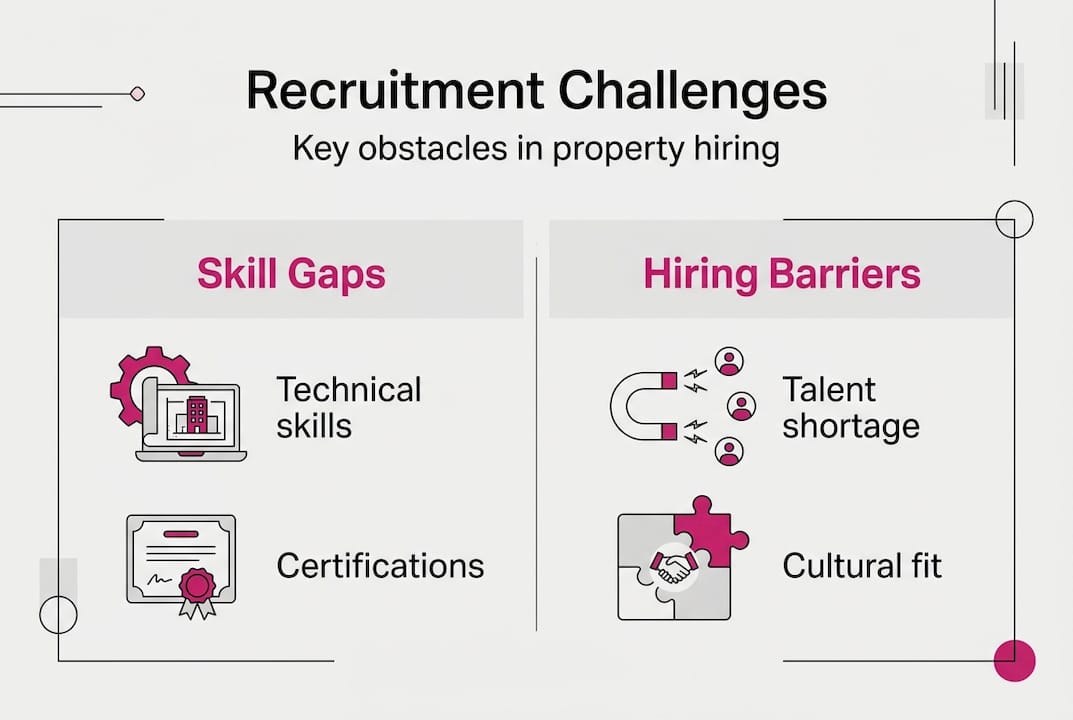
| Challenge Type | Average Impact | Primary Solution |
|---|---|---|
| Sourcing licensed agents | 52 day time to hire | Expand to adjacent sectors, use specialized recruiters |
| Technical skill gaps | 25% budget increase | Partner with universities, offer certification support |
| Cultural misalignment | Higher turnover rates | Structured interviews assessing fit alongside skills |
| Limited candidate pools | Extended vacancies | Leverage industry associations and professional networks |
Pro Tip: Track your recruiting technical talent challenges by role type and source. This data reveals which positions consistently take longest to fill and which sourcing channels deliver the best candidates, allowing you to allocate resources strategically.
Preparing your recruitment strategy: aligning goals and expanding talent pools
Successful recruitment starts long before posting a job description. You need a strategic foundation that connects hiring decisions to business objectives. Define what success looks like for each role by asking how it supports current projects and future growth. A development analyst hired today should contribute to projects launching in six months, so recruitment timelines must work backward from project milestones.
Aligning recruitment and training plans with strategic objectives transforms hiring from a reactive process to a proactive competitive advantage. Industry associations and university programs offer untapped talent pools that many firms overlook. Real estate programs at major universities produce graduates with foundational knowledge who can be molded to your specific needs, often at lower salary expectations than experienced hires.
Critical roles require careful identification. Start by mapping your current team against upcoming project requirements. Which technical certifications are essential versus nice to have? For property development, a CPM designation signals serious professional commitment, but candidates pursuing certification while working demonstrate similar dedication. This flexibility expands your qualified candidate pool significantly.
Non-traditional sourcing opens new possibilities. Consider candidates from adjacent sectors:
- Construction project managers transitioning to development oversight
- Commercial real estate agents moving into development roles
- Urban planning professionals seeking private sector opportunities
- Finance analysts with real estate investment experience
- Sustainability consultants as green building requirements expand
These professionals bring hybrid skillsets that traditional property development candidates may lack. A construction project manager understands timelines, budgets, and contractor management. An urban planner knows regulatory frameworks and community engagement. Both can learn property specific processes faster than someone without transferable project experience.
Balancing cultural fit with technical qualifications prevents costly hiring mistakes. Skills can be taught through training and mentorship, but values alignment and work style compatibility prove harder to change. During interviews, assess how candidates approach problem solving, communicate with team members, and handle project pressure. A technically brilliant candidate who clashes with your collaborative culture will disrupt team dynamics and likely leave within a year.
Pro Tip: Create a strategic talent acquisition framework that includes backup sourcing channels for each role type. When your primary channel fails to deliver candidates within two weeks, immediately activate secondary sources like property technology talent sourcing networks or tailored recruitment solutions partnerships to maintain momentum.
Executing successful recruitment: tactics and tools for property development hiring
Execution separates strategic planning from actual results. Follow this proven recruitment process to move from candidate sourcing to successful onboarding:
- Craft compelling job descriptions that sell opportunities, not just list requirements. Highlight growth paths, project variety, and company culture alongside technical needs.
- Source candidates through multiple channels simultaneously. Post on industry job boards, activate your network, engage recruiters, and reach out to passive candidates on professional platforms.
- Screen applications using structured criteria that weight both technical qualifications and cultural indicators. Phone screens should assess communication skills and genuine interest before investing in full interviews.
- Conduct structured interviews with consistent questions across candidates. Include behavioral scenarios that reveal problem solving approaches and values alignment.
- Make competitive offers quickly. Top candidates receive multiple offers, so delays cost you talent. Benchmark compensation against market rates and be prepared to negotiate on total package value.
- Onboard systematically with clear 30/60/90 day plans. Assign mentors, schedule certification training, and integrate new hires into project teams with defined responsibilities.
Your recruitment approach should match your specific needs and resources. Compare these common options:
| Approach | Best For | Timeline | Cost Structure |
|---|---|---|---|
| Direct hire (internal HR) | Large firms with ongoing needs | 45-60 days | Salary overhead, advertising costs |
| Contract recruitment | Project specific roles, seasonal demand | 15-30 days | Hourly or project rates, flexibility premium |
| Recruitment agency partnership | Specialized roles, faster fills | 20-35 days | Placement fees, quality guarantees |
Structured interviews deserve special attention. Create a scorecard with weighted criteria covering technical skills, cultural fit, communication ability, and growth potential. Ask every candidate the same core questions, then compare scores objectively. This reduces bias and creates defensible hiring decisions. Include scenario based questions like how they would handle a project running over budget or a key contractor missing deadlines.
Formal training, mentorship programs and competitive compensation benchmarking form the foundation of recruitment success. New hires need clear paths to advancement and skills development. Pair junior developers with senior project managers. Fund CPM certification for promising candidates. Create learning budgets that signal investment in employee growth.
Onboarding makes or breaks retention. Beyond paperwork and system access, new hires need context about company history, current projects, and team dynamics. Schedule meetings with key stakeholders across departments. Provide project background documents. Set clear performance expectations with measurable milestones. The first 90 days determine whether someone becomes a productive team member or starts looking for their next opportunity.

Pro Tip: Technology platforms streamline recruitment and reduce time to hire dramatically. Applicant tracking systems organize candidates, automate communications, and track metrics. Video interviewing tools expand your geographic reach and accelerate screening. Avoiding hiring pitfalls becomes easier when you leverage partnering with recruiting firms who use these tools daily and understand the role of recruiters in property talent acquisition.
Verifying successful recruitment outcomes and continuous improvement
Measuring recruitment effectiveness transforms gut feelings into data driven decisions. Track these key performance indicators for every hire:
- Time to hire from job posting to offer acceptance
- Recruitment cost per hire including advertising, agency fees, and internal time
- Offer acceptance rate revealing competitiveness of your packages
- 90 day retention rate showing onboarding effectiveness
- Hiring manager satisfaction scores assessing quality of candidates
- Source effectiveness comparing which channels deliver the best hires
These metrics reveal patterns over time. If your time to hire consistently exceeds 50 days for project managers, you need better sourcing channels or more attractive compensation. Low offer acceptance rates signal that competitors outbid you or your employer brand needs work. Poor 90 day retention points to onboarding failures or misaligned expectations during interviews.
Collecting feedback closes the improvement loop. Survey new hires at 30, 60, and 90 days about their recruitment experience, onboarding quality, and role clarity. Ask what surprised them, what exceeded expectations, and what fell short. Their fresh perspectives identify blind spots that tenured employees no longer notice.
Hiring managers provide equally valuable input. After each placement, ask whether the candidate met expectations, what the interview process missed, and how sourcing could improve. This feedback refines your screening criteria and interview questions for future searches.
Cultural fit matters to 64% of employers, directly impacting turnover rates and long term success. Analyze which hires thrive versus struggle in your environment. Do certain backgrounds or personality types consistently succeed? Which interview questions best predict cultural alignment? Use this analysis to weight cultural assessment more heavily in hiring decisions.
| Metric | Industry Benchmark | Your Target | Improvement Action |
|---|---|---|---|
| Time to hire | 52 days | 35-40 days | Expand sourcing, use agencies for specialized roles |
| 90 day retention | 85% | 90%+ | Improve onboarding, set clearer expectations |
| Offer acceptance | 75% | 85%+ | Benchmark compensation, strengthen employer brand |
| Cost per hire | Varies by role | Track and optimize | Balance speed versus cost based on role criticality |
Continuous training and certification keep new hires engaged and growing. Create individual development plans within the first month. Identify skill gaps and certification goals. Budget for professional development and track completion rates. Employees who see investment in their growth stay longer and perform better.
Data driven refinement never stops. Quarterly, review your recruitment metrics against targets. Which roles consistently take longest to fill? Where do offer rejections cluster? What feedback themes emerge from new hire surveys? Use these insights to adjust job descriptions, expand sourcing channels, revise interview processes, or increase compensation ranges.
Pro Tip: Create a recruitment playbook documenting what works for each role type. Include successful job description templates, effective interview questions, reliable sourcing channels, and competitive compensation ranges. This institutional knowledge prevents reinventing the wheel and maintains quality as your team grows. Regular reviews of balancing recruitment needs and overcoming talent acquisition challenges keep your playbook current and effective.
Explore top recruitment solutions for property development
Transforming recruitment strategy into consistent results requires expertise, networks, and dedicated resources. Many property development firms find that partnering with specialized recruitment agencies accelerates hiring while improving candidate quality. McGlynn Personnel brings deep expertise in contract and flexible recruitment tailored specifically to property development needs.
Our partnership approach aligns recruitment solutions with your business goals, project timelines, and cultural requirements. Whether you need to fill urgent project roles through flexible staffing solutions or build long term teams through strategic hiring, we deliver candidates who drive success. Understanding working with a recruitment agency and partnering with property management recruiters creates competitive advantages that translate directly to faster project launches and stronger team performance.
Frequently asked questions
What are the key skills to look for in property development candidates?
Strong project management capabilities, technical certifications like CPM, and hybrid skills from related sectors form the foundation. Cultural fit and communication skills matter equally because property development requires cross functional collaboration. Look for candidates who demonstrate adaptability, problem solving ability, and genuine passion for real estate.
How can property firms reduce time to hire for technical roles?
Leverage recruitment agencies with specialized property development networks and technology platforms that streamline screening. Pre screen candidates thoroughly and streamline interview rounds to two or three maximum. Use contract recruitment for urgent project needs while conducting thorough searches for permanent positions, allowing projects to progress without delays.
What recruitment sources are most effective for property development?
Industry associations, university partnerships, and property technology networks consistently deliver quality candidates. Professional organizations like NAIOP connect you with experienced practitioners and emerging talent. Recruiting from adjacent sectors like construction management, urban planning, and commercial real estate diversifies talent pools and brings fresh perspectives to traditional challenges.
Why is cultural fit important in property development hiring?
Employees aligned with company culture stay longer, collaborate more effectively, and contribute to positive team dynamics. This reduces recruitment costs by lowering turnover and minimizes project disruptions from team instability. 64% of employers prioritize cultural fit over experience specifically to reduce turnover, recognizing that skills can be taught but values alignment proves much harder to change after hiring.
Recommended
- Avoiding Common Hiring Pitfalls in Property Development: Strategies for Success – Mcglynn Personnel
- Real estate development recruitment: your 2026 guide
- Top Challenges in Recruiting Technical Talent for Property Development Projects – Mcglynn Personnel
- Overcoming Common Challenges in Real Estate Talent Acquisition: Strategies for Success – Mcglynn Personnel