
Cross-border recruitment is reshaping how manufacturing, engineering, and real estate companies fill their most critical roles. The assumption that hiring internationally is too slow, too expensive, or too complicated keeps many employers locked into shrinking local talent pools. Yet global hiring yields 20-50% cost savings on labor and operations, defying the myth that cross-border hiring is impractical for technical sectors. This guide breaks down exactly what cross-border recruitment is, how it works, and how you can use it to secure specialized talent faster and smarter.
Table of Contents
- Defining cross-border recruitment: What it is, and what it isn’t
- Why companies pursue cross-border hiring: Opportunities and benchmarks
- Critical methodologies in cross-border recruitment: How it works
- Common challenges and compliance risks
- Special nuances for technical sectors: Best-fit strategies
- Direct hiring vs. EOR vs. agency partnerships: Choosing the right approach
- Practical steps: Building your cross-border recruitment strategy
- Streamline your cross-border recruiting process
- Frequently asked questions
Key Takeaways
| Point | Details |
|---|---|
| Clear definition | Cross-border recruitment involves hiring across borders, requiring special compliance and process strategies. |
| Sector-specific benefits | Employers in technical fields gain cost savings, talent access, and faster hiring when done effectively. |
| Compliance is critical | Misclassification, taxes, and onboarding delays are major risks without careful planning. |
| Choose the right model | Direct, EOR, and agency solutions each offer unique pros and cons for cross-border hiring. |
| Strategy drives success | Following a clear step-by-step process enables companies to build efficient, compliant talent pipelines. |
Defining cross-border recruitment: What it is, and what it isn’t
Cross-border recruitment means sourcing and hiring talent from outside your country of business operations. It sounds simple, but it’s far more layered than standard international hiring. Where general international hiring might mean posting a job on a global board, cross-border recruitment involves navigating regulatory frameworks, tax obligations, employment law, and compliance requirements across multiple jurisdictions.
The cross-border recruitment strategies that work best are built around four core models:
- Direct hiring with a local entity: You establish a legal presence in the target country and hire directly.
- Employer of Record (EOR): A third-party organization employs the worker on your behalf, handling local compliance.
- Recruitment agency partnerships: Specialist agencies source, screen, and place candidates while managing much of the process complexity.
- Independent contractors: Faster to engage but carry misclassification risk if not structured correctly.
As cross-border hiring best practices confirm, the most effective approach starts with defining hiring goals, understanding local compliance, and selecting the right model for your jurisdiction. Manufacturing, engineering, and real estate firms rely on this approach specifically for technical, operational, and leadership roles where domestic supply simply cannot meet demand. Understanding international recruitment at this level is the foundation for everything that follows.
Why companies pursue cross-border hiring: Opportunities and benchmarks
The business case for cross-border hiring is compelling, especially in technical sectors. Cost is the most obvious driver. Global hiring delivers 20-50% savings on labor and parts, which matters enormously when you’re scaling a manufacturing operation or building out an engineering team.
But cost is only part of the story. Access to specialized talent is equally powerful. Many engineering disciplines, precision manufacturing skills, and real estate leadership competencies are simply not available in sufficient numbers domestically. The world is your talent pool when you remove geographic constraints.
“Manufacturing roles attract 38 applications per role, with a 92% offer acceptance rate and a 55-day average time-to-hire globally.”
That time-to-hire figure is worth noting. With the right process, global hiring timelines are competitive with domestic ones. Real estate is also accelerating its adoption of cross-border talent strategies, driven by real estate investment trends including cross-border M&A activity and digital transformation.
| Sector | Avg. time-to-hire | Offer acceptance rate | Key talent driver |
|---|---|---|---|
| Manufacturing | 55 days | 92% | Precision skills shortage |
| Engineering | 48-60 days | 88% | Certification scarcity |
| Real estate | 40-55 days | 85% | Leadership and compliance expertise |
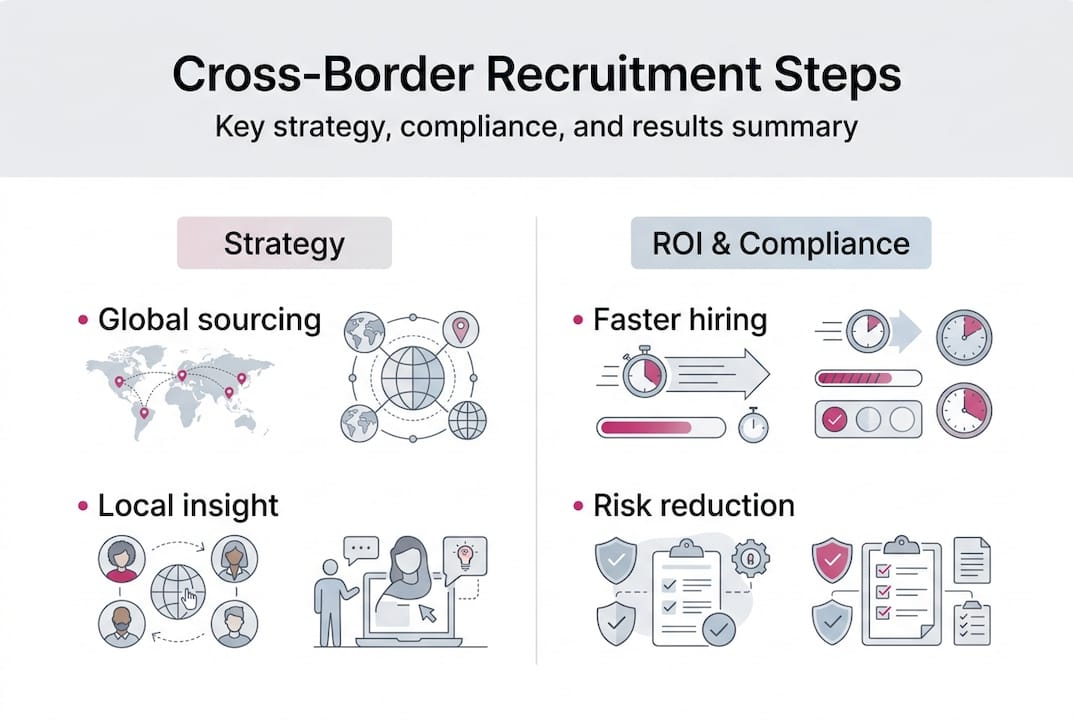
Applying global talent acquisition best practices and combining them with local insight in recruitment is what separates employers who succeed internationally from those who struggle.
Critical methodologies in cross-border recruitment: How it works
Effective cross-border hiring follows a structured process. Improvising at any stage adds cost and risk. Here’s how the best employers approach it:
- Define the role precisely. Specify required certifications, technical competencies, language requirements, and expected outcomes before sourcing begins.
- Research the target market. Understand local pay benchmarks, labor laws, notice periods, and talent availability in your chosen country.
- Select your engagement model. Choose between direct hire, EOR, agency partnership, or contractor based on role level, volume, and jurisdiction.
- Build your technology stack. An applicant tracking system (ATS) with multi-language support, compliance software, and remote onboarding tools are non-negotiable.
- Adapt your interview process. Cultural context affects how candidates respond to behavioral questions, so adjust your framework accordingly.
- Execute compliant onboarding. Contracts, tax registration, and benefits must align with local law from day one.
Best practices in cross-border hiring consistently emphasize the combination of EOR services, specialist agency partnerships, and ATS platforms with multi-language support as the most reliable methodology for technical roles.
Pro Tip: Before engaging any candidate internationally, map out the compliance requirements for their specific country. A 30-minute legal review upfront can prevent a six-month delay later. Explore global recruitment solutions and resources for navigating global recruitment challenges to build this into your standard process.
Common challenges and compliance risks
Knowing the methodologies is only part of the equation. The compliance and operational risks in cross-border recruitment are real, and they can be costly if ignored.

Worker misclassification is the most common trap. Treating an employee as a contractor to avoid local employment obligations can trigger significant fines and back-tax liability. Permanent establishment is equally dangerous. If your cross-border hire creates a taxable presence in another country, you may face unexpected corporate tax obligations.
As practical cross-border considerations outline, visa and certification processes routinely add 3-6 months to onboarding timelines for technical roles. Data privacy is another layer. Transferring candidate and employee data across borders must comply with local data protection laws, which vary significantly between regions.
| Risk | Impact | Mitigation |
|---|---|---|
| Worker misclassification | Fines, back taxes | Use EOR or legal counsel |
| Permanent establishment | Unexpected corporate tax | Jurisdiction review before hiring |
| Visa/certification delays | 3-6 month onboarding lag | Start processes early |
| Data privacy breach | Regulatory penalties | Use compliant HR tech |
Cultural mismatch is often underestimated. Poor cultural integration can reduce first-year productivity by up to 40%, making cross-cultural recruitment expertise and strong expatriate support strategies essential investments, not optional extras.
Special nuances for technical sectors: Best-fit strategies
Generic recruitment advice doesn’t cut it when you’re hiring a precision engineer, a plant manager, or a real estate portfolio director across borders. Each technical sector carries its own complexity.
In engineering, candidates must hold specific certifications that may not transfer directly between countries. Safety regulations differ. Technical language varies. A generalist recruiter without sector knowledge will miss these nuances and cost you time. Sector-specialist recruiters cut time-to-hire by 40% in engineering roles, and nearshoring, hiring from geographically close countries, balances time zone alignment with cultural compatibility in manufacturing and real estate.
For real estate, cross-border hiring increasingly supports M&A activity and portfolio expansion. Leadership candidates must understand both local compliance and international investment frameworks. That’s a narrow profile, and finding it requires precision matching, not broad sourcing.
Pro Tip: Never use a generalist recruiter for cross-border technical hiring. The cost of a bad hire in a specialized role far exceeds the fee difference between a generalist and a specialized hiring agency.
Direct hiring vs. EOR vs. agency partnerships: Choosing the right approach
Selecting the right engagement model shapes your speed, cost, and risk profile. Here’s how the three main approaches compare:
| Model | Speed | Cost | Control | Best for |
|---|---|---|---|---|
| Direct hire (local entity) | Slow | High | High | Long-term, high-volume hiring |
| Employer of Record (EOR) | Fast | Medium | Medium | Single hires, new markets |
| Agency partnership | Fast | Variable | Lower | Specialist and executive roles |
Traditional entity setup offers control but demands significant time and capital investment. EOR services accelerate entry into new markets but add fees and introduce a layer of legal complexity around co-employment. Agency partnerships deliver speed and specialist access, particularly for technical and managerial roles where precision matching matters most.
Key decision factors include:
- Role level: Executive and specialist roles benefit most from agency partnerships.
- Volume: High-volume hiring justifies the cost of a local entity.
- Jurisdiction complexity: Highly regulated markets favor EOR to manage compliance.
- Timeline: If you need someone in 60 days, EOR or agency is your fastest path.
Practical steps: Building your cross-border recruitment strategy
Ready to put it all together? Here’s a sequential roadmap that works across manufacturing, engineering, and real estate:
- Clarify your business goals. Define what success looks like for this hire. Revenue impact, project delivery, team leadership? Get specific.
- Build an internal brief. Document the role, required skills, certifications, language needs, and compensation range before approaching any market.
- Identify target countries. Research talent availability, labor costs, and compliance requirements. Prioritize markets where your skills exist at scale.
- Choose your engagement model. Match the model to your timeline, budget, and jurisdiction complexity.
- Adapt your interview process. Adjust behavioral frameworks for cultural context. Standardize technical assessments across all candidates.
- Execute compliant onboarding. Contracts, payroll, benefits, and tax registration must be in place before the start date.
- Monitor and optimize. Track time-to-hire, retention, and productivity. Real estate investment benchmarks and sector data show that firms who measure and iterate consistently outperform those who treat each hire as a one-off event.
Building this process into a repeatable system is what separates reactive hiring from strategic talent sourcing in specialized sectors.
Streamline your cross-border recruiting process
You now have a clear picture of what cross-border recruitment involves, where the risks sit, and how to build a process that delivers results. The next step is execution, and that’s where the right partner makes all the difference.
McGlynn Personnel specializes in cross-border recruitment for manufacturing, engineering, and real estate. Whether you need engineering staffing solutions for a precision-critical project, flexible contract recruitment to scale quickly, or end-to-end cross-border recruitment expertise for a senior leadership search, we bring the sector knowledge and global reach to get it right. Our rigorous candidate screening and compliance-first approach mean you hire with confidence, not guesswork. Connect with our team today and put your cross-border hiring strategy into action.
Frequently asked questions
What are the biggest legal risks in cross-border recruitment?
The most critical risks are worker misclassification and permanent establishment, which can result in fines and unexpected taxes if not managed with proper legal oversight from the start.
How long does onboarding take for international hires?
Visa and certification processes typically add 3-6 months to onboarding timelines, depending on the target country and the specific role requirements.
What’s the main advantage of using an Employer of Record (EOR)?
EORs simplify compliance and payroll in foreign markets by acting as the legal employer, so you gain EOR compliance benefits without needing to establish a local entity.
Is cross-border recruitment worth it for small manufacturing firms?
Yes. Even smaller operations can access 20-50% labor cost savings and tap into skilled talent unavailable locally, particularly through agency or EOR models that minimize upfront investment.
How do cultural differences impact productivity?
Cultural mismatches reduce first-year productivity by up to 40%, which is why structured cultural onboarding and adaptation support are essential components of any cross-border hiring plan.
Recommended
- Mastering Cross-Border Recruitment: Strategies for Success – Mcglynn Personnel
- The Power of Combining Global Reach with Local Insight in Recruitment – Mcglynn Personnel
- Global Talent Acquisition: Best Practices from Around the World – Mcglynn Personnel
- What is international recruitment? A 2026 guide