
Many employers assume international recruitment is too complex or expensive, yet 65% face sourcing bottlenecks when relying solely on local talent pools. The reality is simpler: international recruitment opens access to specialized skills your local market cannot provide, especially in manufacturing, engineering, and real estate sectors. This guide clarifies what international recruitment truly involves, why it matters for your competitive advantage, and how to implement it strategically in 2026.
Table of Contents
- Understanding International Recruitment And Its Strategic Value
- Key Components And Metrics Of Successful International Recruitment
- Navigating Cross-Cultural Challenges And Providing Expatriate Support
- Applying International Recruitment Strategies To Specialized Sectors
- Explore Tailored International Recruitment Solutions For Specialized Sectors
- Frequently Asked Questions
Key takeaways
| Point | Details |
|---|---|
| Global talent access | International recruitment expands your candidate pool beyond local limitations to find specialized skills worldwide. |
| Strategic planning required | Ad-hoc international posting rarely works; success demands defined goals, market research, and optimized sourcing channels. |
| Metrics drive optimization | Tracking time-to-hire, offer acceptance rates, and qualification levels identifies bottlenecks and improves campaign efficiency. |
| Cultural support matters | Comprehensive expatriate services including relocation assistance and cultural orientation significantly boost retention rates. |
| Sector-specific approaches | Manufacturing, engineering, and real estate each require tailored international recruitment strategies aligned with industry demands. |
Understanding international recruitment and its strategic value
International recruitment means sourcing candidates beyond your local market to access the best talent worldwide, regardless of geographic boundaries. This approach directly addresses talent shortages that plague manufacturing, engineering, and real estate sectors where specialized skills remain scarce domestically. When you limit your search to local candidates, you create artificial constraints that lead to sourcing bottlenecks and unmet hiring targets.
Relying exclusively on your immediate geographic area often results in extended vacancies, compromised hiring standards, or settling for underqualified candidates. International recruitment eliminates these limitations by tapping into global labor markets where your required skills exist in abundance. The difference between struggling to fill a precision engineering role locally versus accessing a worldwide pool of certified specialists is transformative.
Strategic planning separates successful international recruitment from expensive failures. You must define clear hiring goals, evaluate international labor markets for talent density, and optimize sourcing channels before posting a single job description. Strategic planning yields better long-term talent acquisition success than reactive, ad-hoc approaches that waste resources on unqualified applicants.
Effective international recruitment requires understanding which markets produce your needed skills, what compensation expectations exist, and how to position your opportunities competitively. Manufacturing employers seeking CNC machinists, for example, benefit from researching which countries produce strong technical vocational training in precision manufacturing. Engineering firms hunting for renewable energy specialists should identify regions with robust green technology education programs.
Pro Tip: Treat talent acquisition as a capital investment for long-term competitive advantage, not just a short-term operational cost. Companies that view international recruitment strategically build sustainable talent pipelines that competitors cannot easily replicate.
Partnering with specialists who understand global recruitment solutions accelerates your learning curve and reduces costly trial-and-error. The expertise required to navigate international labor laws, cultural expectations, and visa processes justifies working with experienced professionals rather than building this capability from scratch.
Key components and metrics of successful international recruitment
Successful international recruitment comprises five core components that work together systematically. Your international sourcing strategy defines which geographic markets to target based on skill availability, cost considerations, and cultural fit. Candidate screening must account for credential verification across different educational systems and professional certification bodies. Local compliance requires understanding labor laws, tax obligations, and employment regulations in both your location and the candidate’s origin country.
Visa support represents a critical component many employers underestimate. Navigating work permits, sponsorship requirements, and immigration timelines demands specialized knowledge that varies dramatically by country and role type. Integration planning ensures international hires succeed once they arrive, covering everything from housing assistance to cultural orientation programs.

Tracking key metrics transforms international recruitment from guesswork into a data-driven process. Time-to-hire measures how long each stage takes, from initial outreach to signed offer, helping you identify delays in screening, compliance, or visa processing. Offer acceptance rates reveal whether your compensation packages and relocation support meet candidate expectations. Candidate qualification levels show what percentage of applicants actually possess the required skills and credentials.
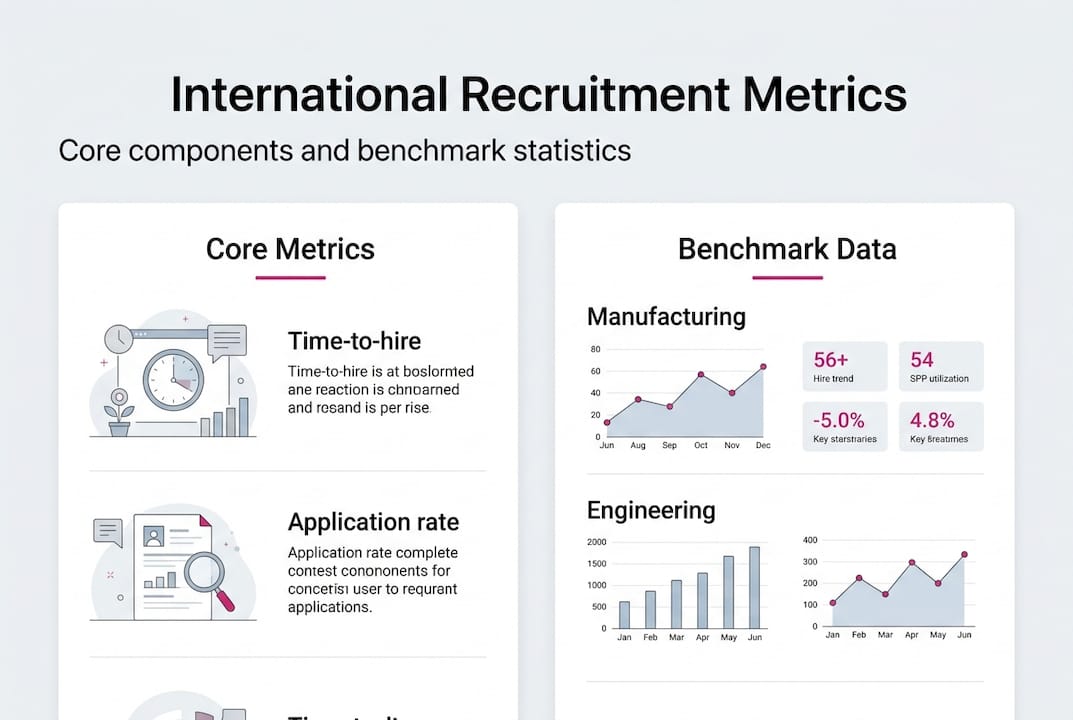
| Metric | Manufacturing Benchmark | Engineering Benchmark | Why It Matters |
| — | — | — |
| Time-to-hire | 45-60 days | 50-70 days | Identifies process bottlenecks and competitive disadvantages |
| Offer acceptance rate | 68-75% | 70-78% | Reveals package competitiveness and candidate experience quality |
| Qualified applicant ratio | 12-18% | 15-22% | Shows sourcing channel effectiveness and screening precision |
| Cost per hire | $4,200-$6,800 | $5,500-$8,200 | Measures recruitment efficiency and ROI on international efforts |
Benchmark data shows many sectors face extended time-to-hire cycles and receive abundant applications but struggle with low qualification rates. This pattern indicates poor sourcing channel selection or inadequate job description specificity. When 85% of your applicants lack basic qualifications, you are advertising in the wrong places or communicating requirements unclearly.
Monitoring these statistics helps you identify specific bottlenecks in your international recruitment process. If your time-to-hire exceeds benchmarks primarily during visa processing, you need better immigration support or should target candidates from countries with faster work permit timelines. If offer acceptance rates lag, your relocation packages may be insufficient or your cultural integration support appears weak to candidates.
Pro Tip: Use a data-driven approach to continuously refine sourcing channels and reduce hiring delays. Track which job boards, recruitment agencies, or professional networks produce the highest qualified applicant ratios, then concentrate resources on your most effective channels.
Implementing global talent acquisition best practices requires establishing baseline metrics, setting improvement targets, and reviewing performance monthly. Companies that measure and optimize consistently outperform those relying on intuition. Learning how to source talent globally with precision reduces wasted effort on unproductive channels.
Navigating cross-cultural challenges and providing expatriate support
Cultural differences, language barriers, and legal variances create substantial challenges for international hires and the employers who recruit them. Candidates moving to new countries face uncertainty about housing, healthcare, banking, education for children, and social integration. Employers must recognize these concerns directly impact candidate decision-making and long-term retention. A talented engineer who feels abandoned after arrival will likely leave within 18 months, wasting your entire recruitment investment.
Providing comprehensive expatriate support including relocation assistance, cultural orientation, and compliance guidance significantly boosts retention rates. Viewing talent as a long-term investment that requires ongoing support aligns your organization toward appropriate resource allocation. The cost of replacing an international hire who leaves prematurely far exceeds the investment in proper integration support.
Employers must develop structured onboarding and integration programs specifically designed for global hires. Generic local employee onboarding misses critical elements international candidates need, such as navigating local bureaucracy, understanding cultural workplace norms, and building professional networks in unfamiliar environments. Your integration program should address both professional success factors and personal settlement needs.
Implementing effective expatriate support follows a systematic approach:
- Conduct pre-arrival assessment to understand each candidate’s specific needs, family situation, language proficiency, and cultural familiarity with your location.
- Develop personalized support plans addressing housing, transportation, legal documentation, banking setup, and family needs like schools or spousal employment.
- Maintain ongoing communication throughout the relocation process, providing a dedicated contact person who answers questions and resolves issues promptly.
- Deliver cultural training covering workplace expectations, communication styles, business etiquette, and social norms to accelerate professional integration.
- Establish feedback loops where international hires share their experiences, allowing you to identify gaps and improve support for future recruits.
Common pitfalls to avoid in international recruitment include:
- Overlooking local labor laws in the candidate’s origin country, creating legal complications or unexpected tax obligations
- Neglecting cultural adaptation needs by assuming professional competence alone ensures success
- Providing insufficient communication during visa processing, leaving candidates anxious and potentially accepting competing offers
- Failing to prepare existing teams for international colleagues, missing opportunities to build inclusive workplace cultures
- Underestimating the time required for international hires to reach full productivity in new cultural and regulatory environments
Developing robust expatriate support strategies transforms international recruitment from a transactional hiring event into a strategic talent development process. Companies known for excellent expatriate support gain competitive advantages in attracting top international candidates. Leveraging cross-cultural recruitment with local expertise helps you avoid expensive mistakes and build reputation as an employer of choice for global talent.
Applying international recruitment strategies to specialized sectors
Manufacturing often requires highly specialized skill sets in areas like precision machining, quality control, automation programming, and production management. Sourcing globally fills critical gaps when local technical schools cannot produce sufficient graduates or experienced professionals relocate away from manufacturing centers. Advanced manufacturing roles demand candidates who understand lean principles, Six Sigma methodologies, and industry-specific safety standards.
Engineering roles demand precision in screening and compliance with certifications across different jurisdictions. A structural engineer licensed in one country may need additional examinations or supervised practice periods before receiving local credentials. Chemical engineers must understand region-specific environmental regulations and safety protocols. Your recruitment process must account for credential evaluation timelines and potential retraining requirements.
Real estate sector recruitment benefits from global sourcing for leadership positions and specialized property management roles. International candidates bring diverse market perspectives, innovative approaches to tenant relations, and experience with different regulatory frameworks. Property development firms especially value professionals who understand cross-border investment structures and international capital markets.
| Sector | Primary Recruitment Focus | Key Screening Criteria | Critical Support Needs |
|---|---|---|---|
| Manufacturing | Technical skills, safety certifications, lean experience | Hands-on assessments, credential verification, cultural fit | Housing near facilities, family integration, technical training |
| Engineering | Professional licenses, project experience, specialization depth | Credential evaluation, technical interviews, portfolio review | License transfer support, professional network building, continuing education |
| Real Estate | Market knowledge, leadership capability, regulatory expertise | Track record verification, market assessment skills, cultural adaptability | Local market orientation, regulatory training, client relationship support |
Best practices for sector-specific international recruitment include:
- Aligning recruitment strategies with sector-specific market insights about where your needed skills concentrate globally
- Leveraging local labor market knowledge internationally to understand compensation expectations, cultural norms, and candidate motivations
- Integrating expatriate support tailored to sector needs, such as professional association memberships for engineers or industry conference attendance for real estate leaders
- Building relationships with international technical schools, professional organizations, and industry groups to create sustainable talent pipelines
- Developing sector-specific assessment methods that evaluate practical skills, not just credentials or interview performance
Pro Tip: Collaborate with specialized recruiters who understand your sector and global talent dynamics to improve results. Generic recruitment agencies lack the technical knowledge to properly screen manufacturing or engineering candidates, while sector specialists recognize quality immediately.
Effective strategic planning and benchmarking prove essential for sector-focused international recruitment success. Understanding how your metrics compare to industry standards helps you set realistic timelines and budgets. Implementing proven manufacturing recruitment strategies adapted for international contexts accelerates your results.
Addressing real estate talent acquisition challenges through international recruitment requires understanding property market cycles, regulatory environments, and investment trends across different regions. Applying manufacturing and engineering recruitment strategies to international contexts demands technical expertise and cultural sensitivity simultaneously.
Explore tailored international recruitment solutions for specialized sectors
Building effective international recruitment capabilities requires more than understanding concepts. You need practical frameworks, sector-specific insights, and proven processes that deliver results consistently. McGlynn Personnel offers extensive resources and services designed specifically for manufacturing, engineering, and real estate employers navigating international talent markets.

Access comprehensive guidance through our talent sourcing guide for specialized sectors in 2026, which provides actionable strategies tailored to your industry’s unique challenges. Learn proven techniques for sourcing talent globally that reduce time-to-hire while improving candidate quality. Implement our expatriate support services frameworks to enhance integration success and maximize retention of your international hires. Partner with recruitment specialists who combine deep sector knowledge with global market expertise to achieve hiring precision and sustainable competitive advantage.
Frequently asked questions
What are the main benefits of international recruitment for specialized sectors?
International recruitment provides access to specialized skills unavailable locally, reduces time-to-hire for hard-to-fill positions, and brings diverse perspectives that drive innovation. Manufacturing and engineering sectors especially benefit from accessing technical expertise concentrated in specific global regions. Partnering with global recruitment solutions specialists accelerates these benefits while reducing implementation risks.
How can employers manage visa and compliance challenges effectively?
Work with immigration specialists who understand sponsorship requirements, processing timelines, and documentation standards for your target countries. Start visa processes early in your recruitment timeline, maintain clear communication with candidates about requirements and progress, and budget appropriately for legal fees and processing costs. Many employers underestimate visa timelines and lose candidates to competing offers during extended waiting periods.
What support services are critical for successful international hires?
Comprehensive relocation assistance, housing support, cultural orientation, family integration services, and ongoing mentorship prove most valuable. International hires need help navigating local bureaucracy for banking, healthcare, and legal documentation. Implementing robust expatriate support strategies significantly improves retention and reduces time to full productivity.
How long does the international recruitment process typically take in manufacturing and engineering?
Expect 50 to 70 days from initial candidate identification to signed offer, with an additional 30 to 90 days for visa processing depending on the candidate’s origin country and your location. Manufacturing roles average slightly faster due to more standardized skill requirements, while engineering positions require longer credential verification and technical assessment periods. Building relationships with pre-screened candidate pools reduces these timelines substantially.
What common mistakes should employers avoid in international recruiting?
Avoid underestimating cultural adaptation challenges, providing insufficient relocation support, neglecting family needs of international hires, and failing to prepare existing teams for cultural diversity. Many employers also make the mistake of applying identical screening criteria used for local candidates without accounting for different educational systems or professional certification standards. Starting without clear metrics and benchmarks leads to wasted resources on ineffective sourcing channels.