
Cross-border talent demand is surging, yet the rules of the game keep shifting. Manufacturing plants need automation-ready engineers. Real estate firms need regional specialists who understand local regulatory landscapes. And both sectors are competing for the same shrinking pool of globally mobile professionals. If your hiring strategy still relies on the same playbook from three years ago, you’re already behind. This article breaks down the key forces shaping global recruitment in 2026, the technology driving smarter decisions, the compliance traps to avoid, and the practical strategies that actually move the needle for HR professionals in manufacturing and real estate.
Table of Contents
- Global talent market: Key forces shaping hiring in 2026
- Emerging recruitment technology and data-driven hiring
- Navigating compliance, culture, and workforce mobility
- Practical strategies for global talent acquisition success
- A fresh perspective: What most HR articles miss about global hiring in 2026
- How to leverage expert recruitment partners for global hiring success
- Frequently asked questions
Key Takeaways
| Point | Details |
|---|---|
| Sector trends matter | Manufacturing and real estate each face unique global talent challenges in 2026. |
| Tech plus insight wins | Successful global hiring requires blending technology with local expertise. |
| Compliance and culture count | International recruitment must balance legal, cultural, and mobility factors. |
| Strategic sourcing is essential | Actionable talent strategies drive better hiring in a global market. |
| Partner with experts | Recruitment specialists offer guidance and tools for global hiring success. |
Global talent market: Key forces shaping hiring in 2026
With the stage set, let’s analyze the core market forces reshaping how HR leaders approach global hiring.
Global recruitment is increasingly shaped by the fusion of digital platforms and localized insight. You can post a role on a global job board in minutes, but converting that reach into a quality hire requires far more than visibility. It demands cultural fluency, sector knowledge, and an understanding of what motivates talent in specific regions.
For manufacturing, the pressure is acute. Automation and advanced production technologies are redefining the skills required on the floor and in the boardroom. You’re not just hiring operators anymore. You’re sourcing robotics technicians, process engineers, and digital manufacturing leads. Real estate faces a different but equally complex challenge. Regulatory shifts across the UK, EU, Middle East, and APAC are forcing firms to prioritize candidates with deep regional expertise and compliance awareness.
A striking 68% of global firms plan to expand cross-border hiring by the end of 2026. That’s a significant signal. It means your competitors are already widening their talent nets, and standing still is not a neutral position.
Here are the key forces you need to track:
- Digital platform expansion driving wider candidate reach but requiring local adaptation
- Automation demand in manufacturing creating new technical role categories
- Regulatory complexity in real estate requiring regionally specialized hires
- Talent mobility shifts post-pandemic reshaping where professionals are willing to relocate
- Cultural fit gaps emerging as a top reason for failed international placements
Pro Tip: Before expanding globally, use your international recruitment guide to map out the compliance and cultural requirements for each target region. Skipping this step is the most common and costly mistake HR teams make.
Underestimating compliance and cultural fit isn’t just a process failure. It’s a financial one. Failed international placements cost organizations an average of three times the annual salary of the role. Get the foundation right before you scale.
Emerging recruitment technology and data-driven hiring
Understanding the market forces, next we examine how technology is fundamentally reshaping global hiring for sector-specific leaders.
AI-powered screening and predictive analytics are central to effective global recruitment strategies. But the real competitive edge comes from knowing how to layer these tools with human judgment, not replace it.

Here’s how technology adoption is changing outcomes across both sectors:
| Metric | Pre-tech adoption | Post-tech adoption |
|---|---|---|
| Time to shortlist (manufacturing) | 18 days | 7 days |
| Time to shortlist (real estate) | 21 days | 9 days |
| Candidate quality score | 62% | 84% |
| Recruiter hours per hire | 40 hours | 18 hours |
| Cross-border placement success rate | 54% | 76% |
The numbers are clear. Technology accelerates the process and improves quality, but only when implemented correctly.
Here’s a practical approach to integrating new tech into your recruitment workflow:
- Audit your current process to identify where delays and quality gaps occur most frequently.
- Select AI tools that align with your sector needs, such as skills-matching platforms for manufacturing or regulatory compliance filters for real estate.
- Train your team on interpreting data outputs rather than treating them as final decisions.
- Run a pilot on a single role category before scaling across your hiring program.
- Review outcomes at 30 and 90 days to measure quality of hire, not just speed.
Technology in recruitment is a force multiplier, not a replacement for expertise. The firms winning globally are those pairing smart tools with recruiters who understand the nuance of each sector and region.
Pro Tip: Explore technology in modern hiring to identify which AI tools are delivering the strongest ROI for manufacturing and real estate hiring teams in 2026. Combine digital screening with local insight for the best outcomes.
Your global recruitment solutions should treat technology as a starting point, not a finish line. The human layer is where precision matching happens.
Navigating compliance, culture, and workforce mobility
Tech adoption is only part of the picture. Next, let’s tackle the essential considerations of compliance, culture, and talent mobility.
A successful global hire blends compliance expertise and cultural alignment. Without both, even the most technically qualified candidate can become a costly misfit.
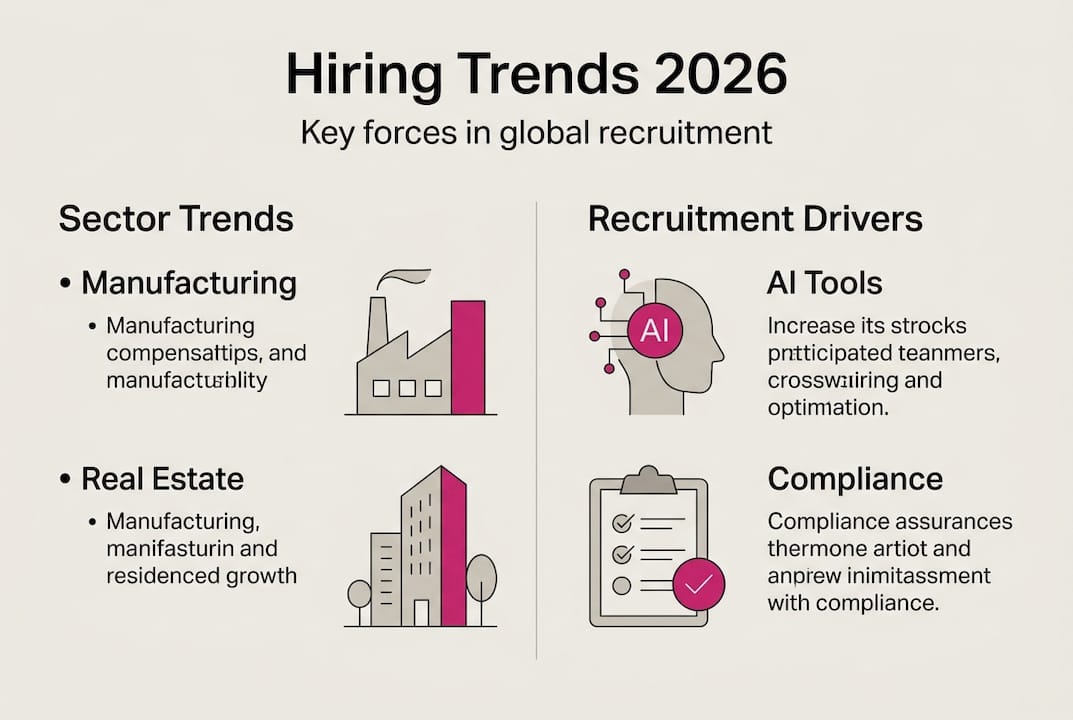
Here’s how the two sectors compare across the critical dimensions:
| Dimension | Manufacturing | Real estate |
|---|---|---|
| Key compliance areas | Work permits, safety certifications, trade regulations | Property law, licensing, regional regulatory bodies |
| Cultural nuances | Hierarchical vs. flat team structures vary by region | Client relationship norms differ significantly across markets |
| Mobility challenges | Relocation for plant-based roles, visa processing times | Remote vs. on-site expectations, market-specific knowledge |
| Risk level | High in APAC and Middle East for technical roles | High in EU and UK for regulatory compliance roles |
Use this checklist to strengthen your cross-border hiring process:
- Verify work authorization requirements for every target country before advertising
- Assess cultural fit alongside technical skills during initial screening
- Build relocation support and timeline expectations into your offer process
- Engage local legal counsel for compliance review in new markets
- Create onboarding plans that address cultural integration, not just role orientation
Pro Tip: Leverage local insight in hiring by partnering with specialists who have on-the-ground knowledge in your target regions. This reduces compliance risk and dramatically improves candidate retention.
The firms that treat compliance as a checklist and culture as an afterthought are the ones calling us six months later to replace a failed hire. Invest in global recruitment with local insight from the start, and you protect both your timeline and your budget.
Practical strategies for global talent acquisition success
Having covered compliance and cultural integration, we’ll now focus on hands-on strategies to maximize global recruitment success.
Strategic talent sourcing ensures sustainable growth and competitive advantage for globally focused companies. Knowing the theory is one thing. Executing it consistently across borders is another.
Do’s and don’ts for global hiring in 2026:
- Do build talent pipelines before you have urgent vacancies
- Do use sector-specific job boards and professional networks for manufacturing and real estate roles
- Do invest in employer branding that speaks to globally mobile candidates
- Don’t rely solely on CV screening without structured technical or behavioral assessments
- Don’t overlook retention planning as part of your initial sourcing strategy
- Don’t assume a candidate who succeeded in one region will automatically thrive in another
Here’s how to implement strategic talent sourcing step by step:
- Define your talent profile with precision, including technical skills, regional experience, and cultural adaptability.
- Map your sourcing channels across job boards, professional associations, and specialist recruitment partners.
- Engage passive candidates through targeted outreach and content that speaks to their career goals.
- Screen for both competency and cultural alignment using structured interview frameworks.
- Build feedback loops by tracking placement outcomes and adjusting your sourcing criteria every quarter.
Pro Tip: Review global hiring challenges and recruitment challenges and innovations to anticipate the obstacles your team will face before they become expensive problems.
Fast adaptation is your greatest asset in 2026. The talent market moves quickly, and the organizations that build agile, data-informed sourcing processes will consistently outperform those still reacting to vacancies after they arise.
A fresh perspective: What most HR articles miss about global hiring in 2026
Before we wrap up, here’s a candid perspective from real HR and recruitment experience that cuts through conventional wisdom.
Most articles on global hiring tell you to adopt better technology or build a more rigorous compliance process. Both are valid. But here’s what they rarely say: technology and checklists don’t build trust with candidates or hiring managers across borders. People do.
In manufacturing and real estate, the roles that are hardest to fill globally are rarely hard because of a sourcing problem. They’re hard because the organization hasn’t invested in understanding what motivates talent in that specific region, at that specific career stage. A plant manager in Malaysia has different professional values than one in Germany. A real estate development lead in Dubai operates in a fundamentally different regulatory and cultural context than one in Chicago.
The organizations consistently winning at global hiring are those treating it as a long-term relationship strategy, not a transactional process. They invest in contract recruitment in specialized sectors, build genuine partnerships with local experts, and develop cross-cultural competency inside their HR teams.
Quick fixes don’t build global talent pipelines. Sustained, strategic investment in people, partnerships, and process does.
How to leverage expert recruitment partners for global hiring success
With actionable strategies and fresh perspective in hand, here’s how expert partners can elevate your global recruitment outcomes.
Global hiring at scale requires more than internal capability. It requires a network, sector expertise, and the kind of localized insight that only comes from operating across multiple markets simultaneously. That’s exactly what McGlynn Personnel delivers.
Whether you’re looking to source talent globally for a manufacturing expansion or build a real estate team across multiple regions, our specialists bring the precision matching and compliance knowledge your hiring program needs. Explore our specialized sector talent sourcing guide for sector-specific frameworks, and review our expatriate support for global hires to ensure your international placements land and stay. Let’s build your global talent strategy together.
Frequently asked questions
What are the top challenges HR managers face in global hiring for 2026?
Compliance and cultural fit are the most persistent barriers, alongside meeting the sector-specific technical demands that vary significantly between manufacturing and real estate markets.
How can recruitment technology improve hiring outcomes?
AI-powered screening reduces time to shortlist and improves candidate quality scores, but the strongest results come when these tools are paired with experienced recruiters who understand regional and sector nuance.
What practical steps drive global talent acquisition success?
Strategic talent sourcing combined with structured feedback loops and retention planning creates a sustainable pipeline that supports long-term organizational growth across borders.
How do manufacturing and real estate sectors differ in global recruitment?
Sector-specific trends show manufacturing prioritizes automation-ready technical talent and safety compliance, while real estate demands regional regulatory expertise and strong client relationship skills that vary considerably by market.