
Hiring a precision engineer in manufacturing can take 60 days, while filling a property manager role averages just 30 days. Why such a dramatic difference? The recruitment process adapts dramatically across sectors, shaped by skill requirements, labor markets, and cultural priorities. Whether you’re a job seeker navigating interviews or an employer refining your hiring strategy, understanding these sector-specific nuances transforms your approach. This guide breaks down the recruitment process with actionable insights for engineering, manufacturing, and property management professionals in 2026.
Table of Contents
- Understanding The Recruitment Process: Definitions And Core Stages
- Sector-Specific Recruitment Dynamics: Manufacturing Vs. Property Management In 2026
- Expert Insights And Recruitment Best Practices For 2026
- Practical Guide: Navigating The Recruitment Process Successfully As A Job Seeker And Employer
- Enhance Your Recruitment Success With McGlynn Personnel
Key takeaways
| Point | Details |
|---|---|
| Sector-specific strategies | Manufacturing prioritizes technical assessments and longer timelines, while property management emphasizes speed and soft skills. |
| Data-driven hiring wins | Predictive analytics and targeted sourcing reduce turnover by 20-25% and improve candidate quality significantly. |
| Employer branding matters | Strong employer value propositions cut sourcing costs and attract higher-quality applicants in competitive markets. |
| Agency partnerships accelerate hiring | Specialized recruitment agencies reduce time-to-hire by 30-50% through targeted candidate pools and streamlined processes. |
Understanding the recruitment process: definitions and core stages
The recruitment process is the systematic approach organizations use to identify, attract, evaluate, and hire talent. At its core, recruitment involves identifying, attracting, interviewing, selecting, hiring, and onboarding candidates. This multi-stage journey serves both employers seeking the right fit and job seekers positioning themselves effectively.
Every recruitment cycle typically follows these foundational stages:
- Job analysis and planning to define role requirements and ideal candidate profiles
- Sourcing candidates through job boards, referrals, agencies, or social media
- Screening applications and resumes to identify qualified prospects
- Conducting interviews and assessments to evaluate technical skills and cultural fit
- Making offers and negotiating terms with selected candidates
- Onboarding new hires to ensure smooth integration into the organization
While these stages remain consistent, their execution varies dramatically between sectors. Manufacturing recruitment often emphasizes technical certifications and hands-on skill demonstrations. Property management focuses on interpersonal abilities and quick decision-making under pressure. Technology plays a pivotal role across both sectors. Applicant tracking systems (ATS) automate resume screening, while video interviews expand geographic reach. Recruiters act as strategic partners, balancing organizational needs with candidate expectations.
Both sectors share a common challenge: early candidate dropout. Clear communication about expectations, timelines, and next steps significantly reduces attrition during the hiring process. When candidates understand what to expect at each stage, they remain engaged and committed.
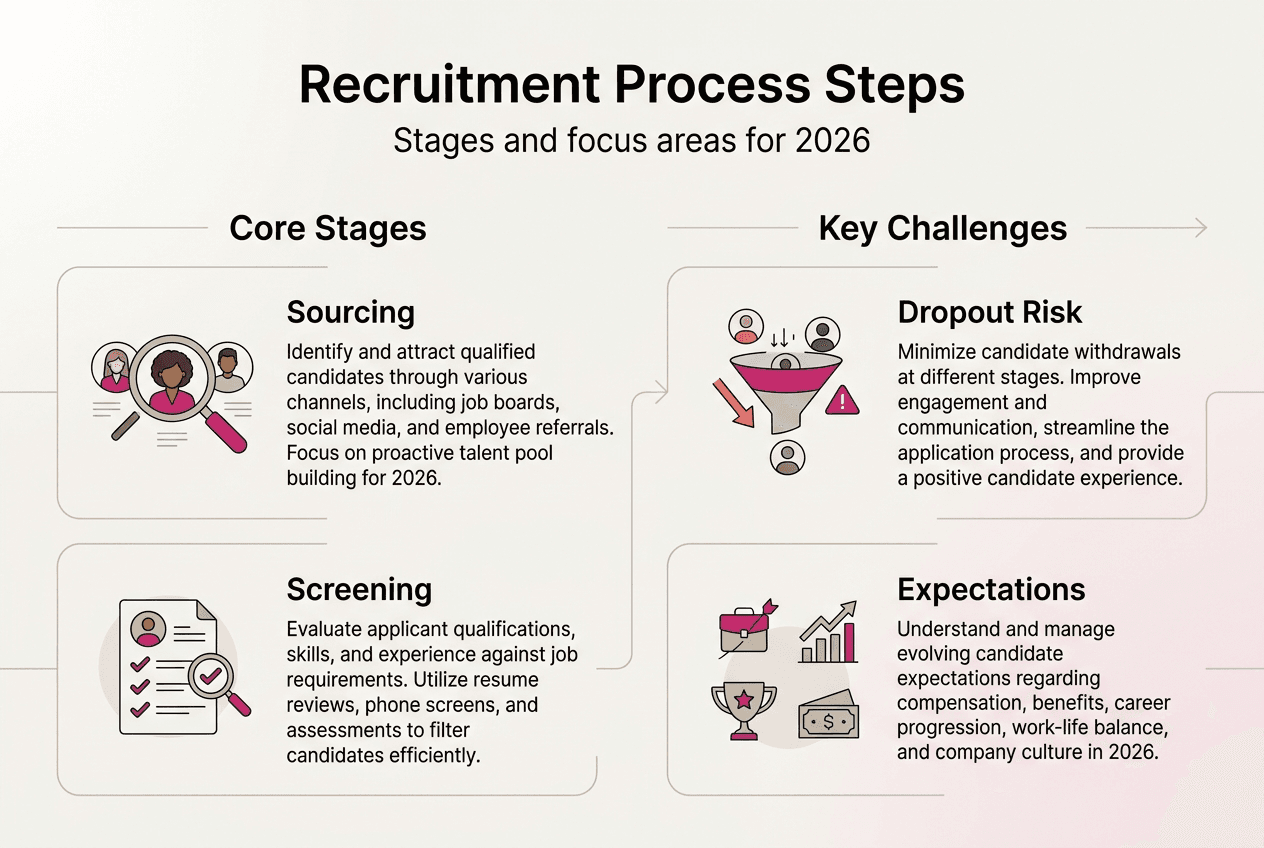
Pro Tip: Establish transparent timelines from the first contact. Job seekers appreciate knowing when to expect feedback, and employers benefit from maintaining candidate interest throughout the process.
Strong employer branding attracting top talent becomes the foundation for successful recruitment. Organizations that articulate their value proposition clearly attract candidates whose skills and values align naturally with company culture.
Sector-specific recruitment dynamics: manufacturing vs. property management in 2026
Recruitment metrics reveal stark contrasts between manufacturing and property management sectors. Manufacturing emphasizes technical assessments due to skill shortages; property management prioritizes soft skills and quick hiring due to high turnover. These differences shape every aspect of the hiring process, from sourcing strategies to final selection criteria.
Key performance indicators vary significantly:
- Time-to-hire: Manufacturing averages 45-60 days due to specialized skill verification, while property management completes hires in 25-35 days
- Offer acceptance rates: Property roles see 75-80% acceptance when employer branding is strong; manufacturing ranges from 60-70% depending on compensation competitiveness
- Turnover rates: Property management faces 30-35% annual turnover, driving constant recruitment; manufacturing maintains 15-20% turnover but struggles with replacement difficulty
- Sourcing channels: Manufacturing relies heavily on specialized recruiters and technical networks; property management succeeds with job boards and employee referrals
The property management sector has embraced data analytics to combat high turnover. Predictive analytics reduces turnover by 20-25% and supports faster hiring in property/real estate. These tools analyze candidate profiles against successful employee data, identifying patterns that predict long-term retention. Property recruiters use behavioral assessments and situational judgment tests to evaluate soft skills like conflict resolution and customer service aptitude.
| Recruitment Factor | Manufacturing | Property Management |
|---|---|---|
| Primary skill focus | Technical certifications, hands-on abilities | Interpersonal skills, problem-solving |
| Assessment methods | Skills testing, technical interviews | Behavioral interviews, situational exercises |
| Candidate sourcing | Specialized agencies, technical schools | Job boards, employee referrals |
| Decision timeline | 2-3 weeks post-interview | 3-7 days post-interview |
| Employer branding impact | Moderate (skills matter more) | High (culture fit critical) |
Manufacturing recruitment faces unique obstacles related to the skills gap. Employers invest heavily in training programs and apprenticeships to develop talent pipelines. Technical assessments often include practical demonstrations, welding tests for fabricators, or CAD proficiency checks for engineers. This thorough vetting extends timelines but ensures candidates possess required competencies.

Pro Tip: Job seekers should align their application materials with sector priorities. Manufacturing candidates must highlight certifications and technical projects; property management applicants should emphasize customer service achievements and conflict resolution examples.
Understanding these dynamics helps both parties optimize their approach. Employers can refine strategies based on sector benchmarks, while job seekers tailor their positioning to match evaluation criteria. The insights from real estate hiring best practices 2026 and challenges and opportunities in manufacturing staffing provide deeper context for navigating these sector-specific landscapes.
Expert insights and recruitment best practices for 2026
Successful recruitment in 2026 demands a data-driven approach combined with human-centered decision-making. Organizations that track the right metrics consistently outperform competitors in quality-of-hire and retention outcomes. The most impactful metrics include:
- Qualified candidates per opening to measure sourcing effectiveness
- Source of hire to identify which channels yield the best candidates
- Candidate experience scores to refine the hiring journey
- 90-day retention rates to validate selection accuracy
- Cost per hire to optimize budget allocation
Partnering with specialized agencies transforms recruitment efficiency. Recruitment agencies reduce time-to-hire by 30-50%, and strong employer brand cuts sourcing costs while improving hire quality. These partnerships provide access to pre-screened talent pools and industry expertise that internal teams often lack. Agencies understand sector-specific requirements and can quickly identify candidates whose skills match organizational needs.
Targeted sourcing dramatically improves hiring outcomes. Sourcing from targeted pools yields candidates 5x more likely to be hired compared to job boards. This data underscores the value of building relationships with technical schools, professional associations, and industry networks. Passive candidates, those not actively job searching, often represent the highest quality hires when approached through trusted channels.
Employer value proposition (EVP) development stands as a critical competitive advantage. Your EVP articulates why talented professionals should choose your organization over alternatives. Compelling EVPs highlight:
- Career development opportunities and clear advancement paths
- Competitive compensation packages with transparent salary ranges
- Work-life balance initiatives and flexible arrangements
- Company culture and values that resonate with target candidates
- Unique benefits or perks that differentiate your organization
“Data-driven recruitment isn’t about replacing human judgment; it’s about enhancing decision-making with objective insights. Organizations that combine analytics with strong employer branding reduce turnover by 25% while cutting hiring costs by 30%. The investment in recruitment infrastructure pays dividends through improved retention and organizational performance.”
Pro Tip: Job seekers should quantify every achievement on resumes and in interviews. Instead of “managed a team,” specify “led 8-person maintenance team, reducing equipment downtime by 23% over 18 months.” Employers should benchmark their metrics against industry standards quarterly to identify improvement opportunities.
The guidance in how to attract top talent and working with a recruitment agency offers practical frameworks for implementing these best practices. Organizations that invest in recruitment excellence build sustainable competitive advantages through superior talent acquisition.
Practical guide: navigating the recruitment process successfully as a job seeker and employer
Job seekers who approach recruitment strategically significantly improve their success rates. The key lies in understanding what employers evaluate at each stage and positioning yourself accordingly. Start by researching target companies thoroughly, understanding their challenges, and articulating how your skills address their specific needs.
For job seekers in engineering and manufacturing:
- Develop a results-focused resume highlighting quantified achievements and technical proficiencies
- Obtain relevant certifications that validate your expertise and commitment to professional development
- Build a portfolio showcasing projects, designs, or process improvements you’ve contributed to
- Practice technical interview questions and prepare to demonstrate problem-solving approaches
- Research company culture and prepare questions that reveal organizational fit
- Follow up professionally after interviews, reiterating interest and addressing any concerns raised
Transferable skills matter enormously, especially when transitioning between sectors. A manufacturing quality control specialist possesses analytical skills valuable in property management. A property manager’s conflict resolution abilities translate well to manufacturing team leadership. Identify these connections and articulate them clearly during interviews.
Employers benefit from structured, transparent recruitment processes that respect candidate time while gathering necessary information. Strong employer branding and streamlined, transparent hiring processes improve candidate experience and retention. The most effective approaches include:
- Clearly defined job descriptions with realistic requirements and transparent salary ranges
- Structured interview processes with consistent questions across candidates
- Timely communication at every stage, even when delivering negative news
- Multiple assessment methods combining technical tests, behavioral interviews, and practical demonstrations
- Quick decision-making to avoid losing top candidates to competitors
- Comprehensive onboarding programs that set new hires up for success
Cultural fit assessments prevent costly mis-hires. Beyond technical qualifications, evaluate whether candidates share organizational values and work styles. Behavioral interview questions reveal how candidates handle stress, collaborate with teams, and approach problem-solving. Situational exercises simulate real workplace challenges, providing insight into decision-making processes.
Employers should also evaluate their recruitment process regularly. Gather feedback from both successful hires and candidates who declined offers. This information identifies friction points and opportunities for improvement. Exit interviews with departing employees often reveal recruitment or onboarding gaps that contributed to turnover.
The strategies outlined in precision hiring for commercial property management roles and bridging the skills gap in real estate and property development provide sector-specific tactics for optimizing recruitment outcomes. Both job seekers and employers who invest time in understanding and refining their approach achieve superior results in competitive talent markets.
Enhance your recruitment success with McGlynn Personnel
Navigating the complexities of modern recruitment requires expertise, resources, and industry-specific knowledge. McGlynn Personnel specializes in connecting skilled professionals with leading employers across manufacturing, engineering, real estate, and property management sectors. Our tailored approach addresses the unique challenges each industry faces, from technical skill verification to cultural fit assessment.
We streamline recruitment through comprehensive candidate screening, targeted sourcing strategies, and deep sector expertise. Our services reduce your time-to-hire while improving candidate quality and long-term retention. Whether you’re an employer seeking specialized talent or a professional exploring new opportunities, our team provides the guidance and support needed to achieve your goals.
Explore our resources to enhance your recruitment strategy. Our simplifying contract recruitment guide helps organizations build flexible workforce solutions. The working with a recruitment agency guide clarifies partnership benefits and best practices. For specialized hiring needs, our talent sourcing guide specialized sectors 2026 offers cutting-edge strategies for competitive markets.
Frequently asked questions
What are the key differences between recruitment in manufacturing and property management?
Manufacturing recruitment emphasizes technical certifications, hands-on skill assessments, and longer evaluation periods averaging 45-60 days. Property management prioritizes soft skills like communication and conflict resolution, with faster hiring cycles of 25-35 days. Assessment tools differ accordingly: manufacturing uses technical tests and practical demonstrations, while property management relies on behavioral interviews and situational judgment exercises. Turnover rates also influence urgency, with property management’s 30-35% annual turnover driving more frequent recruitment compared to manufacturing’s 15-20%.
How can job seekers in engineering and manufacturing improve their chances during recruitment?
Quantify every achievement with specific metrics and outcomes rather than generic descriptions. Highlight relevant certifications, technical proficiencies, and hands-on project experience that demonstrate your capabilities. Research target companies thoroughly to understand their challenges and articulate how your skills address their specific needs. Prepare for both technical assessments and behavioral interviews, practicing problem-solving explanations and cultural fit questions. Show enthusiasm for continuous learning and professional development, which signals long-term value to employers.
What role do recruitment agencies play in speeding up hiring processes?
Specialized recruitment agencies reduce time-to-hire by 30-50% through access to pre-screened candidate pools and industry expertise. They maintain relationships with passive candidates who aren’t actively job searching but represent high-quality hires. Agencies handle initial screening, reference checks, and skill verification, allowing internal teams to focus on final interviews and strategic decisions. Their sector knowledge ensures better candidate-role matching, improving retention outcomes and reducing costly mis-hires.
Why does employer branding matter more in property management than manufacturing?
Property management faces higher turnover rates and relies more heavily on cultural fit than technical credentials. Strong employer branding attracts candidates whose values align with organizational culture, reducing early turnover. In manufacturing, technical skills and certifications carry more weight in hiring decisions, though employer branding still influences candidate choice between comparable opportunities. Property management candidates often have multiple offers simultaneously, making employer reputation and workplace culture decisive factors in their selection.
What metrics should employers track to improve recruitment effectiveness in 2026?
Track qualified candidates per opening to measure sourcing effectiveness and identify the most productive channels. Monitor source of hire to allocate budget toward highest-performing recruitment methods. Measure candidate experience scores through surveys to refine your hiring process. Calculate 90-day retention rates to validate selection accuracy and identify onboarding gaps. Finally, track cost per hire to optimize budget allocation and demonstrate recruitment ROI to leadership.