
Finding the right manager can transform your organization, but here’s what most employers miss: 80% of top managerial talent are passive candidates already employed and not scrolling job boards. Management recruitment is the strategic process of identifying, attracting, and securing skilled managerial and technical leaders who align with long-term organizational goals. Unlike general recruitment, it requires proactive sourcing, specialized expertise, and deep understanding of sectors like manufacturing and property. This guide reveals proven methodologies, challenges, and practical strategies to help you secure exceptional management talent in 2026.
Table of Contents
- What Is Management Recruitment? Understanding The Strategic Difference
- Core Methodologies In Management Recruitment: Process And Best Practices
- Challenges And Nuances In Management Recruitment For Manufacturing And Property Sectors
- Practical Strategies For Effective Management Recruitment In 2026
- Explore Tailored Recruitment Solutions For Your Sector
- Frequently Asked Questions
Key takeaways
| Point | Details |
|---|---|
| Strategic focus | Management recruitment targets leaders with long-term fit, not just immediate vacancies |
| Passive dominance | Top managerial talent requires proactive sourcing beyond traditional job boards |
| Specialist advantage | Expert recruiters reduce time-to-hire by 30-50% with sector-specific knowledge |
| Hybrid models win | Combining internal HR and agency expertise optimizes cost and quality |
| Retention tracking | Measuring 90-day retention reveals true recruitment effectiveness |
What is management recruitment? Understanding the strategic difference
Management recruitment is the strategic process of identifying, attracting, sourcing, screening, interviewing, selecting, and onboarding skilled managerial and technical leaders, distinguished by its focus on long-term strategic fit rather than immediate gap filling. This approach differs fundamentally from general recruitment in scope, timeline, and candidate engagement methods.
General recruitment typically addresses immediate operational needs with reactive job postings and quick turnarounds. Management recruitment operates strategically, often beginning months before a position opens. You’re not just filling a role; you’re shaping organizational direction through leadership selection. This distinction matters enormously in manufacturing and property sectors where managerial decisions directly impact production efficiency, safety compliance, property valuations, and tenant satisfaction.
The process involves multiple sophisticated steps:
- Comprehensive needs analysis examining organizational strategy and culture
- Position profiling defining technical skills, leadership qualities, and sector expertise
- Multi-channel sourcing reaching passive candidates through networks and referrals
- Rigorous screening including behavioral interviews and skills assessments
- Strategic selection balancing technical competence with cultural alignment
- Structured onboarding ensuring smooth leadership transitions
Consider the stakes. A manufacturing operations manager oversees production lines worth millions, while a property development director influences projects spanning years and substantial capital. Getting these hires right accelerates growth and innovation. Mis-hires cost far more than salary: production downtime, delayed projects, team disruption, and damaged client relationships compound quickly.
“Strategic talent acquisition focuses on long-term workforce planning and building talent pipelines, while traditional recruitment addresses immediate hiring needs.”
The manufacturing sector particularly benefits from strategic management recruitment given technical complexity. You need leaders fluent in Industry 4.0 technologies, lean manufacturing principles, and regulatory compliance. Property sectors demand managers understanding market cycles, ESG requirements, and stakeholder management. Generic recruitment approaches miss these nuances entirely.
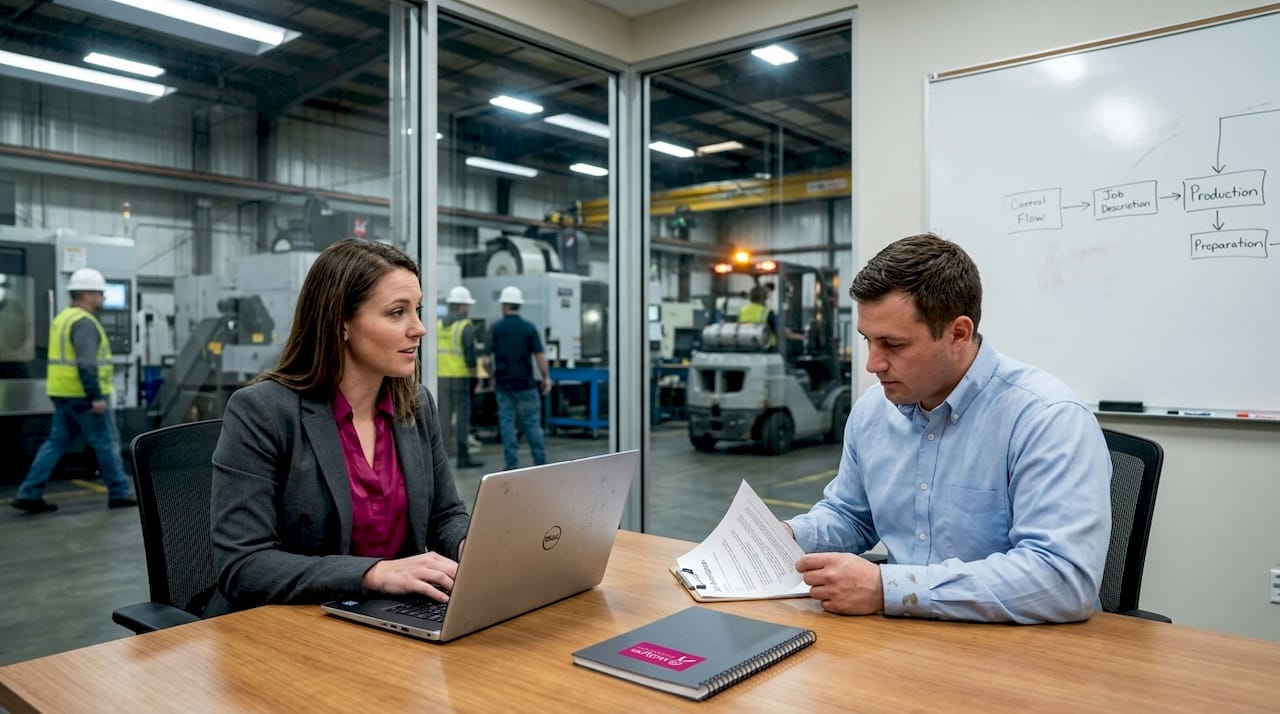
Working with a recruitment agency specializing in your sector provides access to passive candidates and industry intelligence unavailable through standard channels. These partnerships transform recruitment from transactional to strategic, aligning leadership acquisition with business objectives.
Core methodologies in management recruitment: process and best practices
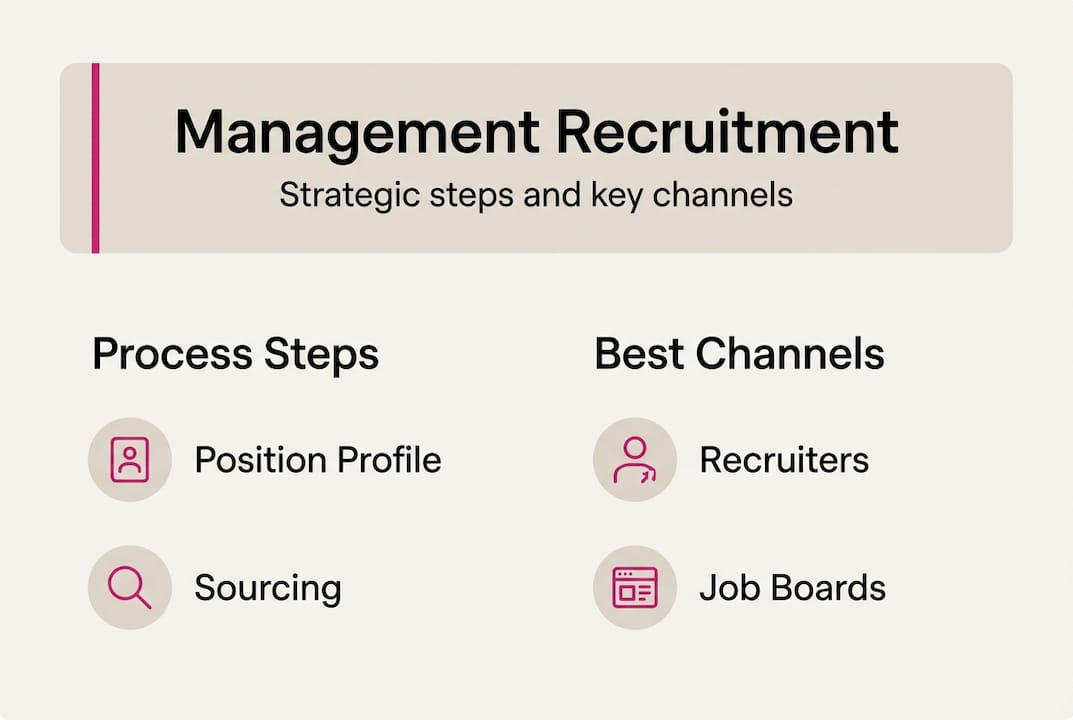
Effective management recruitment follows a structured six-stage process proven to improve hire quality and reduce time-to-fill in manufacturing and property sectors. Understanding each stage helps you optimize outcomes whether managing recruitment internally or partnering with specialists.
-
Needs analysis and position profiling: Begin by examining organizational strategy, team dynamics, and specific technical requirements. Manufacturing roles might require Six Sigma certification or ERP system expertise. Property positions often demand RICS qualifications or development finance knowledge. Document must-have versus nice-to-have qualifications clearly.
-
Multi-channel sourcing: Reaching passive candidates requires going beyond job boards. LinkedIn networking, industry referrals, professional associations, and specialist agencies yield significantly better results. Research shows proactive sourcing increases hire likelihood five times compared to reactive posting alone.
-
Structured screening: Deploy scenario-based questions revealing problem-solving approaches and leadership style. For manufacturing, present production disruption scenarios. For property, explore tenant dispute resolution or development financing challenges. Skills assessments verify technical competencies objectively.
-
Rigorous interviews: Conduct multiple rounds involving different stakeholders. Site tours for manufacturing roles reveal candidate engagement with operational realities. Property candidates benefit from portfolio reviews and market analysis discussions.
-
Reference checks and offers: Verify past performance thoroughly, focusing on leadership impact and team development. Structure competitive offers reflecting market rates and total compensation including benefits.
-
Onboarding with follow-up: Structured onboarding accelerates productivity and cultural integration. Schedule 30, 60, and 90-day check-ins to address challenges early and reinforce strategic priorities.
Data benchmarks provide realistic expectations. Manufacturing roles average 30.7 days to fill, though senior management positions often extend 60 to 90 days given complexity and stakeholder involvement. Costs vary widely: internal recruitment runs $3,000 to $5,000 per hire, while specialist agency fees typically range 15% to 25% of first-year salary but deliver faster, higher-quality results.
| Sourcing channel | Reach | Quality | Time investment | Best for |
|---|---|---|---|---|
| Job boards | High volume | Variable | Low | Junior roles |
| Targeted | High | Medium | Passive candidates | |
| Referrals | Limited | Very high | Low | Cultural fit |
| Specialist agencies | Curated | Very high | Low | Senior management |
| Industry networks | Targeted | High | High | Niche expertise |
Pro Tip: Invest substantial time in position profiling before sourcing begins. Clear definition of technical requirements, leadership qualities, and cultural fit reduces screening time by 40% and dramatically improves candidate-role alignment, minimizing costly mis-hires.
The methodology’s effectiveness depends on execution quality. Finding talent fast in specialized sectors requires balancing speed with thoroughness, a tension best managed through experienced recruitment partners who maintain ready talent pipelines.
Challenges and nuances in management recruitment for manufacturing and property sectors
Management recruitment presents distinct challenges requiring strategic responses rather than tactical fixes. Understanding these obstacles helps you allocate resources effectively and set realistic timelines.
The passive candidate dominance fundamentally reshapes recruitment strategy. With 80% of top managerial talent already employed, you cannot rely on applicant flow. Proactive outreach becomes essential. This requires relationship building, market intelligence, and patience, resources many internal HR teams lack given competing priorities.
Mis-hire costs escalate dramatically at management levels. A poor production manager hire in manufacturing causes quality issues, safety incidents, and team turnover affecting entire shifts. In property sectors, weak development managers delay projects, exceed budgets, and damage investor relationships. These failures cost 5 to 10 times annual salary when accounting for direct and indirect impacts.
“The difference between tactical recruitment and strategic talent acquisition lies in timeline, candidate engagement approach, and alignment with long-term organizational goals rather than immediate gap filling.”
Internal HR teams face inherent constraints. While familiar with company culture, they often lack sector-specific networks and struggle to dedicate sufficient time given operational demands. Specialist agencies bring established relationships, market intelligence, and dedicated focus but require budget allocation. The choice involves weighing speed, quality, and cost trade-offs carefully.
| Approach | Speed | Quality | Cost | Best application |
|---|---|---|---|---|
| Internal HR | Slow | Variable | Low direct cost | Strong internal pipelines |
| Specialist agency | Fast | High | Higher fees | Senior roles, niche skills |
| Hybrid model | Moderate | High | Moderate | Balanced recruitment needs |
Technology introduces both opportunities and risks. AI-powered screening accelerates candidate evaluation and identifies patterns human reviewers miss. However, algorithms trained on historical data perpetuate existing biases, potentially excluding diverse candidates who would excel. Combining AI efficiency with human judgment balances these considerations.
Common pitfalls include:
- Misaligned employee value propositions failing to address sector-specific priorities
- Over-reliance on job boards for senior positions
- Inadequate position profiling leading to poor candidate fit
- Rushed interview processes missing critical competency gaps
- Weak onboarding allowing early disengagement
Pro Tip: Track 90-day retention rates by sourcing channel rather than overall averages. This reveals which recruitment methods deliver lasting hires versus quick fills that churn, allowing you to eliminate ineffective approaches and double down on what works.
Recruiting passive candidates requires different messaging than attracting active job seekers. Passive candidates need compelling reasons to consider change: career progression, technical challenges, or organizational mission. Generic opportunity descriptions fail to engage this critical talent pool.
The intersection of AI and human expertise in recruitment continues evolving. Smart employers leverage technology for efficiency while preserving human judgment for cultural assessment and relationship building, capabilities machines cannot replicate effectively.
Practical strategies for effective management recruitment in 2026
Translating recruitment theory into results requires specific actions tailored to manufacturing and property sector realities. These strategies reflect current market conditions and proven approaches from successful employers.
Prioritize specialist recruiters for senior management positions. Agencies reduce time-to-hire by 30% to 50% through established talent networks and dedicated sourcing capacity. While fees appear higher initially, faster fills and better quality offset costs through reduced vacancy impact and lower turnover.
Develop sector-specific employee value propositions addressing real pain points. Manufacturing candidates care about Industry 4.0 technology investment, continuous improvement culture, and career development pathways. Property professionals prioritize deal flow, ESG commitment, and market positioning. Generic EVPs about “great culture” and “competitive salary” fail to differentiate or compel.
Implement hybrid recruitment models combining internal HR knowledge with external specialist expertise. Your team understands company culture and strategic priorities. Agencies bring market intelligence, passive candidate access, and recruitment process rigor. Structured collaboration leverages both strengths effectively.
Track sourcing channel ROI systematically. Calculate cost-per-hire, time-to-fill, quality-of-hire scores, and 90-day retention for each source. Eliminate low-performing channels ruthlessly and reallocate resources to proven methods. Most organizations waste budget on ineffective job board subscriptions while underfunding relationship-based sourcing.
Employ scenario-based interviews revealing applied competency rather than theoretical knowledge. Present real challenges from your operation: production line disruptions, tenant disputes, financing obstacles, regulatory changes. Evaluate problem-solving approach, stakeholder consideration, and decision-making frameworks. These predict performance far better than resume credentials.
Steps to improve 2026 recruitment outcomes:
- Audit current recruitment performance by role level and sourcing channel
- Develop detailed position profiles for key management roles before vacancies occur
- Build relationships with 2 to 3 specialist recruiters in your sectors
- Create compelling sector-specific EVPs highlighting genuine differentiators
- Implement structured interview frameworks with scenario-based questions
- Establish 30, 60, and 90-day onboarding checkpoints with clear success metrics
- Review recruitment data quarterly and adjust strategies based on results
Pro Tip: Measure retention at 90 days rather than annual averages. Management hires who struggle typically show signs within three months. This early indicator allows faster course correction and reveals recruitment process weaknesses before they compound into expensive turnover.
Contract recruitment solutions provide flexibility for project-based needs or interim coverage during permanent searches. Manufacturing organizations use contract managers for plant expansions or system implementations. Property firms deploy interim directors for development projects or turnaround situations.
Executive search approaches suit C-suite and senior director recruitment requiring confidentiality and extensive market mapping. These engagements involve retained relationships, comprehensive candidate assessment, and white-glove service justifying premium investment for critical leadership positions.
For property-specific challenges, precision hiring strategies for commercial property management address unique requirements around tenant relations, building operations, and financial management distinguishing this sector from residential or development-focused recruitment.
Successful 2026 recruitment balances technology leverage with human insight, speed with thoroughness, and cost management with quality standards. Organizations that master this balance secure competitive advantage through superior leadership talent.
Explore tailored recruitment solutions for your sector
Applying these management recruitment strategies requires time, expertise, and established networks many organizations lack internally. McGlynn Personnel specializes in connecting manufacturing and property employers with exceptional managerial and technical talent across the UK, EU, US, Middle East, and APAC regions.
Our flexible contract recruitment solutions address project-based needs and interim coverage while permanent searches progress. We maintain ready pipelines of pre-screened candidates in advanced manufacturing, precision engineering, real estate management, property management, and property development.
Key benefits of partnering with specialist recruiters:
- Accelerated time-to-hire through established passive candidate networks
- Sector-specific expertise in manufacturing and property management requirements
- Rigorous screening processes including technical assessments and cultural fit evaluation
- Global reach supporting international hiring and expatriate placements
Explore our comprehensive resources on working effectively with recruitment agencies and our detailed specialized talent sourcing guide for deeper insights into optimizing your 2026 recruitment strategy.
Frequently asked questions
What is the difference between recruitment and talent acquisition?
Recruitment typically refers to filling immediate openings through tactical, reactive processes focused on short-term needs. Talent acquisition operates strategically, building long-term pipelines and aligning hiring with organizational objectives. Management recruitment aligns more closely with talent acquisition, emphasizing strategic leadership hires that shape company direction rather than simply filling vacancies. The distinction matters because it determines timeline, budget allocation, and sourcing approaches.
Why are passive candidates important in management recruitment?
Passive candidates represent 80% of top managerial talent currently employed and not actively job seeking. These professionals often possess proven track records, stable career progression, and specialized expertise unavailable among active job seekers. Proactive sourcing through industry networks, referrals, and specialist agencies accesses this hidden talent pool. Passive candidates typically deliver higher quality hires with better retention because they make deliberate career moves rather than reactive job changes.
How can employers reduce time-to-hire for managerial roles?
Employers reduce time-to-hire by using specialist recruiters or hybrid recruitment models that accelerate sourcing and screening through established networks. Clear position profiling before recruitment begins eliminates ambiguity and speeds decision-making. Structured interview frameworks with scenario-based questions improve assessment efficiency. Flexible staffing solutions provide interim coverage for urgent needs while thorough permanent searches continue, preventing rushed decisions that lead to costly mis-hires.
What role does technology like AI play in management recruitment?
AI accelerates candidate screening by analyzing resumes, matching qualifications, and identifying patterns across large applicant pools faster than human reviewers. However, algorithms risk introducing bias when trained on historical data reflecting past discrimination. Effective recruitment combines AI efficiency with human expertise for cultural assessment, relationship building, and nuanced judgment. Technology handles volume and speed while humans ensure fairness, cultural fit, and strategic alignment, creating balanced recruitment processes that leverage both capabilities appropriately.