
Many HR professionals assume technical recruitment is just general hiring with a technical job title attached. In reality, sourcing skilled engineers, manufacturing specialists, and real estate technical experts demands an entirely different playbook. You need deep sector knowledge, specialized evaluation techniques, and targeted sourcing strategies that standard recruitment processes simply cannot deliver. This guide breaks down what technical recruitment actually involves, the stages and skills required, sector-specific challenges across manufacturing, engineering, and real estate, and actionable best practices to help you hire top technical talent efficiently.
Table of Contents
- Key takeaways
- Understanding technical recruitment: definition and scope
- Key skills and stages in technical recruitment
- Comparing technical recruitment approaches across manufacturing, engineering, and real estate
- Best practices and expert pro tips for successful technical recruitment
- Streamline your technical recruitment with McGlynn Personnel
- Frequently asked questions about technical recruitment
Key Takeaways
| Point | Details |
|---|---|
| Definition and scope | Technical recruitment requires specialized focus on sourcing and evaluating engineers and other technical professionals, not just filling generic roles. |
| Key skills and stages | A successful technical recruiter must understand target roles, ask informed technical questions, and guide candidates through sourcing, screening, assessment, and selection. |
| Sector challenges | Manufacturing, engineering, and real estate have distinct requirements and certifications that drive sourcing and evaluation methods. |
| Best practices and tips | Invest in learning the technical language for target roles, engage with niche communities, and present compelling value propositions to attract top talent. |
Understanding technical recruitment: definition and scope
Technical recruitment requires specialized focus on sourcing, evaluating, and hiring skilled professionals in technical fields. Unlike general recruitment, which often relies on transferable soft skills and cultural fit, technical recruitment demands that you understand complex technical skillsets, industry-specific certifications, and the nuanced jargon that defines each sector. You are not just filling a position. You are matching highly specialized expertise to equally specialized business needs.
The scope of technical recruitment spans multiple industries, each with distinct requirements. In manufacturing, you might recruit process engineers who understand lean methodologies and safety compliance. Engineering roles range from civil engineers with structural analysis expertise to mechanical engineers skilled in CAD software and thermodynamics. Real estate technical positions include property managers who grasp building codes and maintenance systems, or construction estimators who can read blueprints and assess project costs accurately.
What sets technical recruitment apart from general hiring is the complexity of skills you must evaluate. A manufacturing recruiter needs to verify that a candidate understands ISO standards and quality control processes. An engineering recruiter must assess proficiency in specialized software like AutoCAD or MATLAB. A real estate recruiter looks for knowledge of zoning regulations and property management systems. These are not skills you can gauge through a standard behavioral interview.
The candidate market for technical roles is also fundamentally different. Technical professionals often have multiple competing offers, specialized networks, and clear expectations about compensation and career progression. They evaluate potential employers as rigorously as you evaluate them. This means your recruitment approach must demonstrate sector credibility and offer compelling value propositions that resonate with technical talent.
Pro Tip: Successful technical recruiters must combine deep sector knowledge with strong sourcing and candidate assessment capabilities. Invest time learning the technical language of your target roles so you can engage candidates authentically and evaluate their expertise accurately.
Key differences between technical and general recruitment include:
- Technical roles require verifiable hard skills and certifications, not just soft skills
- Candidate evaluation involves technical assessments, portfolio reviews, and practical tests
- Sourcing channels are more specialized, including niche job boards, professional associations, and technical communities
- The hiring timeline is often longer due to the complexity of evaluation and the competitive candidate market
- Compensation negotiations require understanding of market rates for specific technical skills and certifications
Key skills and stages in technical recruitment
To excel in technical recruitment, you need a specific skill set that goes beyond traditional HR capabilities. Technical knowledge is foundational. You must understand the roles you are recruiting for well enough to ask informed questions and recognize quality answers. This does not mean you need to be an engineer yourself, but you should grasp key concepts, tools, and industry standards relevant to your target positions.
Candidate evaluation skills are equally critical. You need to design and interpret technical assessments that accurately measure competency. This might involve coordinating coding tests for software engineers, reviewing CAD portfolios for mechanical designers, or evaluating project management case studies for construction managers. You must also recognize when a candidate has genuine expertise versus superficial knowledge gained from brief exposure or training.

Market mapping helps you understand where technical talent congregates and how to reach them effectively. Different technical specializations have different preferred platforms. Manufacturing professionals might be active on industry-specific forums, while software engineers frequent GitHub and Stack Overflow. Real estate technical experts often network through local professional associations and trade shows.
Negotiation and communication skills round out your toolkit. Technical candidates often have strong opinions about work arrangements, project types, and career development opportunities. You need to articulate your employer’s value proposition clearly and negotiate offers that balance candidate expectations with organizational constraints.
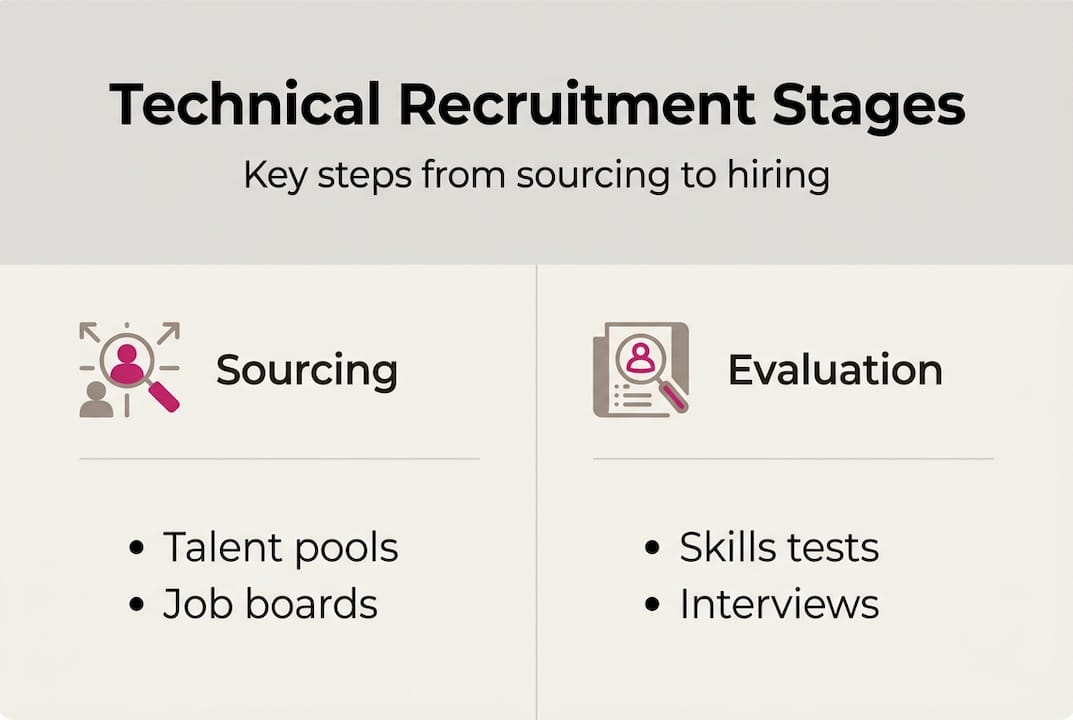
The technical recruitment process follows several key stages, each requiring specialized approaches:
-
Job requirement analysis: Work closely with hiring managers to define technical skills, certifications, experience levels, and soft skills needed. Document must-have versus nice-to-have qualifications clearly.
-
Sourcing and attraction: Use targeted channels like niche job boards, professional networks, employee referrals, and direct outreach to passive candidates. Craft job descriptions that speak the technical language of your target audience.
-
Screening and technical assessment: Review resumes for relevant experience and certifications, then conduct initial phone screens to assess basic fit. Administer technical tests, request work samples, or assign practical exercises to evaluate hands-on skills.
-
Interviewing: Structure interviews to include both behavioral questions and technical deep dives. Involve technical team members who can assess candidate expertise accurately. Use scenario-based questions to evaluate problem-solving approaches.
-
Offer and negotiation: Present competitive compensation packages based on market research. Be prepared to negotiate on salary, benefits, remote work options, and professional development opportunities. Move quickly, as top technical candidates often have multiple offers.
-
Onboarding: Ensure new hires have the tools, access, and information they need from day one. Pair them with technical mentors and provide clear expectations for their first 90 days.
Pro Tip: Collaborate closely with hiring managers early to fully understand role nuances and criteria. Schedule a detailed intake meeting where you ask technical questions, review past successful hires, and clarify deal-breakers versus flexible requirements.
A seamless recruitment process requires detailed understanding of technical requirements and carefully aligned steps from sourcing to onboarding. Specialized technical recruitment demands tailored approaches to screening and interviewing to accurately assess candidate skills. Generic processes miss the nuances that separate good technical hires from great ones.
Comparing technical recruitment approaches across manufacturing, engineering, and real estate
While technical recruitment principles apply across sectors, each industry presents unique challenges and requires tailored strategies. Understanding these differences helps you optimize your approach and avoid common pitfalls that extend hiring cycles or result in poor candidate matches.
Manufacturing recruitment focuses heavily on skilled labor, process engineers, and quality control specialists. Candidates often need industry-specific certifications like Six Sigma, ISO auditor credentials, or safety training certificates. The talent pool is frequently local or regional, as manufacturing roles typically require on-site presence. Emphasis on safety compliance and operational efficiency means you must verify that candidates understand regulatory requirements and can work in environments with strict protocols.
Engineering recruitment spans diverse specializations from civil and mechanical to electrical and software engineering. These roles typically demand advanced degrees, professional engineering licenses, and proficiency in specialized software tools. The candidate market is more global, with many organizations open to remote work or relocation packages for top talent. Competition for experienced engineers is intense, particularly in emerging technology areas or regions with limited technical talent pools.
Real estate technical recruitment targets roles like property managers, facilities engineers, construction estimators, and real estate analysts. These positions require sector-specific knowledge of building codes, zoning regulations, property management systems, and financial analysis. Candidates often need client-facing skills alongside technical expertise, as they interact with tenants, contractors, and stakeholders regularly. The talent pool is typically local or regional, with strong emphasis on understanding the specific market dynamics of the geographic area.
Each sector has unique technical skill demand and candidate availability requiring different recruitment techniques. Here is how approaches differ:
| Sector | Key Recruitment Challenges | Primary Sourcing Channels | Typical Evaluation Methods |
|---|---|---|---|
| Manufacturing | Skill shortages in specialized trades, aging workforce, safety compliance requirements | Trade schools, industry associations, employee referrals, local job boards | Hands-on skill tests, certification verification, safety knowledge assessments |
| Engineering | High competition for talent, diverse specializations, global candidate market | LinkedIn, engineering job boards, university partnerships, professional networks | Technical interviews, portfolio reviews, problem-solving exercises, software proficiency tests |
| Real Estate | Local market knowledge requirements, client-facing skills needed, regulatory complexity | Local real estate networks, property management associations, industry events | Case study analysis, regulatory knowledge tests, client interaction scenarios |
Common recruitment challenges across all three sectors include:
- Skill shortages: High demand for technical expertise often exceeds supply, particularly in specialized or emerging areas
- Competition: Multiple employers compete for the same limited talent pool, driving up compensation expectations and extending hiring timelines
- Candidate expectations: Technical professionals expect competitive pay, clear career progression, modern tools, and often flexible work arrangements
- Evaluation complexity: Accurately assessing technical competency requires specialized knowledge and assessment tools that many HR teams lack
Your recruitment strategy must account for these sector-specific nuances. Manufacturing recruiters should build relationships with trade schools and apprenticeship programs. Engineering recruiters need strong university partnerships and active presence on technical platforms. Real estate recruiters benefit from deep local market knowledge and connections to property management associations.
Best practices and expert pro tips for successful technical recruitment
Implementing proven strategies can dramatically improve your technical recruitment outcomes. These best practices come from years of specialized recruitment experience across manufacturing, engineering, and real estate sectors.
Build strong relationships with niche recruitment agencies that specialize in your target sectors. These agencies maintain deep candidate networks, understand technical requirements intimately, and can access passive candidates who are not actively job searching. Partnering with recruitment agencies can streamline the specialized hiring process and improve candidate quality. Rather than viewing agencies as transactional vendors, treat them as strategic partners who can provide market intelligence and candidate insights.
Invest in ongoing recruiter sector training to stay updated on technical trends, emerging skills, and evolving candidate expectations. Send your recruitment team to industry conferences, provide subscriptions to technical publications, and arrange shadowing opportunities with technical teams. The more your recruiters understand the actual work, the better they can evaluate candidates and sell opportunities authentically.
Leverage technology to assess candidate skills effectively. Use skills testing platforms, video interviewing tools with technical assessment features, and applicant tracking systems designed for technical recruitment. These tools help you evaluate more candidates efficiently while maintaining assessment quality. However, technology should augment human judgment, not replace it entirely.
Maintain clear communication and expectations with candidates throughout the hiring process. Technical professionals value transparency and efficiency. Provide realistic timelines, prompt feedback after interviews, and clear next steps at every stage. If delays occur, communicate proactively rather than leaving candidates wondering about their status. This respect for candidate time builds your employer brand and increases offer acceptance rates.
Pro Tip: Avoid one-size-fits-all strategies. Customize your approach based on role and sector. A strategy that works brilliantly for recruiting manufacturing technicians may fail completely for software engineers. Adapt your sourcing channels, assessment methods, and value propositions to match the specific technical audience you are targeting.
Additional best practices include:
- Create detailed candidate personas for each technical role to guide sourcing and messaging strategies
- Develop compelling employer value propositions that highlight technical challenges, tools, and career development opportunities
- Streamline your interview process to respect candidate time while maintaining thorough evaluation
- Gather feedback from both successful and unsuccessful candidates to continuously improve your process
- Build talent pipelines for recurring technical roles rather than starting from scratch each time
Specialized recruitment agencies bring sector expertise, established candidate networks, and proven assessment methodologies that dramatically improve hiring precision and efficiency. Organizations that partner strategically with these agencies reduce time-to-hire by 40% while improving candidate quality and retention rates.
The most successful technical recruiters view their role as strategic talent advisors rather than administrative coordinators. They understand business needs deeply, anticipate future skill requirements, and proactively build relationships with potential candidates before positions open. This strategic approach transforms recruitment from a reactive cost center into a proactive competitive advantage.
Streamline your technical recruitment with McGlynn Personnel
Navigating the complexities of technical recruitment across manufacturing, engineering, and real estate demands specialized expertise and established networks. McGlynn Personnel offers tailored recruitment solutions designed specifically for these sectors, connecting you with vetted specialist talent across the UK, EU, US, Middle East, and APAC regions. Our deep sector knowledge means we understand the technical requirements, certifications, and industry nuances that define quality candidates in your field.
Partnering with our team gives you access to passive candidates, reduces your time-to-hire significantly, and improves overall candidate quality through rigorous screening and technical assessment. Whether you need permanent placements or flexible staffing solutions for project-based work, we provide end-to-end support tailored to your specific needs. Our expertise in specialized hiring means you can focus on interviewing pre-qualified candidates rather than sorting through hundreds of mismatched applications. Explore our comprehensive talent sourcing guide for specialized sectors to discover advanced strategies for building competitive technical teams.
Frequently asked questions about technical recruitment
What distinguishes technical recruitment from general recruitment?
Technical recruitment focuses on roles requiring specific technical skills, certifications, and industry knowledge, while general recruitment emphasizes transferable soft skills and cultural fit. Technical recruitment demands specialized evaluation methods like skills tests, portfolio reviews, and technical interviews conducted by subject matter experts. The candidate market is also more specialized, requiring targeted sourcing channels and deeper sector knowledge from recruiters.
How can HR professionals improve candidate evaluation for technical roles?
Implement structured technical assessments that test hands-on skills rather than just theoretical knowledge. Involve technical team members in the interview process to accurately evaluate candidate expertise. Use practical exercises, portfolio reviews, or work sample tests that mirror actual job responsibilities. Develop clear evaluation rubrics that define what good, great, and exceptional performance looks like for each technical competency you are assessing.
Why is sector-specific knowledge important in technical recruitment?
Sector-specific knowledge allows recruiters to understand technical jargon, recognize quality certifications, and ask informed questions that reveal true expertise. It helps you identify which skills are truly essential versus nice-to-have, and enables authentic conversations with candidates who can immediately tell if you understand their field. This credibility improves candidate engagement, strengthens your employer brand, and leads to better hiring decisions because you can accurately assess technical fit.
What are common challenges in recruiting technical talent in manufacturing and engineering?
Skill shortages are widespread as demand for specialized technical expertise exceeds supply in many areas. Competition from multiple employers drives up compensation expectations and extends hiring timelines. Evaluating technical competency accurately requires specialized knowledge many HR teams lack. The candidate market includes many passive job seekers who are not actively searching, requiring proactive outreach strategies rather than post-and-pray approaches.
How do recruitment agencies assist with technical hiring?
Specialized recruitment agencies maintain established networks of technical professionals, provide market intelligence on compensation and candidate availability, and conduct initial screening and technical assessments. They can access passive candidates through existing relationships and industry connections. Agencies also handle time-consuming administrative tasks, allowing your internal team to focus on strategic interviews and final candidate selection. Their sector expertise improves candidate quality and reduces overall time-to-hire significantly.