
92% of construction firms struggle to fill open positions, and nearly half report that unfilled roles have directly delayed active projects. That is not a staffing inconvenience. That is a business risk. In construction and real estate, every week a critical role sits vacant translates to schedule overruns, budget pressure, and safety exposure. Recruitment is not simply about finding warm bodies to fill seats. It is about placing the right technical and managerial talent at the right moment to keep projects moving. This guide breaks down why strategic recruitment matters, how the process works in practice, and what you can do right now to stay ahead of the shortage.
Table of Contents
- Understanding the labor shortage in construction
- What effective recruitment actually delivers
- How the construction recruitment process works
- Key challenges and solutions in construction recruitment
- Partnering for construction recruitment success
- Frequently asked questions
Key Takeaways
| Point | Details |
|---|---|
| Labor shortage is critical | Most construction firms report major hiring difficulties that slow projects down. |
| Recruitment prevents delays | Effective recruitment fills gaps quickly, keeping construction projects on schedule. |
| Process matters | A step-by-step recruitment approach tailored to construction yields better hiring outcomes. |
| Agencies add value | Recruitment partners can reach skilled talent that standard methods miss. |
Understanding the labor shortage in construction
The numbers are stark. 92% of construction firms report difficulty filling positions, according to the NCCER/AGC 2025 Workforce Survey. This is not a regional blip. It is a structural challenge driven by an aging workforce, declining trade school enrollment, and surging project pipelines across commercial, residential, and infrastructure sectors.
The AGC workforce impact report confirms that workforce shortages are the leading cause of project delays across the industry. Both craft positions (electricians, ironworkers, concrete finishers) and salaried roles (project managers, site supervisors, estimators) are affected. The shortage is broad and deep.
Here is a snapshot of how the shortage breaks down by role category:
| Role category | Difficulty filling | Primary impact |
|---|---|---|
| Skilled craft trades | Very high | Schedule delays, rework |
| Project management | High | Budget overruns, coordination failures |
| Safety and compliance | Moderate to high | Regulatory risk, incident exposure |
| Estimating and preconstruction | High | Bid accuracy, pipeline management |
The consequences extend beyond timelines. When you cannot staff a project correctly, quality suffers. Overworked crews make mistakes. Supervisors stretch thin across too many sites. Safety incidents increase. Understanding these construction hiring challenges is the first step toward solving them.
“Workforce shortages are not just a hiring problem. They are a project delivery problem that touches every part of your business.”
With the stakes clear, it is time to look at exactly what modern recruitment accomplishes for construction businesses.
What effective recruitment actually delivers
Reactive hiring is the norm in construction. A project ramps up, a gap appears, and someone scrambles to fill it. The problem is that last-minute hiring almost always means compromised quality, higher costs, and longer onboarding times. Proactive, strategic recruitment solutions flip that equation entirely.
The 2025 Workforce Survey Analysis.pdf) makes clear that recruitment directly addresses both skilled labor and managerial needs, and that filling these roles proactively is the most reliable way to prevent project delays. The difference between reactive and proactive hiring is significant:
| Approach | Time to fill | Quality of hire | Cost impact |
|---|---|---|---|
| Reactive (last-minute) | Longer, rushed | Lower, less vetted | Higher agency fees, overtime |
| Proactive (planned) | Shorter, structured | Higher, precision matched | Lower total cost of hire |
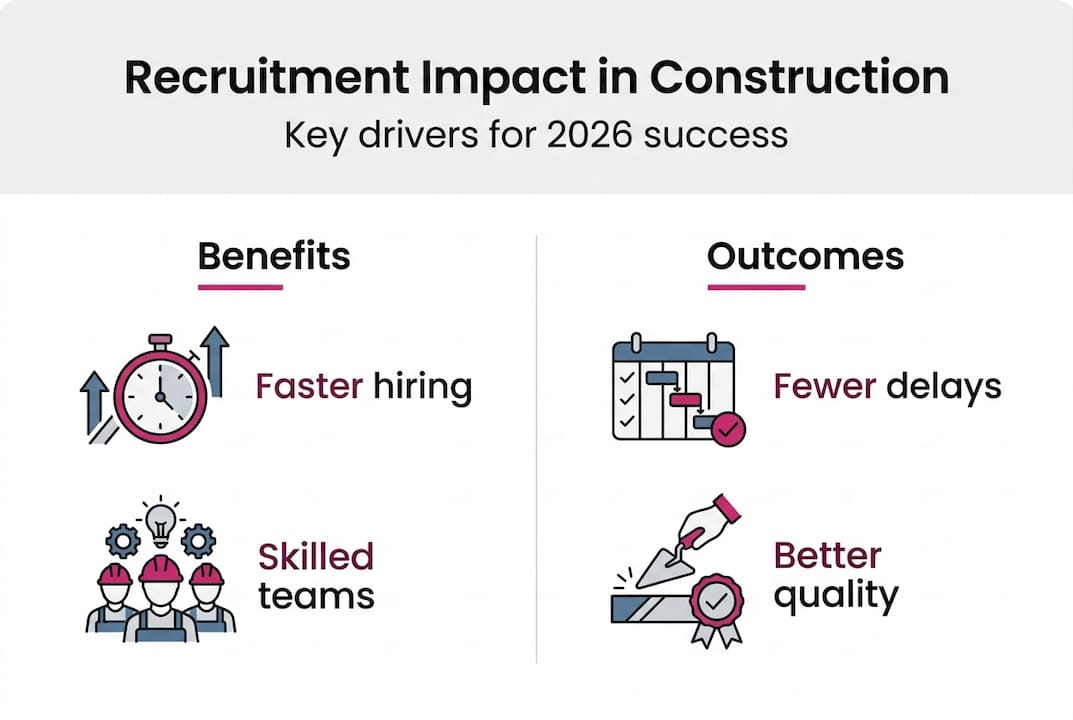
Effective recruitment also delivers benefits that go beyond individual hires. When you build a pipeline of pre-screened candidates, you reduce downtime between project phases. When you invest in recruitment strategies that target both technical and leadership talent, you create teams that can actually execute at scale.
Pro Tip: Start building your candidate pipeline at least 90 days before a project mobilization date. The best craft workers and project managers are rarely available on short notice. Early engagement gives you first access to top talent before your competitors do.
Key benefits of effective construction recruitment include:
- Reduced project delays through timely placement of skilled workers
- Stronger team cohesion when roles are filled with precision-matched candidates
- Lower turnover because candidates are properly screened for fit, not just availability
- Better safety outcomes when qualified supervisors and compliance staff are in place from day one
- Improved bid competitiveness when your estimating and preconstruction teams are fully staffed
Knowing what recruitment can accomplish, let us look at how the construction recruitment process actually works and the unique challenges and opportunities this industry presents.
How the construction recruitment process works
Construction recruitment is not a one-size-fits-all process. Project-based work, global mobility requirements, and the sheer variety of technical roles demand a structured yet flexible approach. Here is how a well-run recruitment cycle looks in practice:
- Workforce planning: Identify upcoming project requirements by role, skill level, and timeline. Map gaps between your current team and what the project demands.
- Job profiling: Define the technical competencies, certifications, and experience levels required. Be specific. A “site manager” in a high-rise project is a very different hire from one on a civil infrastructure job.
- Sourcing: Tap into specialized networks, trade associations, and global talent pools. Flexible staffing for construction is often the fastest route to qualified candidates for project-based roles.
- Screening and assessment: Conduct technical screenings, verify certifications, and assess cultural fit. For managerial roles, behavioral interviews and reference checks are non-negotiable.
- Offer and negotiation: Move quickly. Top candidates in construction receive multiple offers. Delays at this stage cost you the hire.
- Onboarding: Site-specific inductions, safety briefings, and team integration are critical. Poor onboarding is one of the top reasons new hires leave within the first 90 days.
As the 2025 Construction Hiring and Business Outlook Report confirms, project success depends on finding and onboarding the right talent quickly. Speed and quality must work together, not against each other.
For global and cross-border projects, agile recruitment in construction adds another layer. You need to account for visa requirements, local labor regulations, and relocation logistics. Skipping these steps creates compliance risk and delays that can derail a project before it starts.
Pro Tip: For international hires, build a compliance checklist that covers work authorization, credential recognition, and local employment law before you extend any offer. This protects both the candidate and your business.
With the process outlined, it is crucial to address real-world challenges where even the best strategies run into obstacles.
Key challenges and solutions in construction recruitment
Even with a solid process, construction hiring is genuinely hard. The competition for skilled trades is fierce. Experienced project managers are in short supply globally. And the project-based nature of construction means demand spikes unpredictably, leaving little room for slow hiring cycles.
The AGC Survey found that labor shortages delay almost half of all construction projects. That figure should sharpen your focus on solving these challenges before they hit your timeline.
Here are the most common obstacles and how to address them:
- High competition for skilled trades: Partner with specialist agencies that maintain active candidate databases. Waiting for applicants to come to you is not a viable strategy in this market.
- Geographic talent gaps: Embrace regional and global mobility. The world is your talent pool if you are willing to support relocation and manage cross-border compliance.
- Slow internal hiring processes: Streamline approvals and reduce the number of interview rounds for trade roles. Every extra day in your process is a day a competitor can make an offer.
- Candidate ghosting and drop-off: Maintain regular communication throughout the process. Candidates who feel ignored move on fast.
- Credential verification complexity: Use agencies with established verification protocols, especially for international hires where credential recognition varies by jurisdiction.
“Your hiring speed is a competitive advantage. In a market where 92% of firms are chasing the same talent, the fastest and most organized employer wins.”
Adopting innovative hiring strategies and addressing technical talent challenges head-on is what separates firms that consistently deliver projects on time from those that are perpetually scrambling. All these factors show why having the right recruitment partners and strategies is an investment, not a cost.
Partnering for construction recruitment success
You now have a clear picture of the labor shortage, what strategic recruitment delivers, and how to navigate the process. The next step is putting that knowledge into action with partners who specialize in exactly this space.
McGlynn Personnel works with construction and real estate employers across the UK, EU, US, Middle East, and APAC to source, screen, and place technical and managerial talent at every level. Whether you need to understand how streamlining specialized hiring works in practice, explore flexible contract staffing for project-based needs, or simply want to start a conversation about your next hire, we are ready to help. Visit McGlynn Personnel to connect with a team that understands your sector and moves at the pace your projects demand.
Frequently asked questions
What are the main causes of labor shortages in construction?
Labor shortages stem from high retirement rates among experienced tradespeople, fewer new entrants into vocational training, and rising project demand outpacing supply. 92% of firms.pdf) report hiring difficulties driven by these workforce demographic shifts.
How does recruitment directly impact project delivery in construction?
Effective recruitment reduces project delays and budget overruns by ensuring skilled workers are in place before mobilization, not after. 45% of firms report project delays tied directly to unfilled positions.
What roles are hardest to fill in the construction sector?
Skilled craft positions such as electricians, ironworkers, and concrete finishers are the most difficult to source, followed closely by specialized management roles. Both craft and salaried roles remain persistently hard to fill across the industry.
How can recruitment agencies help with construction hiring?
Agencies provide access to pre-screened candidate pools, handle credential verification, and accelerate time-to-fill for hard-to-source roles. The 2025 Construction Hiring Report highlights that specialist agency support is one of the most effective tools for filling urgent and technical positions quickly.