
Most employers treat talent sourcing and recruiting as the same thing. They are not. Recruiting is what happens after a role opens. Sourcing is what happens before, and that distinction is the difference between scrambling to fill a critical position and selecting from a ready pipeline of qualified candidates. Talent sourcing is the proactive process of identifying, researching, attracting, and engaging potential candidates, particularly passive ones, to build pipelines for current and future roles. For employers in manufacturing, engineering, and property sectors, where skill shortages are real and time-to-fill is costly, mastering sourcing is not optional. It is your competitive edge.
Table of Contents
- Defining talent sourcing: Core principles and value
- Active vs. passive sourcing: Methods and best uses
- Building a talent pipeline for critical roles
- The role of employer branding and partnerships in sourcing
- Technology and innovation in modern talent sourcing
- Talent sourcing in action: Sector snapshots and case strategies
- How expert support accelerates your talent sourcing
- Frequently asked questions
Key Takeaways
| Point | Details |
|---|---|
| Proactive sourcing pays off | Employers who build talent pipelines fill critical roles faster with better-quality candidates. |
| Blend active and passive methods | Mixing direct outreach with job boards and referrals expands your reach and engagement. |
| Brand and tech drive results | Strong employer branding and AI tools give you an edge, especially in competitive sectors. |
| Specialized roles need tailored strategies | Adapting sourcing tactics for your sector’s unique needs and shortages is crucial for success. |
Defining talent sourcing: Core principles and value
Before exploring the methods, it is crucial to lock in what talent sourcing truly means and what it does not mean.
“Talent sourcing is the proactive process of identifying, researching, attracting, and engaging potential candidates, particularly passive ones, to build talent pipelines for current and future roles, distinct from reactive recruiting.” — Spiceworks HR
Recruiting responds to a vacancy. Sourcing anticipates one. When a precision engineer resigns or a property development project scales up fast, reactive recruiting leaves you exposed. Sourcing means you already have warm candidates ready to engage.
The core strengths of a dedicated sourcing function include:
- Reduced time-to-fill because candidates are already identified and partially vetted
- Higher candidate quality since you are selecting from a curated pool, not whoever applied that week
- Access to passive talent who would never see your job ad but are open to the right conversation
- Resilience in tight markets where specialized skills in manufacturing, engineering, and property management are genuinely scarce
Think of sourcing as building a bench. When the game demands a substitution, you are not scrambling. You already know who is ready.
Active vs. passive sourcing: Methods and best uses
With a clear definition in place, let us examine how sourcing happens in practice, starting with the two main approaches.
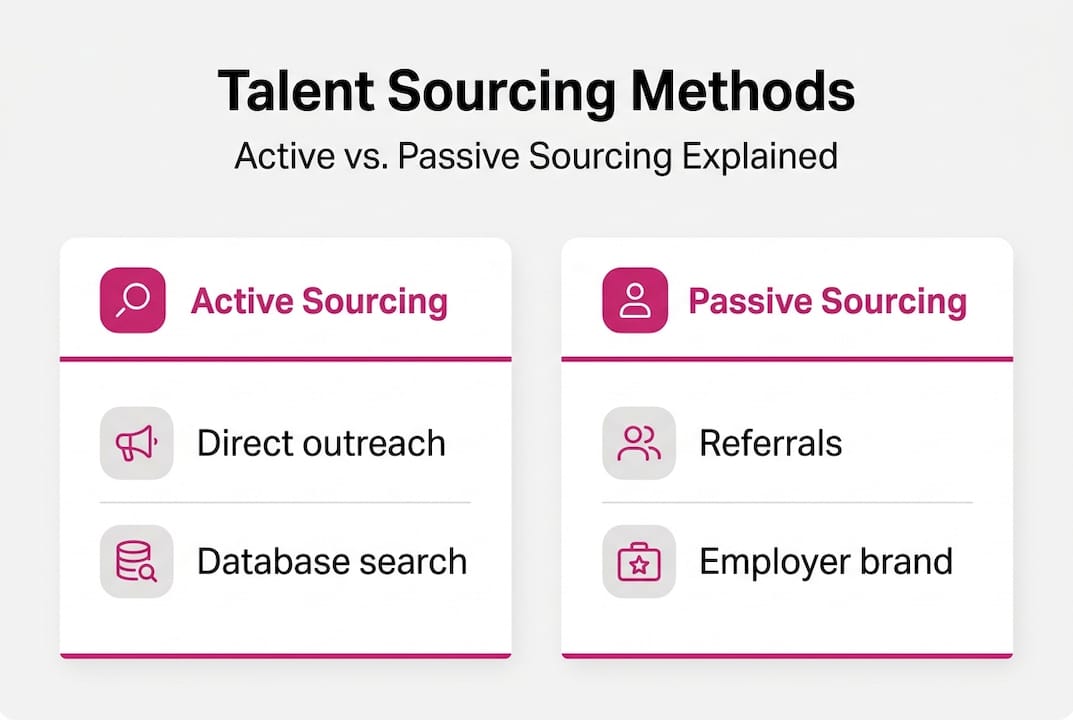
Core sourcing methodologies split into active and passive strategies, each with distinct strengths depending on the role and market conditions.
| Approach | Methods | Best used for |
|---|---|---|
| Active sourcing | LinkedIn outreach, Boolean searches, alumni networks, association lists | Specialized roles, passive candidates, senior hires |
| Passive sourcing | Job boards, employee referrals, campus partnerships, career fairs | Volume hiring, entry-level roles, brand-building |
Active sourcing puts you in the driver’s seat. You identify a structural engineer with niche CAD expertise and reach out directly. You do not wait for them to find you. This is especially powerful in engineering and precision manufacturing, where the talent pool is narrow and competition is fierce.

Passive sourcing, by contrast, lets your reputation do the work. A strong referral program in a property management firm can generate a steady stream of pre-vetted candidates who already understand your culture. Campus partnerships with trade programs build early pipelines for production and technical roles.
The smartest approach integrates both. Use active sourcing for hard-to-fill or senior roles and passive sourcing to maintain volume and brand visibility. This is central to attracting top talent in markets where every qualified candidate has options.
Pro Tip: Run Boolean searches on LinkedIn using role-specific certifications, such as “RICS” for property professionals or “CNC machinist” for manufacturing, to surface passive candidates who would never appear in a standard job board search.
Building a talent pipeline for critical roles
Now that we understand sourcing methods, the next step is channeling these efforts into sustainable pipelines that give you a real edge.
A talent pipeline is a curated, actively engaged group of candidates for roles you hire for regularly or anticipate needing. It is not a static spreadsheet. It is a living network you nurture over time.
Here is a practical step-by-step process for building one:
- Identify your critical roles. Which positions, if unfilled, would halt operations or delay a project? Start there.
- Map your sources. Where do qualified candidates for these roles spend their time? LinkedIn groups, trade associations, university programs, or competitor companies?
- Engage early. Reach out before you have a vacancy. Share relevant content, invite candidates to webinars, or simply connect with a personalized message.
- Nurture consistently. A candidate who is not ready today may be ready in six months. Stay visible and relevant.
- Track and segment. Use a CRM or ATS to categorize candidates by role type, readiness, and engagement level.
The data makes the case for urgency. Manufacturing faces 2.1 million unfilled US jobs by 2030, with 76% of employers already reporting hiring challenges. Time-to-fill for engineers and production roles runs between 49 and 70 days. Employers with active pipelines cut that window significantly.
| Metric | Benchmark |
|---|---|
| Average applications per manufacturing role | 38 (48% below industry average) |
| Time-to-fill for engineers and production roles | 49 to 70 days |
| Offer acceptance rate with pipeline sourcing | 21% higher than reactive hiring |
| US manufacturing jobs unfilled by 2030 | 2.1 million |
Pro Tip: Segment your pipeline by urgency. Candidates who are “open to opportunities” on LinkedIn are warm leads. Prioritize outreach to them first before targeting those with no visible signals.
The role of employer branding and partnerships in sourcing
A pipeline is only as strong as the candidates you attract. Here is where reputation and relationships transform sourcing results.
In competitive sectors, your employer brand is not a marketing exercise. It is a sourcing tool. Engineering graduates choose firms known for innovation and career growth. Property professionals gravitate toward companies with strong project portfolios and clear advancement paths. If your brand does not communicate these things, your sourcing efforts will always fight an uphill battle.
Employer branding and partnerships with schools and trade programs are among the most effective long-term sourcing strategies available. Here is how to activate them:
- Partner with trade schools and universities that produce graduates in your target disciplines, such as mechanical engineering, construction management, or facilities management
- Sponsor industry events and competitions to build visibility among active professionals and emerging talent
- Develop a referral program that rewards employees for introducing qualified candidates, especially in property and manufacturing where networks are tight-knit
- Publish thought leadership content that positions your company as a place where skilled professionals can grow
With 2.1 million manufacturing jobs projected to go unfilled by 2030, the employers who invest in brand and partnerships now will have a measurable advantage in sourcing later. Explore employer branding tips tailored to competitive hiring markets to sharpen your approach.
Technology and innovation in modern talent sourcing
Technology is rewriting the sourcing playbook. Here is how to leverage it for better hiring outcomes.
AI and automation tools have fundamentally changed what a small sourcing team can accomplish. Tasks that once took days, such as screening hundreds of profiles, segmenting candidates by skill set, or sending personalized outreach sequences, now take hours. The result is a recruiter who spends less time on administration and more time on high-value conversations.
AI and automation for screening are now core to modern sourcing strategy. Key capabilities include:
- Automated profile matching that surfaces candidates based on skills, certifications, and experience rather than keyword guessing
- Engagement sequencing that keeps passive candidates warm through scheduled, personalized touchpoints
- Predictive analytics that flag which pipeline candidates are most likely to be open to a move
- ATS integrations that connect sourcing activity directly to your hiring workflow
“AI innovation with agility is essential for managing 2026 hiring risks.” — Gartner
For manufacturing, engineering, and property teams, the right tools depend on your hiring volume and role complexity. Explore how AI in talent sourcing can amplify your team’s reach, and review AI-driven recruitment tools that are purpose-built for reducing time-to-hire in specialized sectors.
The key caution: technology accelerates sourcing, but it does not replace judgment. Use AI to find and filter. Use human expertise to evaluate and engage.
Talent sourcing in action: Sector snapshots and case strategies
All the strategy comes together in real-world sector examples. Here is what practical, effective talent sourcing actually looks like.
These scenarios reflect common challenges and the sourcing tactics that resolve them:
-
Filling a specialized CNC machinist role. A mid-size manufacturer needs a CNC operator with multi-axis experience. The job board produces 38 applications, but only two meet the technical threshold. A sourcer using Boolean search on LinkedIn and trade association directories identifies 15 passive candidates with the exact certifications needed. Direct outreach yields three strong interviews within two weeks, cutting the typical 49-to-70-day window nearly in half.
-
Scaling a property development team fast. A property developer wins a large contract and needs three project managers within 30 days. Their existing pipeline, built through referrals and a university partnership, already contains eight pre-screened candidates. Two are hired within three weeks. The pipeline made the difference between meeting the project deadline and missing it.
-
Sourcing a senior structural engineer. An engineering consultancy needs a chartered structural engineer with bridge infrastructure experience. This is a narrow pool globally. The sourcing strategy combines LinkedIn outreach, professional body directories, and a targeted employer branding campaign. 76% of employers in this space report difficulty filling roles like this, and a proactive pipeline approach is the only reliable solution.
The pattern across all three scenarios is consistent: proactive sourcing, combined with a maintained pipeline and the right tools, outperforms reactive recruiting every time.
How expert support accelerates your talent sourcing
If you are ready to move talent sourcing beyond internal capabilities, the right support can make an immediate difference.
Building and maintaining a sourcing function takes time, tools, and sector-specific knowledge that most internal teams are still developing. Partnering with a specialist recruitment agency gives you instant access to pre-built pipelines, proven outreach strategies, and deep networks in manufacturing, engineering, and property. Whether you need flexible staffing solutions or a long-term sourcing partner, our contract recruitment guide is a practical starting point. For hard-to-fill roles, explore how streamlining specialized hiring through an agency accelerates results. And if engineering talent is your priority, our engineering recruitment guide covers the full sourcing-to-hire process in detail.
Frequently asked questions
How does talent sourcing differ from traditional recruiting?
Talent sourcing is proactive, focused on building candidate pipelines before vacancies arise, while traditional recruiting is reactive and begins only after a role opens. Sourcing gives you a head start that recruiting alone cannot provide.
What are passive candidates and why are they important?
Passive candidates are professionals not actively applying for jobs but who are open to the right opportunity. They are valuable because they are often already employed, skilled, and not visible on job boards, making them accessible only through proactive sourcing outreach.
How can employers measure the effectiveness of their sourcing strategy?
Track time-to-fill, application quality, pipeline conversion rates, and offer acceptance rates. In manufacturing, benchmarks show 49 to 70 days to fill engineer and production roles, so any reduction signals that your sourcing strategy is working.
Are AI and automation replacing human decision-making in sourcing?
No. AI accelerates screening and outreach, but human expertise remains essential for evaluating candidate fit, managing relationships, and making final hiring decisions. The best sourcing strategies combine both.